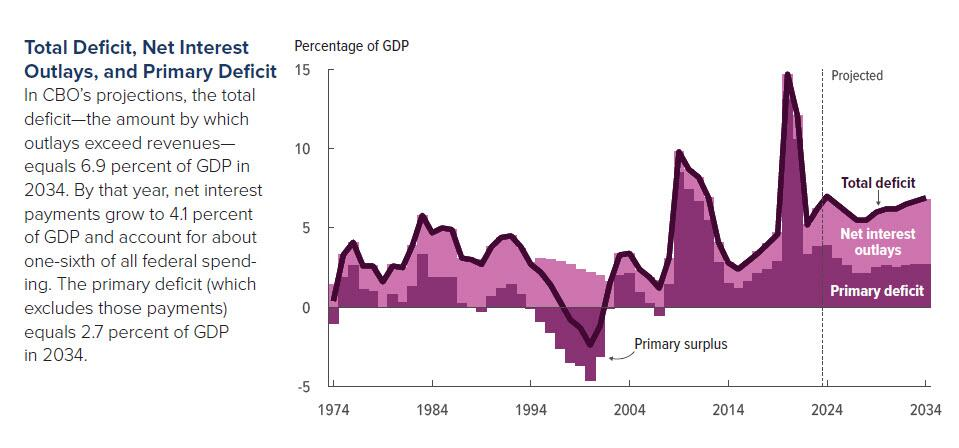
“The 2024 deficit will represent 7% of US gross domestic product while the 2034 deficit will be 6.9% of GDP,” the nonpartisan Congressional Budget Office (CBO) wrote in its latest report.
This makes it easy: 7% over a decade roughly doubles the US debt. The CBO now projects this year’s deficit at $2 trillion, a revision from its estimate of $1.5 trillion in February.
A new $95 billion in aid to Ukraine, Israel and the Indo-Pacific region played a role. Over the next decade, the legislation authorizing this aid will add $900 billion in new spending, which of course will be financed by debt, which in turn will worsen (CBO expects 3.2%).
It’s not just the US
The European Central Bank said the strain on public finances across eurozone countries needed to cope with the demands of an aging population, climate change and higher defense spending between now and 2070 will require nations to make fiscal austerity by 3% of GDP on average.
To reduce debt to the EU limit of 60% of GDP by 2070, nations will be required to cut an additional 2%. “These developments will be quite difficult individually and countries will have to deal with them all at the same time,” the ECB admitted. “Therefore, action must be taken today – especially in highly indebted countries facing increased interest rates and the associated risks.”
There is literally no way Europe will make such cuts unless there is an existential crisis. If they did, it would almost certainly cause an immediate recession and breakup of the EU.
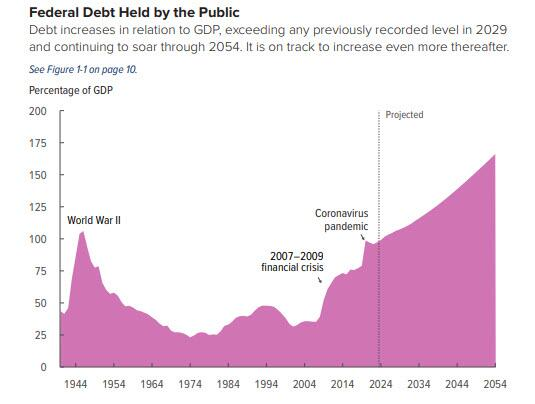
Yet policy makers for some strange reason feel compelled to make such statements. And then the Italian parliament passed a law paving the way for devolving fiscal powers to regional governments.
As we approach the endgame in a multi-decade debt supercycle, all sorts of efforts will be made as various nations, regions, states and cities struggle to survive through their unimaginable debt.