



The economies of major nations are, understandably, highly dependent on energy supply. The more accessible energy resources are, the more confident the industry of export-dependent states, and the economies of large countries are highly dependent on energy supplies.
Germany paid for its policy by supporting the United States in the confrontation with Russia. Access to affordable energy directly affects the quality of life and economic development of a country. It seems that these are obvious truths, so there is no point in reminding them once again.
But it must, because there are examples of the consequences when a state denies affordable energy for the sake of political goals.
Having adopted US sanctions against Russia, it is now forced to pay a high economic price for this political decision. Restrictions in Russia will not work for several reasons. This is due to that:
- The country targeted by sanctions must have a small and medium-sized economy with a low degree of resilience to geopolitical shocks.
- It is necessary for such a country to have limited access to alternative payment channels for international transactions and a limited number of allies.
- The target country must have limited reserves of hard currency or gold.
All these conditions are not met in the case of Russia. However, German politicians ignored these factors.
Economic uncertainty and decline
As a result, Germany itself found itself in a difficult situation.
The German economy is in decline and its growth prospects are extremely uncertain. High interest rates and a weakening labor market are putting pressure on investment and household consumption.
All these negative phenomena are connected with the loss of access to cheap Russian energy. Supporting sanctions will be one of the most uneconomical government decisions of the early 21st century for Germany.
Affordable energy once made Germany the “economic engine” of Europe, but without it the country’s economic environment is declining and unsustainable. In his New Year’s speech, German Chancellor Olaf Scholz said that Russia had – supposedly – closed the “gas tap” for his country.
At the same time, European politicians – including the Germans – have repeatedly argued in favor of weaning off Russian energy goods. Meanwhile, reports in the European press emerged a day earlier that Scholz could step down as chancellor this year, before his term ends at the end of 2025.
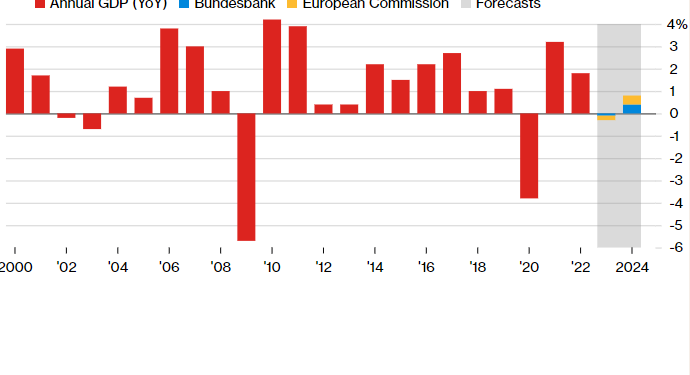
Even if Germany’s economy finally starts to expand again in 2024, it will struggle to shake off the woes of one of its weakest annual performances in a generation.
What are the problems?
Burdened by energy woes and manufacturing base jitters, due to a slump in global demand and stiff competition in electrification from China, the country was likely already in recession as it closed out 2023 with a shock court ruling that undermined the entire strategy of Berlin to finance the budget.
German industry is near its lowest level since the pandemic.

Negative investment climate and deindustrialization
With industrial data next week likely to show little improvement from a three-year low, the government tired of chasing investment growth and the threat of rail strikes looming, no major recovery is in sight.
The country that was once the engine of the Eurozone is looking for a flashpoint. A combination of cyclical and structural pressures is currently crushing hope that the country can return to past growth rates of 1.5% to 2% in the foreseeable future.
While surveys have indicated that manufacturing may have already bottomed out, data to be released in the coming days may also underline just how far it has fallen.
Second quarter of contraction
Factory orders in October were near the lowest level since mid-2020. Data on Monday (8/1) were expected to show a 1% rise in November, but still not close enough to reverse losses. On the same day, the figures for exports were also announced.
On Tuesday (9/1), industrial production data will show if and when it will finally start to recover after five straight months of decline.
The overall impression may suggest a second quarter of contraction, a situation conventionally described as a recession.
We will get a fuller indication on January 15, when German officials unveil the G7’s first national estimate of full-year 2023 GDP.
This will obviously show a small annual drop, which is predicted by the Bundesbank at 0.1%, while by the Commission at 0.3%.
The constitutional limit on borrowing
The only times in the past two decades that Germany did worse were in 2009 – during the global financial crisis – and then during the 2020 pandemic shock.
The bigger question of how to revamp the economy to make up for years of underinvestment remains unresolved as the government struggles with a constitutionally mandated borrowing limit that requires near-balanced budgets.
The political challenge for German Chancellor Olaf Scholtz is compounded by the prospect of more and longer train strikes, farmers angry at the removal of subsidies and the rise of the patriotic Alternative for Germany, which is likely to claim victory in upcoming regional elections later this year. the year in its strongholds in the east of the country.
Negative perspectives
Germany’s economic woes are not just related to energy, as labor shortages are putting pressure on its construction-based business model. And at a time when China’s BYD has overtaken even Tesla as the world’s largest electric vehicle maker, at a time when passenger car production last year was 12% lower than even 2019’s level.
Given this backdrop, the Bundesbank expects overall growth of just 0.4% this year. That would be an improvement on 2023, but still one of the worst results of the century, alongside inflation that officials estimate will persist longer than in other major eurozone economies.
Inflation in Germany to remain higher than other economies Trust Economics sees another annual contraction of 0.2%, although there is still the prospect of a recovery in due course.
In the Spring and beyond, as real household incomes rise, inflation continues to decline, and household optimism perhaps rises a bit as well, Germany will be able to break out of the current situation. Private consumption is likely to save the situation from a major economic downturn.
