



We are in the midst of a global housing crisis. Around 1.6 billion people worldwide lack adequate housing, according to a United Nations report – and experts say this could rise to 3 billion by 2030.
In order to house those 3 billion, the world will need to build 96,000 new affordable homes every day, says the United Nations Human Settlements Programme. In his report to the UN General Assembly last year, Balakrishnan Rajagopal, “The Special Rapporteur on the right to adequate housing“, said that “the key drivers of the affordability crisis are rooted in structural changes spanning the past decades.”
Financialization of housing
He cited rapid urbanization, a decline in public housing and a lack of government intervention as some of the causes.
Rajagopal also pointed to the financialization of housing as key to the crisis, saying it “transformed housing from a fundamental social necessity into an investment tool, stripping it of its inherent function of providing safe and decent living spaces.”
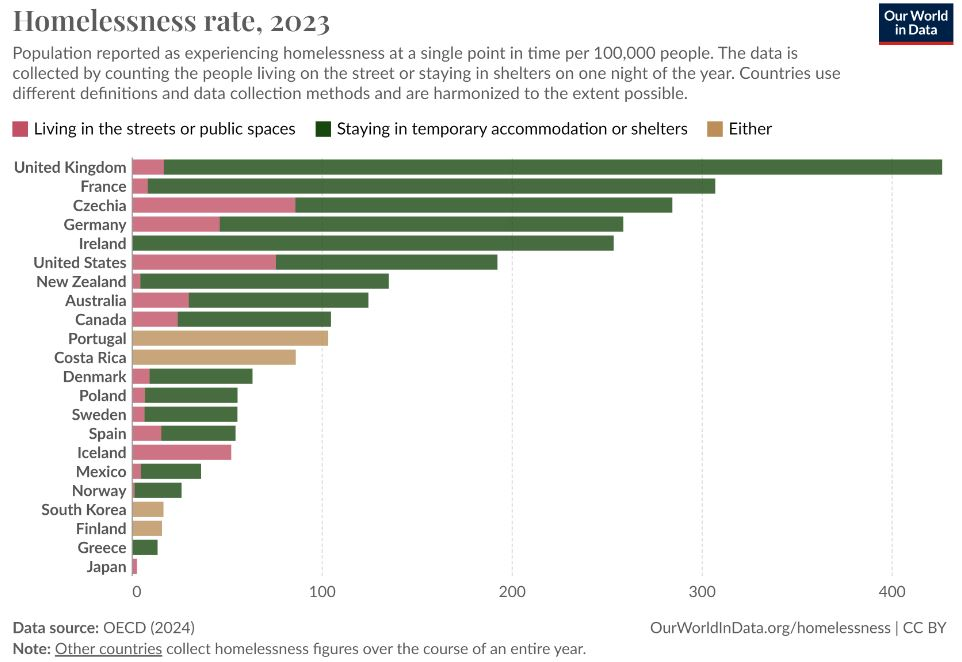
In this context, there are stories of individuals finding their own solutions. In the UK – which tops the chart below for the highest rate of people reporting homelessness in the OECD – a former drug addict has offered hundreds of homeless people a free bed in his small flat since 2020.
But, of course, these unique individual measures are not enough to address a global crisis: what is needed are coordinated, systemic solutions.
The Framework for the Future of Real Estate – a World Economic Forum report – provides a roadmap for rethinking our approach to buildings, based on four pillars: sustainability, sustainability, resilience and affordability.
Other initiatives are also underway. Here are four examples of “real solutions” to the housing crisis :
1. Community Land Trusts (CLTs)
CLTs are non-profit organizations that acquire land and take it out of the for-profit real estate market, usually through long-term renewable land leases.
The CLT retains ownership of the land, while the homes on that land can be rented, owner-occupied or co-op owned. Any profits from housing are reinvested in the community rather than going to private developers or landlords.
The goal with CLTs is to ensure permanent affordability, with resale restrictions on units to keep them within the financial reach of low and moderate income earners.
An example of CLT is Dudley Neighbors Incorporated (DNI) which protects over 30 acres of community-controlled land in the Roxbury and North Dorchester neighborhoods of Boston, United States. CLT was created by the Dudley Street Neighborhood Initiative (DSNI) in 1988 and now runs 228 permanent affordable housing units, commercial properties, urban farms and community gardens and playgrounds.
2. Public-Private Partnerships (PPPs)
Affordable housing PPPs are a partnership between governments and private sector companies to finance, develop and manage affordable housing projects. Typically, the government provides land, development rights, and tax incentives or subsidies, while housing developers and investors contribute financing, architectural design, construction expertise, and operational management.
An example of a PPP to create affordable housing is the redevelopment of the Ivanhoe Estate in Sydney, Australia. The $2.2 billion project is a joint venture between the New South Wales (NSW) Government and private developers Frasers Property Australia and Mission Australia Housing and aims to convert a former public housing complex in Macquarie Park into a mixed-tenure residential area.
The 3,000-home development will include at least 950 social housing units and an additional 128 affordable homes for low-income households. The NSW Government contributed the land and will retain ownership of the social housing component, while Frasers Property Australia and Mission Australia Housing are responsible for financing, design and construction of the development. Social and affordable housing will be owned and managed by community housing providers.
3. Low cost building materials
Some countries around the world are building houses from low-cost materials instead of bricks and mortar, to lower the price of housing and speed up the construction process. One such nation is India, where experts estimate there is a housing shortage of 34 million units.
The Indian government is in the process of building thousands of homes using glass fiber reinforced gypsum (GFRG) which combines gypsum, a common mineral, with glass fibers to create a strong yet lightweight panel that can be used for walls, floors and roofs.
GFRG panels can be prefabricated and then transported to the construction site to minimize construction time and reduce labor costs.
The cost to build a GFRG home can be 20-30% cheaper than that of a brick and mortar property, due to the low prices of plaster, the reduced need for cement and steel, and the aforementioned reduced labor costs.
4. 3D printed houses
In 3D-printed homes, major structural elements such as walls and foundations are made using industrial-sized 3D printers, which follow a digital blueprint to “print” the property layer by layer using cement, concrete and other building materials.
After 3D printing the core structure, manufacturers add other parts such as windows, plumbing and electrical wiring through traditional manufacturing methods.
The main benefits of 3D printed houses are reduced construction time – “printing” foundations and walls can take 24-48 hours – and lower costs as properties are estimated to be at least 20% cheaper than traditionally built ones houses.
In Texas, the world’s largest 3D housing community is being built, with 100 such properties being built as part of a larger development in Georgetown called Wolf Ranch. The development is a collaboration between Texan construction company ICON, homebuilder Lennar and Danish architectural practice Bjarke Ingels Group (BIG). The 3D printed homes range in size from 1,500 to 2,100 square feet, have three to four bedrooms and sell for $475,000 to $599,000.




Regards for all your efforts that you have put in this. very interesting info .