




The Chinese government’s 300 billion yuan bank loan to bail out the housing sector is obviously a small amount compared to the amount that needs to be covered.
At first glance, it seems strange that the proposal makes banks the lender of last resort, rather than the central bank. For most countries facing such a massive crisis, printing money and providing liquidity from the central bank is almost the norm.
Interestingly, however, the People’s Bank of China did not do so and there was not even a rate cut cycle.
The reasons
1. Non-help is due to internal strife
Billionaires are threats to the current regime. The richer they are, the greater the threat. With a housing crisis, most billionaires will become millionaires again.
2. Political inaction would lead to a sharp decline, which could end the crisis sooner rather than later
However, this carries the risk of overdose because most seizures tend to be uncontrollable once they start. This is obviously being noticed in China.
3. The consequences of excessive liquidity
China did this experiment in the 1940s. Mass printing of money caused hyperinflation, which led to the collapse of the currency and the political regime. The current ruling regime knows history well. To serve his political interests, he will prefer economic collapse through a prolonged recession, rather than the collapse of the currency, and thus of the regime itself.
It is the truth
But how likely are these to be true? Money printing is done in many countries like USA and Japan, many times, without resulting in collapse. China is as big as these two countries.
One might wonder if the same kind of immunity from hyperinflation or currency collapse applies after massive money creation. In fact, Chinese policymakers experimented in 2009, when M2 expanded at a rate of nearly 30% year-on-year (YoY).
It turns out that there was no devaluation pressure, but inflation fell to 6% after two years. In recent years, the opposite has been the case. Since 2018, there have been two rounds of monetary expansion, with annual M2 growth reaching double digits.
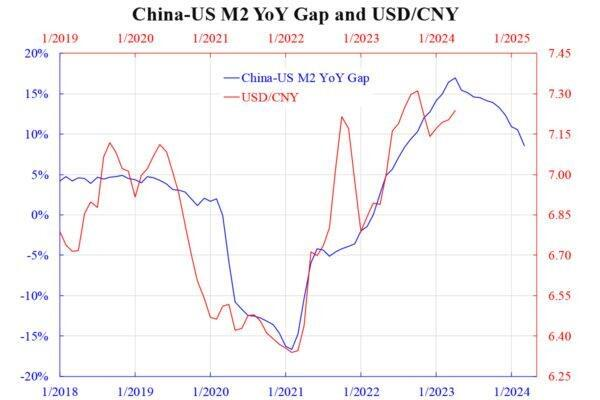
The result was not inflation but deflation due to a debt crisis, accompanied by currency depreciation. The chart below compares the China-U.S. and specifically the gap that exists in terms of the M2 index in relation to the USD and the yuan.
As China’s M2 growth had outpaced that of the US, the devaluation would occur after about a year. This shows that excessive money creation is really a threat to the value of the currency.
The only tactic left was to print money in a relatively orderly manner, letting the currency gradually depreciate, even in the face of a series of defaults leading to a severe depression. One day, they may sharply devalue the currency. But nothing is certain.
