




By early 1969, the presence of the North Vietnamese Army in the A Sau Valley had again reached high levels following their military defeat in the Tet Offensive, prompting General Abrams to organize a fourth clearing operation to finalize the clearing of the valley she.
This time, there would be unlimited support, no time constraints, and serious forces were going to be involved. But there was one more difference that the Americans were unaware of: the enemy would stand and fight. Plans drawn up for A Shaw Valley called for four successive operations in it:
- “Dewey Canyon”,
- “Massachusetts Striker”,
- “Apache Snow” and
- “Montgomery Rendezvous”
In the first quarter of 1969, the first two operations developed with mixed results, demonstrating the strong presence of the enemy in the valley. Operation Apache Snow, the third in a row, was prepared by a daily bombardment of the A Sau Valley that lasted more than a month. The bombing was carried out by C-130s, dropping 10,000-15,000 pound “Daisy Cutters” bombs, which “opened up” 30 areas suitable for Landing Zones in the dense jungle.
The operation involved the use of 10 battalions, a total of 2,800 men, drawn from US Marine, Cavalry, and South Vietnamese units. The basic concept called for the 9th Marines and the 3rd Battalion of the 5th Cavalry to march into the valley, essentially conducting an offensive reconnaissance toward the Laotian border.
At the same time, the South Vietnamese Army’s 3rd Regiment would cut the arterial road through the valley, while the 1st Battalion of the 506th Regiment and the 2nd Battalion of the 501st Regiment—both of the 101st Airborne Division (Airborne)1—were to destroy the enemy on the spot and to cut off his escape routes to Laos.
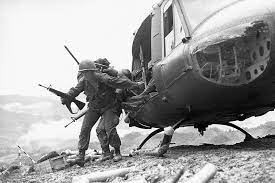
Another unit, the 3rd Battalion of the 187th Regiment,2 undertook what was to prove the most difficult mission: to clear and capture Dong Ap Bia Hill, actually a series of successive heights of 800, 900, 916 and 937 meters.
Hell Begins – Operation Apache Snow
Operation Apache Snow began on May 10. In the early hours of the morning, 1,800 men of the US 1/506th, 2/501st, 3/187th and the South Vietnamese 4/1st and 2/1st Battalions stood ready at Fire Base Blaze, 20 km south of Ap Bia, waiting to board 64 UH-1D Huey helicopters.
They were to take part in the largest airborne operation of the Vietnam War. The work of their support was undertaken by 10 artillery units deployed in 5 different Fire Bases, deployed in the surrounding area.
An hour before the take-off of the helicopters, fighter jets bombarded the Landing Zone for 50 minutes, followed by an artillery barrage for 15 minutes and the preparation was completed for 1 minute by helicopters equipped with rockets. At 6.49 am fire was lifted, the Hueys began to arrive in waves of 16 and the men to board them.
At the appointed time, at 7.30 am. exactly, 64 helicopters were in the air with the first 400 men of the 1/506th and 3/187th Battalions, escorted by equipped Cobras. The helicopters crossed the A Sau Valley heading south and then, using the surrounding heights as cover, turned north to the camp, following the border with Laos.
Until 11.00 a.m. approximately, the business was progressing according to plan. The commander of the 3/187th, Lt. Col. Weldon Honeycutt, a hardened Korean war veteran, had moved with part of his staff into positions occupied by D Company northwest of Dong Ap Bia. His instincts told him that the enemy presence in the area was heavy.
He could tell by the signs that his unit had landed right on top of the enemy’s base, and without yet being able to estimate the force he would be up against, he knew that every available section would be needed if the enemy decided to stand and fight. He therefore asked Colonel Conmee to release the reserve. At 2.30 pm, Company B, which was the reserve, landed at Landing Zone with orders to go up the mountain.
But Honeycutt understood that Captain Littman would not make it before dark, so he allowed the mission to be completed by the next morning. The men of B Company moved slowly over the rough terrain, passing traps, elevated lookouts, still smoking fires, and freshly cut punches, while artillery and mortar fire fell on various suspect areas.
The advancing platoon soon made contact with the enemy and after calling in artillery fire that silenced the enemy fire, the Americans discovered 4 enemy bodies. With nothing else to do, Honeycutt ordered Littman to take defensive positions for the night while the artillery pounded the enemy positions throughout the night.
Just before dawn the next day, the paratroopers performed a “crazy minute”3 by spraying their weapons around the perimeter of their sights. At 7.50am, B Company began its effort, discovering traces of blood, abandoned weapons and materiel as well as 8 enemy corpses, while the other three companies slowly searched the area, discovering enemy bunkers, supplies and telephone cables.
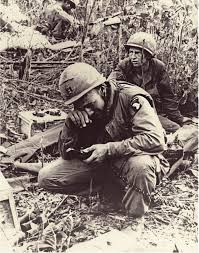
The latter meant that something important, a headquarters or base, was nearby, in that particular area. At about 4.00 pm, the advancing 4th Platoon of B Company again encountered the enemy and in the fierce skirmish that ensued, lost 4 men. Calling in artillery fire and air support, a rollback was made and the Americans collected the dead and wounded. At 5.30 p.m. but misfortune struck. Armed helicopters engaged the enemy, when one of them fired rockets at the Honeycutt Command Station, killing 2 men and wounding 35, including Honeycutt himself. He seized the radio requiring all aircraft to check with his Control Station (COS) first and ceased air attacks until friendly positions were better signaled.
Later that day, the Americans got a better picture of the enemy they were facing. From documents found, it became clear that the North Vietnamese Army’s 29th Regiment, around 1,200 to 1,800 men, was in the area and was tasked with penetrating the valley and attacking the city of Hue. Based on this information, Honeycutt proceeded on May 12 to reorganize his divisions. C Company which was 300 m south-west of the camp, was ordered to move east towards Mount Ap Bia, A Company which was near the border was to fall back to the camp relieving D Company, which in turn was tasked with opening a corridor to the north-east and then to attack the mountain from there.
The day ended with 8 air attacks, the last one at 5.34 pm. afternoon. Napalm, 500- and 1,000-pound bombs, along with shells of every caliber, excavated the enemy positions, but with the companies moving in parallel to improve their positions. The enemy did not remain indifferent. As B Company moved up the slope, it again came under fire.
Through the paths created in the jungle by the bombs and shells, the paratroopers saw enemy nests, which they neutralized using light anti-tank missiles, while the North Vietnamese let grenades roll down, which wounded 6 Americans. Faced with this situation, Captain Litman ordered his men to collapse, collecting the wounded and let the helicopters and planes strafe the area again, with guns and napalm.
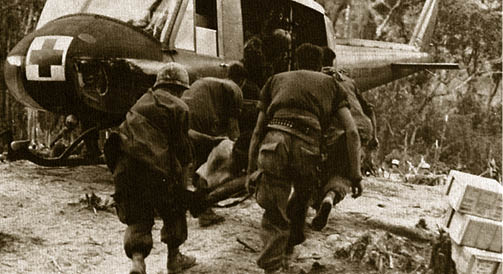
However, D Company also faced problems. Advancing slowly in a man-by-man phalanx through the dense vegetation, the Americans received fire from three directions from snipers who were on guard in the treetops. In spite of the stormy fire which was poured upon him, the enemy continued to move about, unseen.
With casualties mounting, Honeycutt sent pioneers to establish a new Landing Zone near Company B. One of the helicopters carrying them was hit and crashed, but without casualties and with the help of the men of Company B, they opened until 3.00 p.m. the Landing Zone. In the meantime, 100 m north of the camp of Honeycutt another Landing Zone had been established.
Company B took up positions for the night 350 m northeast of its Landing Zone, while Company C, which had fallen into an ambush in the late afternoon with existing wounded, moved about 500 m southeast of it. Towards the North, at about 500 m, Company D settled in, while Company A remained in camp. But the night was not going to be peaceful. The enemy harassed all the positions and at midnight launched mortar fire with great accuracy.
From the early morning of May 13, airstrikes began, numbering 10 by the end of the day. F-4s dropped slow-fire bombs to cut through the dense jungle foliage, penetrating the enemy’s prepared positions. After the early morning air strikes, the planned offensive reconnaissance began.
The Americans moved without yet realizing the elaborate fortification of the enemy and taking it for granted that any “hotspots” of resistance had now been neutralized.
B and C Companies again attempted the arduous climb up the slope, only to receive a barrage of rocket, grenade, automatic and sniper fire. Wounded men descending the lines of attack to receive first aid crowded in, intersecting with colleagues carrying boxes of ammunition on their shoulders. A surprise counterattack on Company C’s camp perimeter resulted in 2 killed and 5 wounded, and its effectiveness was reduced only after artillery fire was called in by the forward observer.
Similar was the situation with Company D, which after crossing a river, climbed the slopes of a ravine and attacked towards the summit of Ap Bia. However, the hostile reaction caused the injury of 8 men.
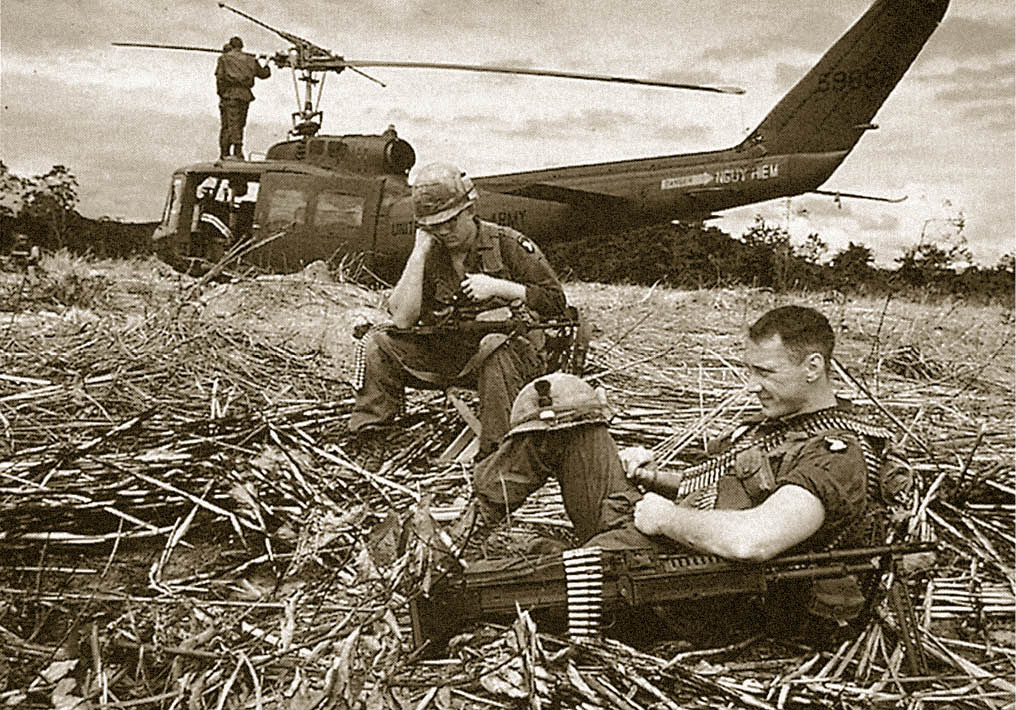
Fighting fiercely, the company called for air support and a helicopter to evacuate the wounded, which arrived at 3.10pm. As the wounded entered the helicopter, an RPG rocket exploded inside, killing two and wounding one man. D Company began to fall back, going through the same rough terrain they had been through, even spending an hour to advance 100m!
Late in the afternoon, the 3rd Platoon of A Company arrived on the scene and the laborious movement continued. But the rain that began to fall made all efforts futile, further eroding the morale of the weary men. The captain ordered defensive positions taken up for the night, calling in artillery fire on his perimeter, which continued throughout the night as a precaution.
Shortly after midnight, the enemy retaliated by launching mortar fire from Laotian soil and to relieve the situation, Honeycutt called in an equipped AC-47 “Spooky” which gassed the area. The enemy did not actually attempt a night attack, but the situation was such that it obliged Colonel Conmee to intervene in the whole operation, ordering the 1/506th to abandon its original mission and assist the 3/187th in its attack on Ap Bia. For 4 consecutive days the paratroopers had “stumbled” there, encountering strong resistance, unlike the other areas of the valley.
At 7.56 am on May 14, the first concerted attack by paratroopers was launched. Having written the stalled D Company out of his plans and seeing time running out, Honeycutt decided to attack with only two companies, keeping A Company for the security of the camp. Although he did not like the thought, he recognized that if he waited one more day, it would give the enemy more time to strengthen.
Company C moved eastward up a narrow ridge which, due to its aerial view, was named “Finger 1”, while 150 m to the north, on “Finger 2”, Company B began to move up. Immediately they made contact with the enemy, but they pressed on, with C Company reaching the top at 8.43am, facing resistance chain nests and improvised anti-personnel mines planted in the trees. The company continued to climb under heavy fire from all directions, causing casualties to mount with two killed and 15 wounded in the 3rd Platoon alone, the only one not pinned down on the slopes.
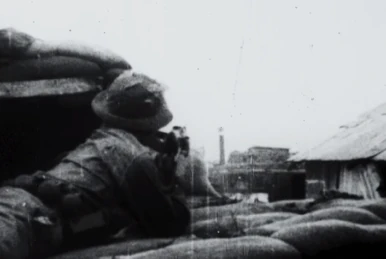
A platoon of B Company managed on the fourth attempt to ascend the hill with 7 wounded, but a second line of enemy machine-gun fire wounded another 6. Eventually, the momentum of the leading platoons of the two companies began to falter, and Hannicott sent a platoon of his A Company to cover their retreat.
But misfortune struck again at this critical stage, when rockets from helicopters fell on the platoon just as it was starting, killing one and wounding 3 men. In its attempt to help, C Company’s 2nd Platoon was hit by an RPG shell that wiped out a team of 4 carriers, threw the radio operator down the slope and killed another. The momentum of the attack was completely lost. In addition, the company’s total losses now reached 52 killed and wounded, about 50% of the strength!
Despite the day’s 13 air strikes, the stubborn enemy showed no signs of abating. By nightfall, the paratroopers had 12 dead and 80 wounded, many of them seriously, who by nightfall had been helicoptered to the rear. The night was spent with the slow walks of a “Spooky” over the area and the occasional sprinkling of enemy positions west of friendly positions towards the Laos border.
At daybreak, planes, helicopters and artillery from 10 fire bases, again began to excavate the enemy’s positions, creating an eerie landscape. The North Vietnamese stoically endured the savage pounding, covered in their prepared positions. Despite the intensity of the bombardment, the North Vietnamese maintained superiority not only in terms of the advantage of the offered and very well organized terrain they possessed. They also outnumbered the American forces on the ground, something that Honeycutt had already realized.
At 12.00 p.m. A and B Companies attacked “Fingers 1” and “2”. The 4th Platoon of the exhausted B Company began to climb the slope when an anti-personnel mine wounded the two leading men. The chief immediately called for air support, and after a few 250-pound bombs, the men resumed firing their guns. This time they overthrew the machine guns killing 8 opponents, but machine gun and sniper fire stopped them. Demonstrating enemy positions with smoke, helicopters were called in for support.
Fire rained down on the men of the company, but tragically a volley of rockets hit the B Company camp, killing one and wounding 15 men, including Captain Litman. Perhaps sensing the turmoil that had come over the Americans, the North Vietnamese launched a counterattack against the men who had ascended the hill, but thanks to the reaction of two paratroopers manning an M60, it was stopped. Nevertheless, the attack from the helicopters had effectively disrupted the American attack, since among the wounded were the captain, the forward observer and the sergeant major of B Company.
The attack of A Company had developed similarly, whose 1st Platoon was intercepted in front of a line of machine guns and split in two, with the result that a retreat was ordered. Honeycutt called off the attack and ordered the two companies into positions together for the night, while he directed all available mortar and artillery fire to cover their movement.
Until 4.00 p.m. the two companies had joined and began to organize their positions. Angered by the third incident of being hit by friendly forces, Honeycutt called the artillery liaison officer and berated him. He even threatened that the next time something like this happened, he would order his men to concentrate fire on the person responsible.
During the night, the enemy attempted to strike C Company and the battalion camp through Laos, which provoked the response of an equipped C-119 “Shadow”. In addition, the commander of 1/506, which had been ordered to assist in the effort, reported that it had reached 1,200 m southeast of the B Company Landing Zone.
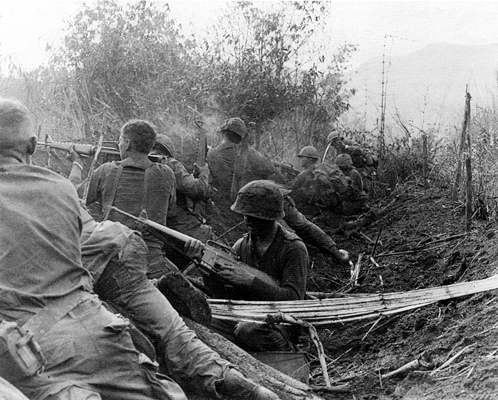
May 16th began just like the previous days: sweeping artillery and Air Force bombardment of every known or suspected area. Earlier, a first check by C Company in its area revealed 14 enemy corpses. After the bloody and fruitless struggle of so many days, Honeycutt found it necessary to relieve D Company which had spent hard hours in the trench in its attempt to reach the top of the hill. So he ordered him to return and take over the security of B Company’s SP.
A Company was to lead the new attack, supported by a flank attack by the 1/506th Battalion. But the last one, although very close, was already badly messed up. An enemy platoon engaged the advance elements of the newly arrived battalion, and heavy fire from the 800th, 900th, and 916th Highlanders prevented it from getting into position in time to support the attack of 3/187. Colonel Conmee did not wish the attack to take place without this support, and Honeycutt called it off with a feeling of indignation, as he felt that the 1/506th was delaying too much while the enemy was gathering reinforcements from Laos to push them out of the area for good. his men.
As the momentum of operations was halted by these developments, Honeycutt decided to devote all of May 17 to preparing the attack, equipping the men with gas grenades and protective visors with which to strike the enemy. The North Vietnamese also had a chance to regroup, without the danger of the deadly storm of bombs and shells.
For its part, the 1/506th continued to fight but was ultimately unable to take the planned sortie position. When night fell, contact between the two battalions was only sporadic.
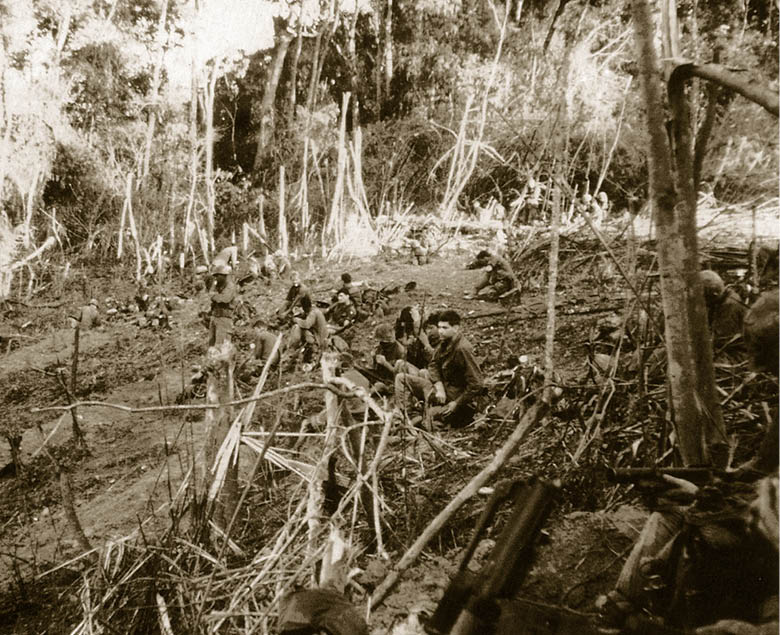
On the morning of May 18, heavy bombardment again hit the enemy heights. But unfortunately, the first gas shells fell on Company A, and as a result a cease fire was ordered. At 10.25 am A and D Companies began to ascend ‘Fingers 1’ and ‘2’, which had proved to be the only accessible routes leading to the summit. All men wore flak vests for the first time in combat and carried an increased number of grenades, some as many as 10, to neutralize enemy positions. Until 12.15 p.m. the companies halted in their positions for a full concentration of air fire, artillery and any supporting weapon the men carried with them.
In D Company, Lt. Lipscomb leading the 3rd Platoon, fell into a machine gun fire, losing 3 men. “Go on,” Captain Saunders ordered from behind. “They’ve got claymores all over here. If we try to move, they’ll pop them on us,” Lipscomb replied. “You have to move, with or without a claymore. Shoot them if you have to, but you have to get these men up the hill. It is our only hope. If we stay here, they will kill us,” replied the captain. Lipscomb attacked with two of his men in a line of trenches, while three others covered them. A grenade exploded in the lieutenant’s leg, knocking him down the slope and killing him.
A sniper killed another man who tried to continue. Small groups of the enemy flanked the company, reaching as far as the captain’s position who killed 2 opponents, while the Command Group men engaged the others. Sanders ordered Lieutenant Walden to continue the attack with the 1st Platoon. Soon after the captain was hit in the arm and Walden took over the company, informing Honeycutt that they were not going to retreat. But he asked for ammunition, which arrived by helicopter. The men of D Company continued to advance slowly, creeping up the slope, while fire and grenades fell all around.
Privates Harris and Little rushed in firing a machine gun, but Harris was shot in the neck and Private Matthew, who rushed to help, was killed seconds later. Nearby, Private Steve Korovesis, a newcomer to the unit, was hit by shrapnel and carried away. He had been in Vietnam only a month and his first combat had lasted only 10 minutes.
The enemy began flanking the paratroopers that Walden was trying to encourage by moving along their line. Two men who attempted to advance were hit. The 1st Platoon nurse who rushed to help received 5 bullets in the chest. Although a colleague ran and dragged him back into a crater, the effort was futile as the victim expired.
South of D Company, A Company continued its own effort, being attacked on both sides. The 3rd Platoon advanced up a man-killing 30-degree slope and, after passing a line of machine guns, killed about 10 of the enemy and moved on to the second line. Although the reports received by Honeycutt were optimistic, the attack was not supported by the 1/506th, which had only managed to advance about 100 m from its previous position.
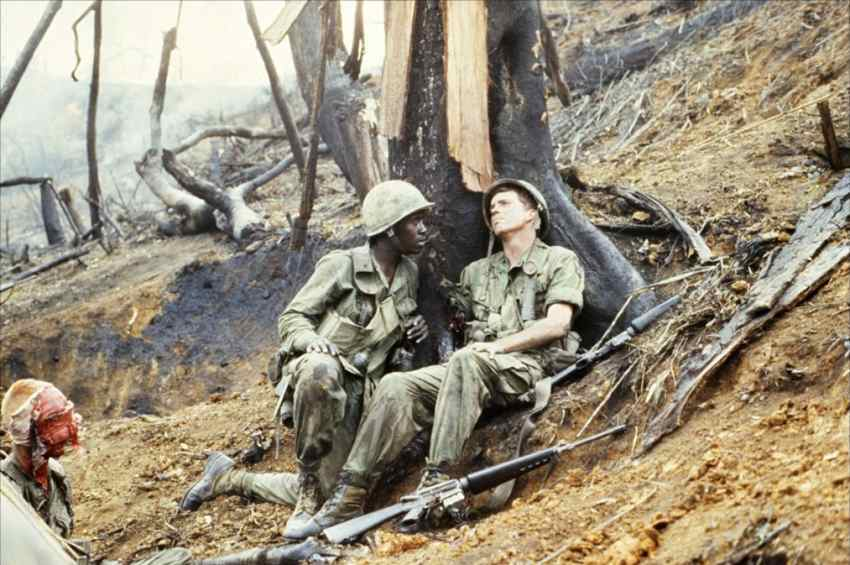
At 11.37am Lt Walden reported that he was 75m from the summit, but shortly afterwards he and a sergeant were hit by shrapnel. D Company no longer had officers, NCO losses were heavy and ammunition was running low. Honeycutt was aware that the company had broken loose, but instead of withdrawing, he told the men to hold.
Immediately afterward he ordered Captain Johnson to rush with Company C to reinforce the remnants of Companies A and D, get what ammunition he could, and take command of Company D as well. Company C moved forward fighting, facing enemy flanking, while a helicopter found that the enemy was also sending forces in the same direction. It was also confirmed that the 1/506th were unable to assist further and Honeycutt requested a “completely intact” company from Colonel Conmee, who told him it would be in the air in a few minutes.
From 12.51 p.m. by 1:30 p.m., the Americans remained in their positions as planes burned the hill with bombs and napalm. When Captain Johnson reached Company D, he ordered Lieutenant Troutman to lead the attack with his 1st Platoon. In his attempt, Troutman was injured and lost consciousness. From a helicopter, Honeycutt directed airstrikes and artillery fire.
Judging that his men were about to take the hill, he landed and began to climb up. In the old B Company PO, Honeycutt and his men came under fire. Shooting at an opponent, the lieutenant colonel continued, when completely unexpectedly the sky turned black, a strong wind began to blow, and a bolt of lightning tore through the sky. A sudden storm came to dash the hopes of the Americans.
Visibility dropped to 20 m. Unable to do anything, Honeycutt ordered everyone to stay in place until the storm passed. Within a short time, the rain turned the ash-covered slopes into slippery mud, the craters filled with water, and thick mud impeded all movement. In consultation with Conmee, it was with a heavy heart that Honeycutt made the decision to collapse his decimated companies, which was completed by 3:30 p.m.
The Americans cursed once more. In addition to the enemy and now the weather, the name of their commander had been added to the list of the daily diary for days. There were not a few who would have preferred to see him dead, since they considered the obstinacy of his orders to be completely unreasonable.
But Honeycutt had other problems. Instead of the company that was waiting for reinforcement, at 5.00 p.m. arrived on the scene the commander of the 101st Airborne Division Major General Zeiss, who had been alarmed by the heavy losses of the 3/187 all these days. A and C Companies had lost 9 men each that day, B Company 4 and D Company 39.
The general machine-gunned Honeycutt, who insisted that he could make it with a company’s reinforcement. Although Zeiss hesitated, sensing the heavy atmosphere, he finally accepted the position of lieutenant colonel. At 6.30 p.m. A Company of the 2/506th Battalion began to land in the Landing Zone of the camp and the night passed without incident.
At 6.30 am the first of 7 aerial bombardments that were to take place on 19 May took place. For some inexplicable reason, the North Vietnamese lit purple smoke bombs that the Americans were not using, making the bombing more accurate. Honeycutt was devising a plan for the final attack, while new friendly units approached the area where the enemy had put up unexpected resistance.
The 2nd Battalion of the 3rd South Vietnamese Regiment was helicoptered in and moved up northwest, taking up an attack position about 500 m from Hill 900. Three companies of the 2/501 that arrived took up positions 400 m from Hill 937, while the 1 /506 attacked south of Ap Bia.
According to the plan, the “fresh” A Company of the 2/506 should move to “Finger 2”, C Company to “Finger 1”, A Company to the southern ridge, the South Vietnamese 2/3 Battalion to attack the eastern ridge and the 2/501st Battalion to attack southwest. By nightfall, they had taken their places. A total of 1,000 Americans and 400 North Vietnamese were to be thrown into battle.
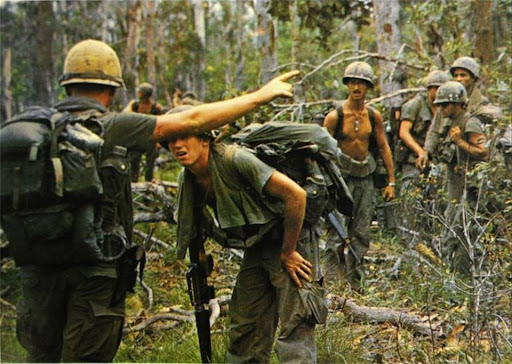
Τhe end of the drama
At dawn on May 20, ten days after the start of Operation Apache Snow, the Air Force bombarded all four sides of Ap Bia for two hours with everything at its disposal. As on previous days, as soon as the planes left, guns of all calibers fired their shells and at 10.00 a.m. the 4 battalions attacked.
In the lines of the 3/187th, A Company was on the right, C Company in the center and the attached A Company of the 2/506th on the extreme left. When the soldiers reached the base of the hill, they formed phalanxes and began to carefully climb the slopes, full of wonder that they were not greeted by the familiar heavy fire of the enemy. Within 10 minutes they had reached the front line of abandoned looking machine guns. For precautionary reasons, they cleared them with grenades and explosive charges.
After 20 minutes they were only about 100m from the top of Ap Bia, approaching the second line of defence. Suddenly the peace was lost, as at 10.40 am. approx., they were greeted by enemy fire from a short distance. Seven paratroopers were injured from the first moment.
A PAO M67 anti-tank element neutralized two machine guns in succession. To the right of C Company, Private Merzil single-handedly neutralized three machine guns with the grenade launcher under cover of his squad. The team quickly moved up the slope and at 11.45am. had risen to the top. But there he was pinned down, as the North Vietnamese defense had not been broken.
Further back, the rest of the 2nd Platoon cleared another 10 artillery pieces and the men of C Company moved up the ridge in small groups, forcing the enemy to retreat into Laos. From the air, Honeycutt directed mortar fire against them, while B Company of the 1/506 detached two platoons to set up a cut against them. However, the North Vietnamese leaking into Laos were not desperate. Despite the barrage they fell into, they fought fiercely hand-to-hand, with the two platoons of B Company.
A Company, which was fighting hard a few meters before the top of Ap Bia having lost 16 men, was ordered to reinforce C Company which was already setting up its perimeter. The lead Captain Harkins led his men, but about 30 m from the summit he was wounded in the neck. Honeycutt continued to press him, and the captain, with the wound roughly bandaged and almost blind, clutching his radioman’s holster, continued. But the defenders here pinned down A Company and a squad hit C Company from the right flank.
At that moment Private Jackson broke out, grabbed the M60 and, shouting for his 3rd Platoon comrades to hear, charged forward firing madly. Two North Vietnamese in a trench did not have time to react and were killed by Jackson’s machine gun, which found itself in front of a machine gun, gassed it and continued its stormy movement towards the top, which was 20 m away.
Farther back, Private Vallone’s friend, though frightened, plucked up courage and, firing his gun, called out to the others to follow him, which they did, with the result that Company A rose to the top. By 12.46 pm, A and C Companies had converged on the ridge.
To the southwest, B Company of 1/506 was fighting hard. The 3rd Platoon attacked Hill 900 but 100m before the summit the advance party was hit by claymore mines hidden in the trees, killing one and wounding 7 men. Two platoons of North Vietnamese counterattacked down the slope and returned to their positions by cutting through the broken platoon. Within 15 minutes the 3rd Platoon had another 10 dead with a pile of enemy bodies strewn about. The commander of 1/506 ordered C Company to send a force to relieve the 3rd Platoon, and after a two-hour fight, the company reached the top where 65 North Vietnamese dead were counted.
From the helicopter, Honeycutt could see the enemy leaking in all directions and called in artillery fire and air support.
In the center of Hill 937, the paratroopers found 15 North Vietnamese, shocked by the fierce fighting, unable to communicate with the environment. In fact, 4 of them were chained to the trees and had notes on their clothes that read “kill the Americans”. The Americans gassed them without a second thought…
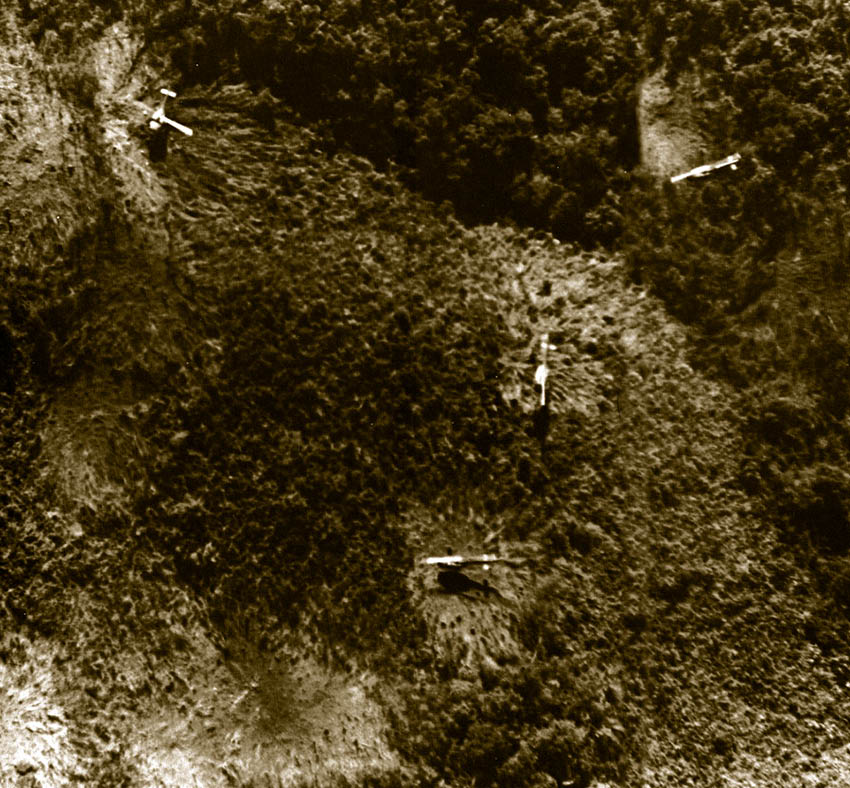
It was now the turn of the search on the eerie-looking hill, which revealed some macabre but impressive findings. More than 40 naked corpses, deep tunnels, a huge hospital, 25 heavy weapons, 75,000 rounds of ammunition, hundreds of rockets with mortar shells, and more than 10 tons of rice were found gathered in an underground room.
By the end of the day, the 29th Regiment of the North Vietnamese Army had ceased to exist. According to a POW, his 7th and 8th Battalions had been completely disbanded.
As it turned out, on this day, the enemy had left only 250 men to defend the hill. The battle for Dong Ap Bia was over and 3/187 withdrew on 21 May, but for the next 17 days, the other three battalions continued to probe the mountain. But the price the Americans had paid was unbearable.
3/187 had 39 dead and 290 wounded! Total American losses were 70 dead and 372 wounded. Based on a body count, the 2nd Bureau of the 101st put the enemy dead at 633, and no one could count the wounded or the bodies that had been carefully removed by the enemy.
According to other sources, however, the losses of the Americans were 56 dead and 420 wounded, while the North Vietnamese lost 597 dead. Newer reports put American casualties at 44 killed and 297 wounded in the battle for Hill 937 alone and the total in the operation at 132 killed and 535 wounded.
