



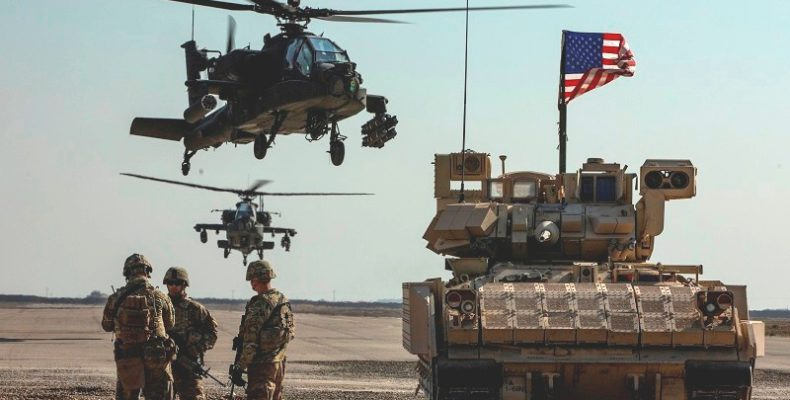
At the Fort Irwin National Training Center in California, the 1st Armored Division’s command, mission planners, operations and intelligence officers are trying to decide how best to respond to the combined wargame (wargame) designed to prepare them for a conventional match. They had spent months preparing, curtailing their communications to reduce their electromagnetic and optical footprint, ditching large satellite dishes, computers and antennas in favor of cheap, low-profile radios. For about two weeks, the 1st Armored Division moved non-stop, finding the enemy and striking from hidden locations while fighting to push back the invaders.
Many of those taking part in the exercise, which took place in January, have spent their careers fighting in brigades of up to 4,000 soldiers or even smaller units. This was by design. The U.S. military transformed into a modular force of brigade-level battlegroups in the early 2000s. But as the U.S. now has adversaries such as China, Russia, Iran, and North Korea, the military has had to rethink its role and for large-scale combat operations they will have to fight with divisions and formations of 12,000 to 45,000 troops. The headquarters of these formations will orchestrate the battle, striking deep with long-range fires linking joint capabilities from the Air Force, Navy and Marines. The last time the US military fielded a large division-level unit was in the 2003 invasion of Iraq.
Before that, the last major combat operation of this scale was in 1991 during the Gulf War. When a brigade goes into battle it moves its smaller units such as battalions, companies and platoons. These units have mainly infantry fighting vehicles and limited fire support capability. The brigade must call on outside units or its command for additional tools such as air support, long-range fires, or electromagnetic attacks. But when a division hits the battlefield, it controls entire brigades in the fight. He already has these extra “tools” in his hands. And the command uses these elements to destroy any threat and support its brigades.
The National Training Center has been the proving ground for Army units for decades. During the war on terror, tens of thousands of soldiers were trained there. The training area is suitable for brigade-centric training with a strength of approximately 4,000 soldiers, 400 combat vehicles and 800 wheeled vehicles. In the recent exercise, however, more than 70,000 soldiers participated, real or hypothetical. The scenario echoes what is happening now in Ukraine – a larger force invades an ally that has US equipment. If the Army actually entered such a fight, a US division would rush to the allied nation’s aid, as the 1st Armored Division did during exercise. Major General e.a. Thomas Spoehr, a senior adviser at the Center for Strategic and International Studies, told Army Times that the shift to division-level formations makes sense given the need for large-scale operations.
The cellphones
Also an American officer likened the use of a mobile phone to lighting a cigarette in the trenches at night during the old wars. Just as the lighting of a cigarette at night betrays the position of a soldier by “drawing” enemy fire on him, so the mobile phone today is detected with deadly results as seen in the Russia-Ukraine war.
The units are under constant attack
The soldiers of the division during the January exercise were not far from danger. The opposing forces simulated 100 artillery strikes daily, forcing them to move frequently. Adding to the artillery threat were enemy drones. The 1st Armored Division responded with an attack 300 miles deep using 24 Apache helicopters at night, covering the traffic by flying close to the ground. Electronic warfare aircraft attacked enemy electronic systems while fighters stood ready to provide direct support. From the second to the last day of the two-week exercise, the division’s command was holed up in buildings rather than in a command post full of satellite communications dishes, antennas and other easily detectable equipment by the enemy.
Division-level change is any indicator. The US military has spent a generation fighting a kind of war against terrorists and insurgents. To do this, he abandoned his skills in using large units on wider battlefields while fighting a powerful enemy with a regular army and new capabilities. Changing the 1st Armored Division is the first tangible step toward relearning how to fight major wars.

