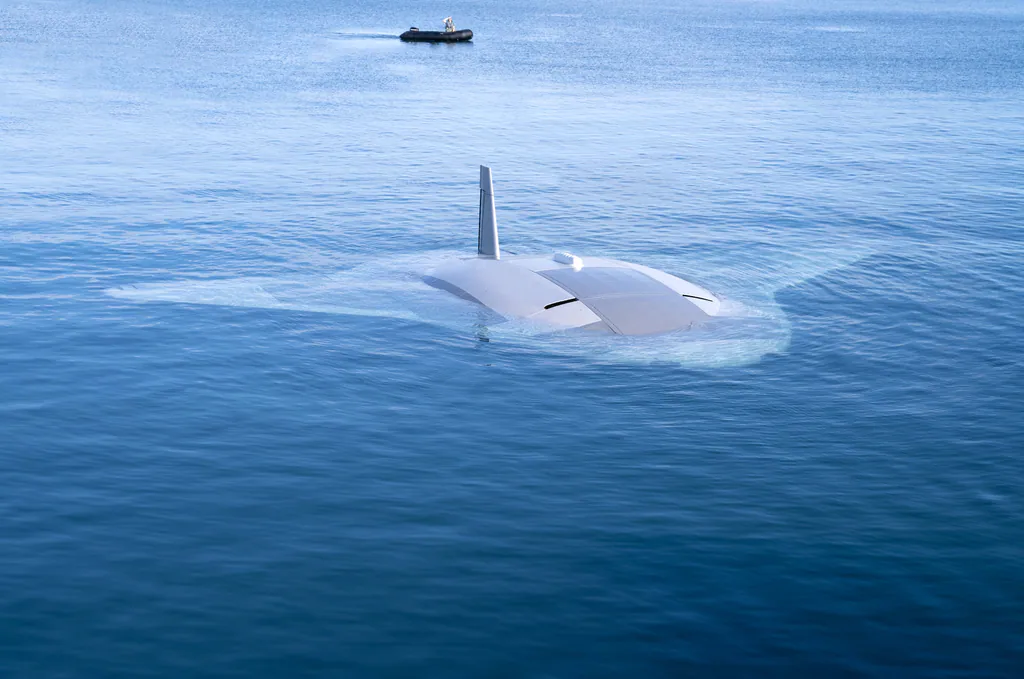
Northrop Grumman’s massive Manta Ray underwater unmanned underwater vehicle has completed its sea trials, validating its ability to operate beneath the waves and with minimal human intervention. A photo shared for the first time shows the C4ISRNET prototype just below the surface of the water. The unmanned underwater vehicle is “extremely large. Those working on the secret program declined to give details on its size, but said the UUV is modular. It was taken apart on the East Coast and assembled by a small team with only shared support equipment and a single crane, according to Northrop’s Brian Theobald.
Subsequent tests off the coast of California showed no problem. DARPA (Defense Advanced Research Projects Agency) launched the program in 2020 to create a large underwater drone that can operate independently of manned vessels, ushering in a new category of underwater drone for “payload capable UUVs”. The key bets for Manta Ray’s development are threat detection, communication capabilities, high-performance propulsion systems and the ability to withstand the rigors of underwater environments. Having a drone that can survive on its own for extended periods of time would reduce logistical requirements and free up manpower.
The design goal is to be completely autonomous, requiring little human interaction or maintenance to achieve its mission goals. “what makes it stand out is its low energy consumption, its ability to travel very long distances, its ability to operate without human interaction for long periods of time. The Department of Defense is increasingly interested in unmanned technology platforms. The US NAVY is seeking to create a hybrid fleet.