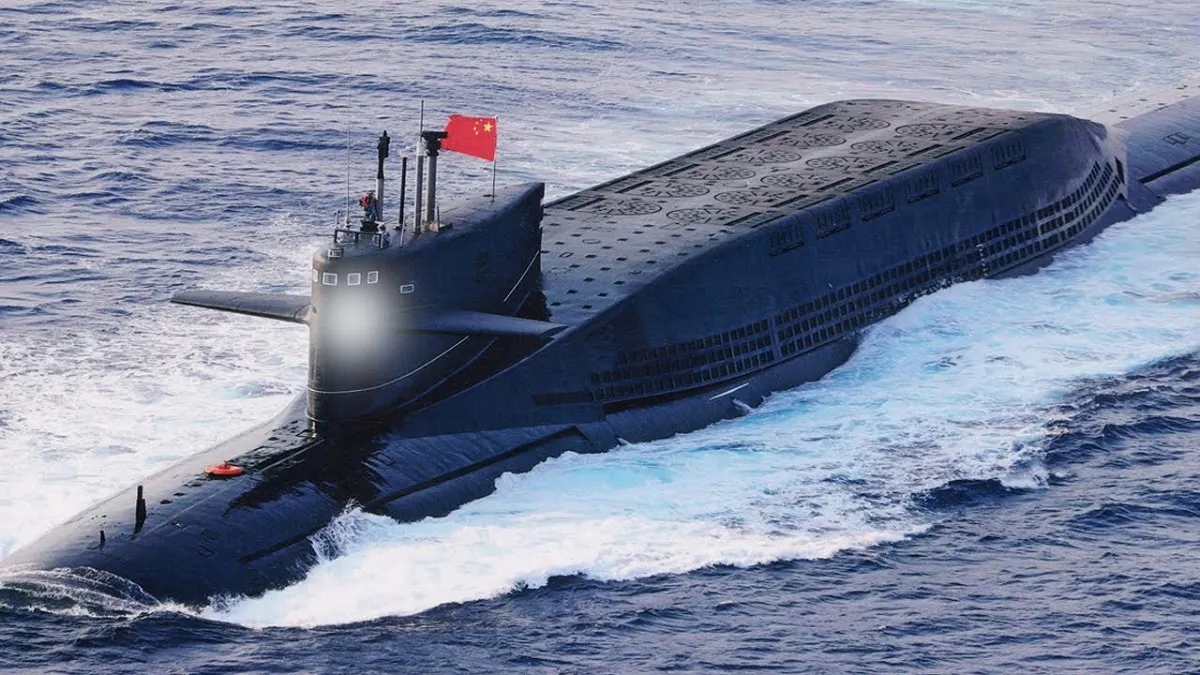
Chinese submarine officers tend to come from military academies with the lowest entrance exam scores, according to US analysts. This means that submarine commanders in the Chinese Navy are not the “best and brightest” officers who may be qualified to deal with the pressures and challenges endemic to submarine warfare. Based on the Chinese university entrance exams – similar to the Panhellenic ones – the engineering university of the People’s Liberation Army Navy is ranked second in the rankings of military academies, while the submarine academy is consistently ranked in the bottom three.
The thought of a submarine—especially a nuclear one—commanded by an officer with a low entrance exam score isn’t all that reassuring. Assuming that a student’s entry score is generally indicative of overall performance, this suggests that non-engineer submarine cadets are inferior to their engineer counterparts. Rivalry between the engineers on the lower decks who keep the ship’s engines running and the officers on the bridge, such as the captains, navigators and gunnery officers, is not uncommon in any navy.
A question of leadership
By the time a Chinese officer reaches submarine command, he has had over a decade of training and fleet experience since taking the entrance exam. However, the difference within the Chinese navy is notable, given that submarines would be one of China’s most important weapons in a conflict with the US, Japan or Taiwan. China has about 60 submarines, including six armed with nuclear-tipped ballistic missiles, plus six nuclear and 46 diesel-powered attack submarines armed with a variety of anti-ship missiles and torpedoes. Regardless, the Chinese navy appears to have been suspicious of those who commanded its surface ships and submarines: senior officers often accompanied them to supervise. Historically, a submarine commander’s command could be eroded by the presence of more senior officers on board.
Chinese submarine
The issue of flotilla-level leadership deployed in single-ship formations and the “babysitting” of ship captains has been so important to the surface fleet that the Chinese navy banned the practice explicitly in 2019. It is unclear to what extent senior officers continue to “are under the supervision” of submarine commanders, who must already share command with a civilian commissioner on each vessel. There is evidence that having a senior officer effectively take command of a submarine causes resentment among a submarine’s crew.
Conditions are difficult
A survey conducted by a Chinese university in 2021 found that 21% of South China Sea fleet crews reported experiencing mental health problems. Sailors and officers “in the submarine force in the South China Sea face mental health risks and suffer from serious psychological problems,” concluded the study, which listed education – along with age and experience – as the best predictors of mental health. health for submarine crews. Life underwater is tough. The conditions are difficult and China has had submarine accidents in the past.
The thought of a submarine—especially a nuclear one—commanded by an officer with a low entrance exam score isn’t all that reassuring. However, Li believes that China’s submarine fleet is still a capable force. There are no clear and glaring flaws in the way the Chinese Navy handles its submarines. However, the poor training qualifications of Chinese submarine commanders may be a vulnerability that US surface anti-submarine ships can exploit.
China’s submarine force is more likely to make mistakes as it draws its leaders from some of the worst-performing cadet officers. Even if the quote score is not indicative of overall human performance, it does reflect some level of intelligence and individual dedication. China’s submarine force must therefore rely on its less talented officers to lead forces that can be cut off for days if not weeks.