

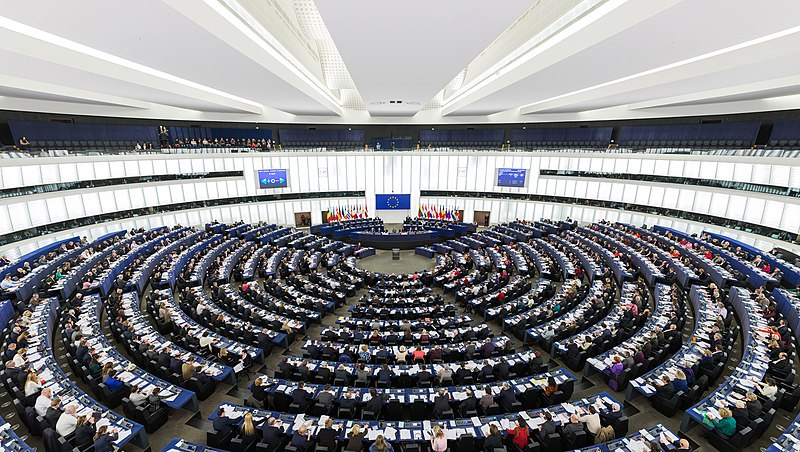
Many European media, French included, duly “decorated” Greece for the violations of the rule of law. If one accepts as a hypothesis that it is true that Emmanuel Macron’s party orchestrated and supported the specific decision of the European Parliament, a series of interesting observations about Greek foreign policy emerge. Reading the big picture of geopolitical rivalries, policy is designed with an eye on national interests, as all states do. With their international behavior, they attempt to maximize their national interest.
This admission, however, implies that there are also institutions that elaborate and recommend this policy, either the “grand strategy” of a country, or the movements at the tactical level. Not everyone does what they want, no matter what they say, whether they are prime minister or president or minister of any government. In the serious countries, I repeat, because this is absolutely unconditional.
If this information is true, whoever leaked it, apparently did so because he considered that his interests were being served.
- The French perhaps to indirectly publicize their displeasure?
- The Americans perhaps to reinforce the trend of exclusive attachment of Greece to their chariot?
- The Greeks perhaps to inform the French that “we know”?
Obviously, no conclusion can be drawn. If the information is not true, the motives of whoever channeled it are darker and seek to undermine Greek-French relations. So the key question returns to how a country’s international relations are managed by its government, a topic we will return to below.
If the information is correct, France, with which Greece signed a mutual defense assistance agreement, has been displeased with Greece’s shift to American weapons systems and orchestrated the resolution condemning the Greek government in the European Parliament, regarding its performance in the field. state of justice”. If the information is true, the foundations of Greek-French relations are fragile. If Greece has to continually award contracts to the French defense industry in order to keep the mutual defense assistance pact in place, some people have not understood something. Let’s not forget, of course, that his signature was a condition set by the Greek side and was presented, reasonably, as a surplus value weighing in favor of the French proposal (FDI HN), against the Dutch (Sigma 11515) and the British (AH-140 Arrowhead).
With Greece’s declarations of “co-production” of the FFG-62 Constellation, Greece is flirting with the Italian proposal! Because the Constellation is an evolution of the design of the Italian FREMM, the Bergamini-type frigates, with probably American armament, but which was not qualified! The Egyptians, who apparently have a different perception of the so-called “geopolitical factor” in equipment, took care and seized the opportunity, acquiring two second-hand Bergaminis for 1.2 billion euros. Two for the price of one, to be understood. The above describes a country (Egypt) with a strategic perspective that knows what it is doing and not one (Greece) that is driven and carried by the current situation.
In this irrational image, possibly French dissatisfaction with Greek manipulations can also be included. Obviously, Paris is not legitimized to have a say in Greece’s eventual decision to adopt the two-supplier model, as in the case of the Hellenic Air Force (USA and France). But this is one thing, and the message it sends out is another to start investing in a type of frigate, regardless of how it was chosen, and abandon it in the middle.
Not exercising the option to purchase another FDI-Belharra frigate does not create economies of scale, thus undermining the support of the weapon system (platform and weapons) over time. It should be noted that there is no co-production between Greece and the French, as it does not go along with the nature of the urgency with which the relevant contracts were promoted.
Consequently, the problem is the overall problematic image of Greece as a country, part of which is the free-flowing consumption of all sorts of geopolitical narratives. This cannot disguise the reality of the frivolous way in which Greece’s international relations are managed, as they see fit, by the Greek governments. This situation, unfortunately, is constantly worsening, as a result of which such issues arise in the bilateral, supposedly strategic relations of Greece. Pathogenicity lies within. Unfortunately, not the slightest inclination to rationalize can be found, with the result that arbitrariness reigns in the manipulations.