“Information is power only if you can take action with it. Then, and only then, does it represent knowledge and, consequently, power” – Daniel Burrus
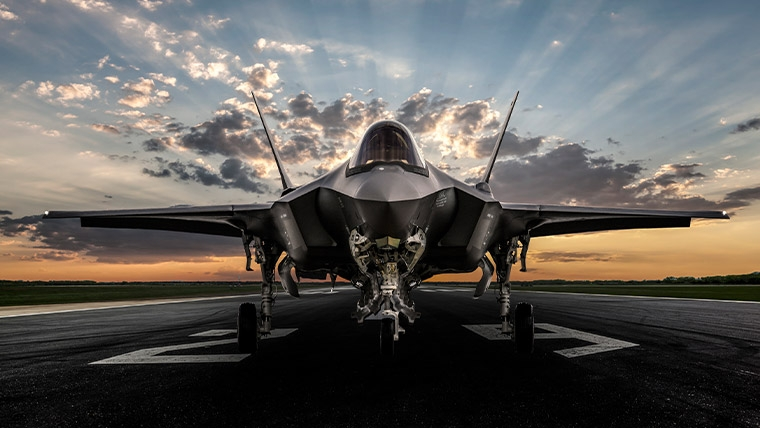
The F-35 is more than a STEALTH fighter, it is a weapon system – systems (system of systems), which brings to the field of operations an unprecedented ability to collect, store, and process data.
The F-35 is the result of the Joint Strike Fighter program, which in turn is a mix and match of various programs that ran from the 1980s onwards (the ASTOVL: Advanced Short Take-Off / Vertical DARPA Landing etc.). Opening a parenthesis, it should be emphasized that serious countries start looking for a replacement for a weapon system, almost as soon as it is put into service! In 1997 the joint ventures of Boeing and Lockheed Martin were selected to present the concept demonstrator aircraft, which were named X-32 and X-35 respectively.
The main feature of the program (and possibly the source of many of its problems to this day) was the incorporation into a basic design of three sub-variants – one for the Air Force, one for the Navy, and one for the US Marines – with each subvariant to have different (and largely conflicting) requirements. The last time an attempt was made for something similar was in the 1960s, during the administration of Robert McNamara, and which – although it created the F-111 for the US Air Force (USAF) – nevertheless it was not possible to present and the corresponding version for the Navy. Several of the subsystems, however, were integrated into a new program, which produced the F-14 Tomcat.
The F-35 is an aircraft designed with stealth predictions in mind, based on the key radars it is expected to encounter. Whether it is stealth and from which angles has been the subject of controversy almost from the beginning of the program. Although relatively safe estimates can be made, just how stealthy the F-35 is is known only to Lockheed Martin, and indeed knows with extreme precision the reflective surface of each – new – F-35 aircraft that leaves its production line.
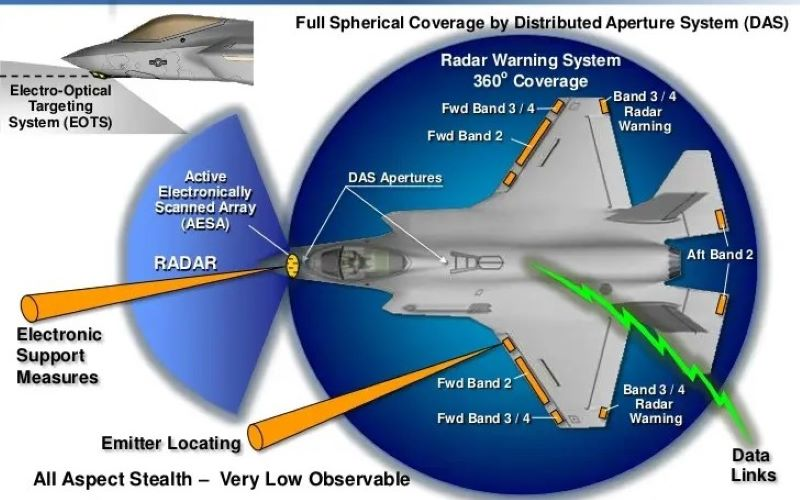
But in the information age, the F-35 could not be an exception. As we mentioned above, the F-35 incorporates a multitude of sensors, in addition to the AESA-type radar, which provide an excellent and fully clarified image around the aircraft. The two main subsystems are the AN/AAQ-40 Electro-Optical Target System (EOTS) and the AN/AAQ-37 (Electro-Optical) Distributed Aperture System (DAS). In Block 4 configuration the aircraft will carry new versions of these systems.
A few days ago it became known that an F-35 Adir of the Israel Defense Forces (IDF) managed to intercept and intercept a cruise missile, which had been launched by Houthi rebel forces, with the possible target of the port of Eilat on the Red Sea. This is also the first recorded downing of a cruise missile by an F-35 (possibly the first time since World War II that an aircraft manages to shoot down a cruise missile).
As more information is not known, we can estimate that the cruise missile was detected either by the F-35’s excellent AESA radar which managed to detect and lock onto a target that was “hiding” in the “ground clutter”, or by the DAS system. The latter is designed to cover the perimeter of the A/F, monitoring and recording any potential threat.
It can thus act as a Missile Warning Receiver, but also detect ballistic missiles and anti-aircraft missiles, acting as an atypical anti-aircraft radar. The related possibility became known already in 2010, when the USAF also released video where the DAS recorded the launch of a Falcon 9 rocket. Unconfirmed information states that the detection was made from several hundred kilometers away.
It is now clear that the way business is conducted is changing and transforming. The center of gravity shifts to information and its securing and exploitation.