

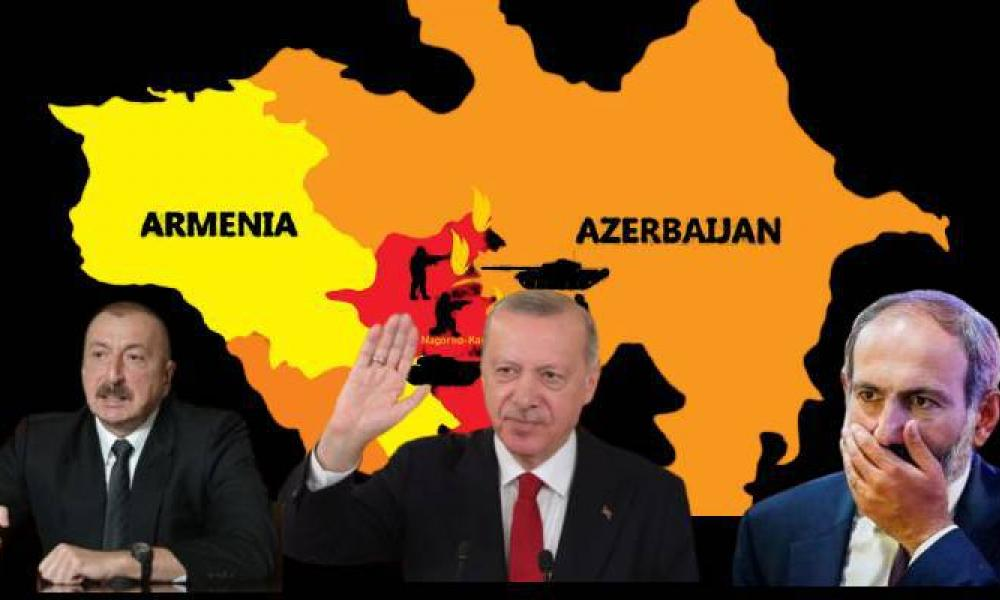
After the successful Azeri military offensive in Nagorno-Karabakh, which resulted in the uprooting of thousands of Armenians, with the subsequent outcry of Armenians against their country’s government and the outbreak of violent incidents in the country’s capital, Yerevan, combined with political -diplomatic support of Ankara towards Baku and the resumption of the issue of opening the Zagezur corridor in southern Armenia, many were those who, not unjustly, estimated that a new Turkish-Azerbaijani military operation against Armenia was imminent, for the opening of the vitally important for Turkish and Azeri interests of the aforementioned corridor. However, with the intervention of Joe Biden, the operation in question will not be carried out.
Turkey’s geopolitical interests dictate good relations with Armenia
While Turkey publicly supports Azerbaijan’s 24-hour assault on the Armenian-occupied Karabakh territories, Turkey’s long-term interests, and the government of President Recep Tayyip Erdogan, may lead to a more constructive approach to Armenia.
Ankara’s top geopolitical interests in the region include establishing diplomatic relations with Armenia, establishing direct trade routes to Azerbaijan and other Central Asian Turkic republics, and reducing Western and Russian influence in the South Caucasus by increasing its own footprint. Beyond short- and medium-term geopolitical benefits, better relations with Armenia could boost Ankara’s global standing.
Much of the impetus for the normalization talks comes from Armenian Prime Minister Nikol Pashinyan’s domestic reform agenda and his desire to move Armenia out of the Russian sphere of influence and toward the West.
The Erdogan government believes that better relations with Armenia are just as important as supporting the needs of Azerbaijan, arguably Turkey’s closest regional ally, as well as its own geopolitical interests.
Ankara’s other geopolitical interest is the creation of a so-called “Zangezur Corridor” that would connect mainland Azerbaijan with the enclave of Nakhchivan, which is sandwiched between Armenia, Turkey and Iran.
The importance of Zangezour Corridor for Ankara and Baku
The corridor would open a shorter and safer land route from Turkey to Azerbaijan as the Turkish government seeks to deepen its trade and political ties with it and the Turkic republics of Central Asia.
Both Ankara and Baku are trying to convince Armenia to open the corridor. The corridor would open a shorter and safer land route from Turkey to Azerbaijan as the Turkish government seeks to deepen its trade and political ties with it and the Turkic republics of Central Asia.
Both Ankara and Baku are trying to convince Armenia to open the corridor. Ankara may also want to get along with Armenia to limit Russian, Iranian and even Western meddling in the South Caucasus.
While Russia’s invasion of Ukraine has limited its influence, Iran is another matter.
Iran’s attitude towards Armenia and Azerbaijan
During and after the 2020 war between Azerbaijan and Armenia, which led to Baku’s recapture of the Armenian-held Nagorno-Karabakh region, Iran sided with Armenia out of concern that a stronger Azerbaijan could spark separatist sentiments in its Azeri minority.
Tehran has opposed the Zangezour Corridor projects, fearing it would cut off Tehran’s land links with Russia through Armenia and Georgia. Ankara will likely work to sweeten the deal by offering expanded logistical access to Iran through Armenia as well as Azerbaijan. Earlier this week, Erdogan said Iran was now signaling “positive” messages about the corridor plans.
Turkey wants US-France “at a distance” from Armenia
Similarly, Turkey does not want France or the United States to gain prominence in the Armenia-Azerbaijan conflict.
Until the 2020 war, France and the United States were members of the so-called Minsk Group, which was set up to broker a solution to the Nagorno-Karabakh conflict. Both Western nations, however, were seen as favoring Yerevan due to its large number of citizens of Armenian descent. Azerbaijan’s victory in 2020 meant their services were no longer needed.
Ankara wants to limit Washington’s footprint in the Caucasus because of US military action in neighboring Iraq and Syria, which has worsened Ankara’s security outlook. Turkey is also keen to keep its NATO ally at bay to avoid counterattacks from Russia and Iran, complicating Turkish plans for the South Caucasus and Central Asia.
Better relationships are necessary
As of 2021, Erdogan has been negotiating with Pashinyan through one of his most trusted foreign policy aides, Serdar Kilic, a career diplomat whose previous position was Turkey’s ambassador to the United States.
Last June, a first for a Turkish president, Erdogan invited Pashinyan to his inauguration ceremony and had a telephone conversation with him on September 11. Ankara’s involvement with Yerevan has continued since the last Karabakh war.
A Turkish “source” even “outlined” an almost fantastical picture of how a peace between Turkey-Azerbaijan and Armenians could be “sold” to the citizens of the three countries.
Along with Erdogan, Pashinyan and Azerbaijani President Ilham Aliyev near Mount Ararat or another site of historical and cultural significance embraced, which would signal to the world that they are leaving behind their nations’ embarrassing past.
Coming from Turkish national security bureaucrats, who are traditionally suspicious of the Armenian government and diaspora because of a dark history in the 1970s and 1980s, the visualization of such an image showed that the thinking of some in Ankara is changing.
Conclusion
From the above, it can be seen that for a number of reasons and interests, Erdogan wishes to approach Armenia, seeking on a win-win basis to succeed in convincing Pashinyan, to sign a peace agreement with the Azeris and above all to allow the opening of Zangezour Corridor.
However, our assessment is that the US is “baking” a solution that will satisfy all parties, except Russia, which will be the big loser, and Iran, according to which the Zangezour Corridor will continue to be Armenian territory, but be opened as an International Trade and Transport Corridor, thus partially satisfying the aspirations of Turkey and Azerbaijan to be connected by land to each other and through the Caspian to the “countries of the Turkic world”.
The US, for its part, through an alliance it will develop with Armenia, will have the ability to control the corridor in question, curbing Turkey’s ambitious ambitions, while putting a “wedge” in the Chinese Silk Road.