



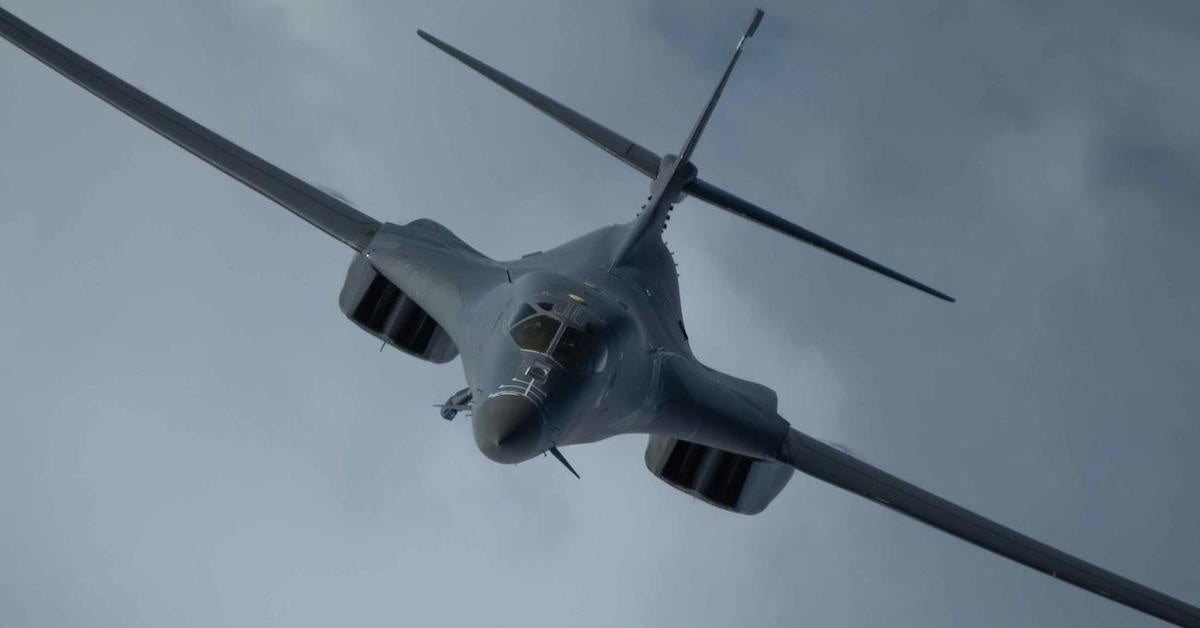
The US Air Force wants to turn the B-1B Lancer supersonic strategic bombers into “killers” of the Chinese Navy’s aircraft carriers. To do this, experts want to convert the bomber so that it can carry anti-ship weapons.
The B-1B Lancer will be able to carry 36 Long Range Anti-Ship Missiles (LRASM) based on the JASSM-ER but using satellite communications, allowing it to bypass enemy air defenses. The LRASM is believed to achieve a range of over 900 kilometers.
The idea to arm the B-1B with 36 LRASM missiles has its roots in the Arsenal Plane design that emerged at the end of the last century. The idea is that military aircraft, including transport aircraft, could carry a large number of missiles.
The Arsenal Plane concept spawned the technology called Rapid Dragon. It is a long-range AGM-158B JASSM-ER cruise missile launch system on pallets from military transport aircraft. The average age of B-1B Lancer supersonic bombers is almost 35 years. The US Air Force plans to retire the aircraft early next decade, replacing them with the B-21 Raider, which will not be able to carry as many missiles as the B-1B.
During the Cold War, a B-52 Stratofortress bomber test-fired twelve Harpoon anti-ship missiles. The F/A-18 Super Hornet fighter can carry no more than two LRASMs, and the P-8A Poseidon anti-submarine aircraft can carry up to six missiles.
If the conversion takes place a single B-1B Lancer will carry about twice as many anti-ship missiles as the Super Hornet, Stratofortress and Poseidon combined. A group of five B-1B Lancer aircraft could launch a “barrage” of 180 LRASM missiles. Decades ago, the US feared Soviet Tu-22 jets with AS-4 anti-ship missiles. This prompted the development of the Aegis combat system and the equipping of the F-14 Tomcat with AIM-54 missiles.
Now the opponent is China, and five B-1B Lancers with 180 LRASM missiles will be capable of sinking a Fujian-class aircraft carrier, four Type-055 and Type-052D destroyers, and one Type-054A frigate, even if Chinese air defenses intercept the 95 % of missiles. Installing LRASM on the B-1B Lancer would give the US Air Force one of the most powerful non-nuclear weapon systems in history.

