



In today’s day every citizen of a country (at least every citizen of the countries of the West and not only them) uses in their everyday life and generally in the course of their lifetime knowledge offered by certain people and which Knowledge has been transformed into devices and works that are the modern culture of mankind.
Without all this knowledge, mankind would not have succeeded in improving and facilitating his life. These are the basic theories on which today’s modern civilization was based:
1. The Law of Gravity
The law of gravity which presented by the top English physicist Isaac Newton (1642-1727) explains the movement of the planets and how the body’s gravity behaves on earth and space.
Gravity on Earth causes the traction of body materials creating their downfall on its surface when released freely. Gravity is responsible for the existence of Earth, Sun, Moon and other celestial bodies as well as the orbits that follow these celestial bodies.
It was first published on July 5, 1687 in the work of “Philosophia Naturalis Principia Mathematica”. Until Einstein’s theory of special relativity appeared in the spotlight, the law of gravity was a benchmark.
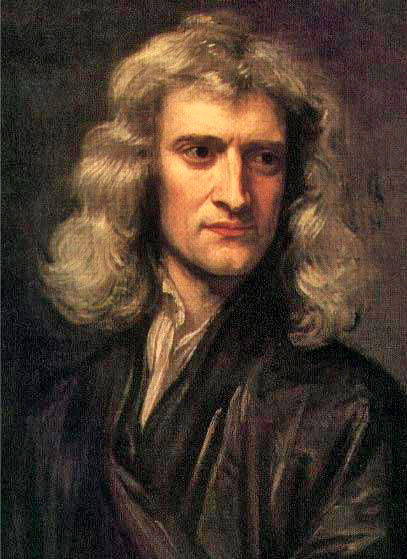
Artist Godfrey Kneller (1646-1723)
Source/Photographer: http://www.newton.cam.ac.uk/art/portrait.html
2. The Theory of Relativity
Albert Einstein’s (1879-1955) Special Relativity Theory is the prevailing theory on the structure of spacetime and is based on two axioms and has four main implications.
These axioms are that the laws of physics are the same for all observers who are in an inertial reference system (which is based on the theory of Galileo’s general relativity) and that the speed of light in the void is the same for all observers, irrespective of their relative movement or the movement of the source of light.
The four main consequences of this are:
- Time dilation
- The contraction of the length
- The relevance of concurrency
- The mass-energy equivalence
The theory of special relativity was formulated for the first time in 1905 and changed the course of physics, and enriching the knowledge of mankind about the past, present and future of the world.
3. The Pythagorean theorem
The Pythagorean theorem was formulated by the ancient Greek philosopher Pythagoras between 570-495 B.C. and is considered a theorem of flat geometry and specifically describes the relationship between the sides of a rectangular triangle. It is a fundamental principle of Euclidean geometry.
The square of the hypotenuse (of the side opposite the right angle of the triangle) of a rectangular triangle equals the sum of the squares of the other two sides.
4. Maxwell’s equations
The equations of the Scottish physicist James Clerk Maxwell (1831-1879) are a set of differential equations and are the foundations of classical electrodynamics, classical optics and electrical circuits.
They were published for the first time in 1861 and are of equal value for electromagnetism with the value of Newton’s Law in classical mechanics. Maxwell’s equations find application in modern electrical and communications technologies.
5. The second Thermodynamic Law
Published for the first time by the German physicist Rudolph Clausius (1822-1888) in 1865. There are two equivalent basic formulations of this theory.
Every thermal machine has power loss. An energy payment is required for the operation of a cooling machine.
The thermal energy is transported spontaneously from the warmer bodies to colder, while in the reverse that is the operation of a cooling machine is also required energy payment. Essentially the second thermodynamic law proves that heat cannot spontaneously pass from a warmer to a colder body.
Its application led to the development and operation of technologies such as internal combustion engines, generators and cold genetics.
6. The Logarithms
The Logarithms were first formulated by Scottish mathematician, physicist and astronomer John Napier in the early 17th century to simplify calculations. Calculation methods are based on i.e. the logarithm of a given number x is the exponent to which another fixed number must be raised to produce the number z. The Logarithms’ were adopted by seafarers, chemists, scientists and engineers.

Photo by digitized from an engraving by G.J. Stodart from a photograph by Fergus of Greencock
7. Calculus
Calculus is defined as the mathematical study that deals with the constant change in prices. It has two main axes. Differential calculus-studying the proportions of changes and gradients of curves and Totalitarian calculus-studying the accumulation of quantities and areas under curves. These two axes are formed the fundamental theorem of Calculus. Calculus is a basis for mathematics education and finds numerous applications in mechanics, economics and science.
8. The Schrodinger equation
This equation is a differential equation and was formulated in 1926 by Austrian physicist Ervin Schrodinger (1887-1961) and describes how the quantum state of a quantum system changes over time.
It is a basis for quantum theory and mechanics respectively because it shapes the behaviour of atoms and subatomic particles. In fact, Schrodinger’s equation led mankind to the development of nuclear energy, quantum computing and microchips.
9. The information theory
The information theory is a branch of applied mathematics and deals with the quantification of information. Developed by American mathematician, electrician-engineer Claude Shannon who encoded the information in the shape of the sequence symbols and the speed that this information can be transmitted. It finds application such as data compression and reliable data transfer and storage as well as info channel coding. Its implementation is a fundamental basis for the evolution of the internet and mobile telephony.
10. Chaos theory
Chaos theory is an area of mathematics and is applied to physics, meteorology, economics, computers, engineering, philosophy and biology. This theory studies complex systems whose behaviour is extremely sensitive to the infinitesimal change in conditions. In other words, it shows how small changes can cause multiple large-scale consequences.

