



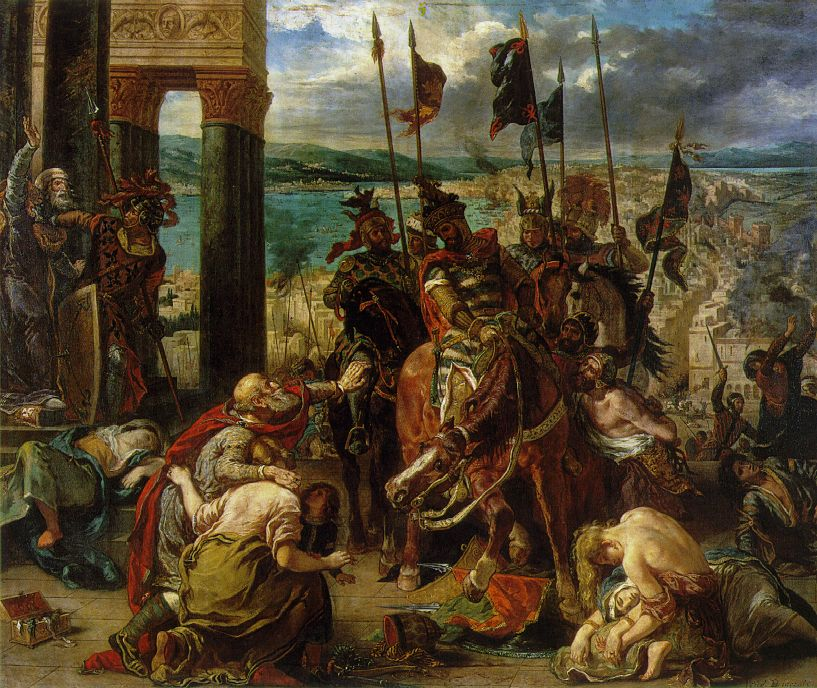
The 4th Crusade has its starting point in the year 1198. It was inspired by Pope Innocent, but the difficult task of rousing the Western chivalry and “taking the Cross” was undertaken by the French preacher Fulk du Nouigi.
Fulk managed to convince several feudal lords, but also small lords and common knights to join and also raised a lot of money for the campaign. The plan called for a concentration of forces in Venice, from where the crusading Army would cross to the East on Venetian ships. Until they were all gathered, they would remain in Venice.
The city, however, made it a condition that the Crusaders advance their fares to the East, as well as money for their accommodation and food, for the time they would remain in Venetian territory.
But as the Crusaders gradually flocked to the city of the doges, an unpleasant event worsened their situation. Preacher Fulk, the real soul of the campaign, died. His loss, in addition to the psychological, had practical consequences.
The money he had collected was given to the Cistercian monks, who in turn gave it to the East Franks to repair the fortifications of Acre, Tire and Beirut, which had collapsed due to a strong earthquake.
Other than what money was not allocated for the Frankish states of the East, only a small part reached the Crusaders. One of Fulk’s associates, Petros of Rossi, embezzled large sums.
Even for Pope Innocent, the bad tongues of the time said that he “purged” large sums and invested them ensuring the income of Saint Peter! The pope, of course, publicly denied the rumors. But he failed to convince many.
The Crusaders may have been facing major financial problems, but the Venetian doge, Henry Dandolo, did not seem willing to wait. The old doge demanded the payment of what had been agreed upon.
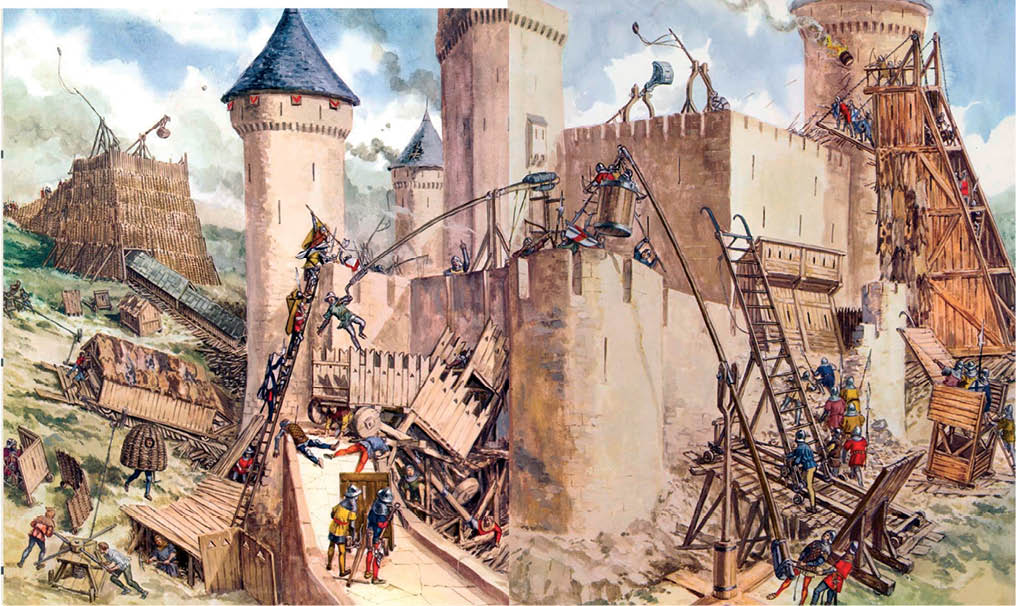
He emphasized to the unresponsive Franks that he and his city had kept the agreement to the letter. The ships necessary to transport them had been built and were now rotting immovably in the lagoon, expenses were running high, and the assembled sailors, who had left their work to respond to the doge’s call, demanded to be paid.
At Dandolo’s words the Frankish rulers merely bowed their heads. They could do nothing but promise to pay him. And they really tried. They collected all the money they had at their disposal, which, however, did not cover even half of the agreed amount.
When the doge found out, he was furious. As it had opened, his city faced the specter of financial ruin. Everyone, artisans, sailors, merchants, asked him for their money, the money promised to him by the leaders of the Crusaders.
Unable to pay the money, the Crusader rulers fell into despair. Some, the most romantic, made an appeal asking the rest to donate all their possessions to the common cause.
The proposal was not accepted by many, who objected that they had done their duty, and since the fault was not theirs they were by no means disposed to sell off their possessions to liberate the Holy Land. If the Venetians did not provide them with their ships with the money they had, then they would have to look for them.
Apparently the agreements did not weigh much on the Frankish rulers. Nevertheless, at the suggestion of one of the leaders of the Crusade, Count Villeardouinos, the lords yielded to the ideological weight of the struggle and agreed to pledge their valuables to the Doge.
Even this act of desperation was of little use, since the Crusaders were unable to pay the last 36,000 marks missing, out of the 85,000 they had promised. Despair returned to the Crusader camp, who knew that no one could strengthen them, not even Pope Innocent and the mighty Catholic Church.
Day by day, conditions in the Crusader camp became more and more difficult. In the sandy areas of the island where they had camped, the Crusaders fell exhausted from the excessively hot climate for them. Food soon began to run out, not because the Venetians did not want to supply them, but because the bad harvest of the previous year forbade them.
Even the water, brackish as it was, created health problems for them. Several men died during the very hot summer of 1202. But nothing changed, only the same irritating immobility still plagued them.
The poorer had exhausted what little money they had in trying to buy food, while others were forced to borrow money from the moneylenders who thrived in Venice.
Faced with this situation, several Crusaders began to leave the camp, in a futile attempt to search for food in the Italian hinterland. It was now certain that if this situation continued the crusading Army would disintegrate before it could even begin its mission.
The men resented and grumbled against their leaders, who did not even bother to keep them busy with marches and military exercises.
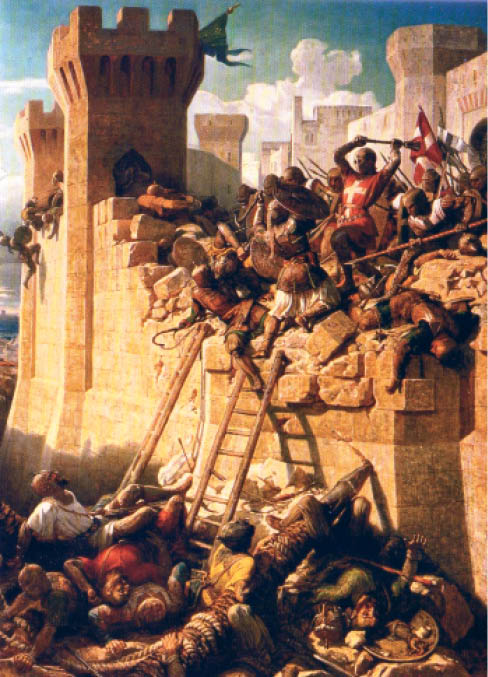
Solution to the impasse
In this climate of bloodless destruction, the rulers of the Crusaders hastened to inform Doge Eric Dandolo that they were unable to pay additional money, since they no longer even had the necessities to live!
In doing so, however, they were literally left to the whims of Dandolo, who now had to find a way to repay the expenses incurred by his city, which was indeed in danger of declaring bankruptcy.
Some historians, however, believe that all this was part of the plan of the cunning Dandolo, who knew that the Crusaders would in no way be able to gather either the men or the money they were counting on.
According to their view, Dandolo, certain of the turn of events, could appropriate the Crusader Army and turn it against his enemies, either on the opposite Dalmatian coast, or in Constantinople. However, this theory cannot be valid and this is proved by the facts.
If Dandolo had indeed estimated that only 12,000-14,000 Crusaders would appear in his city, he would certainly have taken care to build fewer ships rather than 500. Thus they would have achieved the same result with less expense and without, above all, disturbing the Venetian trade, the lifeblood of the city.
After all, as a tough merchant that he was, he could never be sure that the Crusaders would ultimately honor the agreement and not return home leaving him and his 500 ships tossing in the shallow waters of the lagoon.
The Doge knew, firstly, that the Crusaders were clearly stronger than the Venetian Army and, secondly, that there was always the possibility that the Crusaders, in view of the stalemate, would move in another way towards the East. For all these reasons, then, it should be considered improbable that all this was due to the demon Dandolo. Dadolo was of course brilliant, but until then he had not had to prove it.
Apparently, he sincerely wished to find a solution which would lead to the end of the impasse. Realizing that the Crusaders were unable to pay, Dandolo sought and eventually found the most beneficial solution. He would direct the Crusaders to Zara, the great and powerful Dalmatian city, which still defied the omnipotence of the city of St. Mark, relying on its alliance with the king of Hungary.
If the Crusaders helped the Venetians to conquer Zara, then they would grant them an extension of time to pay off the debt of 36,000 marks, until the conquest of the Holy Land and repayment in booty. Because the Venetian merchants were unable to forgive the debt! In this way, the initiator of the Dandolo scheme saved both the Crusade and the Republic’s money, and in addition secured a considerable profit.
Zara was not an insignificant city. First of all, it controlled the trade in timber from the forests of the north-west Balkans, timber necessary for Venice to build its ships, and secondly, it was an important hub for shipping to the east.
Immediately after the decision was made, the Council of Venice addressed the leaders of the Crusade and submitted its proposals. Apart from the “economically advantageous” proposal, the Venetian envoys informed the Franks that anyway winter would soon come, a season unsuitable for long sea voyages. Besides, if the Crusaders occupied Zara they would also secure excellent winter quarters.
Then, next spring, they could set sail for the East. The Frankish rulers listened carefully to the Venetian terms and promised to study them. However, their non-immediate response was simply a gun price maneuver. They knew they had no choice but to accept the Venetian terms.

So they finally agreed and agreed to occupy Zara first, i.e. to kill Christians first, before settling their scores with the infidel Muslims. The agreement was of course not announced to either the knights or the soldiers, as reported by the chivalric chronicler Roberto of Clari. They were only informed that they were about to depart. All of them naturally assumed that they would be departing for the Holy Land or Egypt and celebrated the news accordingly.
The next day, Sunday September 8, 1202, the feast of the Virgin Mary, the doge and many Crusaders had gone to the church of Agios Markos to attend the Divine Liturgy. The huge temple was also overwhelmed by crowds of Venetian citizens. Suddenly, the old doge ascended the pulpit and began to speak in his stentorian, despite his age, voice:
“Gentlemen, you are joining the bravest men in the world for the greatest enterprise ever undertaken. I am old and weak, I need rest because my health is bad. But I see that no one can rule and direct you better than I, your lord. But if you agree that I too wear the sign of the cross and leave my son behind to guard the homeland, then I too will go to live or die with you and the pilgrims.”
Enthusiastic cheers rang out from the shocked audience. The whole crowd cheered the old doge and called on him to lead them in the holy war against the infidels. Then Dandolo approached the Holy Altar and knelt down weeping before it. The sight of the old, almost blind, doge, clothed in luxurious purple and humbled before the Lord, shocked the crowds.
The entire direction of Dandolo was indeed amazing. So much so that even his merchant compatriots were moved. We don’t talk about the Crusaders, because they had already fainted! So he managed with a few tears to anoint himself as the leader of the Crusade and to offer the hereditary right of succession to his son! This was Errikos Dadolo, in one of the best performances of his life.
However, some of his apologists consider that his speech was the product of “deep religious faith”. Rather, they forget the temperament and commercial spirit of the Venetian leader. Was not his “deep faith” deeply at odds with his later actions? Or were the people of Zara, and later Constantinople, less religious? Some dispute the episode, but it is mentioned by the eminent chronicler of the Fourth Crusade, Villeardouinos.
A third batch of pro-Venetian historians consider that the episode did take place, but was an invention of the Crusader leaders, in particular Villehardouin. This portion argues that Dandolo cannot, half-blind and old as he was, really wanted to lead the Crusade. But unfortunately for them, ambition has nothing to do with age or position. There are countless examples capable of convincing even the most skeptic.
Regardless of being old and blind, Dadolo was by no means weak, as a character of course. He was extremely hard, ambitious, vain, avaricious, pompous, but also an experienced politician with an incredible clarity of mind for his age.
He also knew very well his countrymen and their feelings, a key weapon for any politician who wishes to exploit the crowd.
The only problems presented were related to the publication of the news about the attack on Zara. The Crusaders were particularly displeased both with the decision to attack the Christian city and with the assignment of leadership to Dandolo.
The religious beliefs of the time forced the bearers of the cross not to venture into operations against Christians. The men were afraid that they would be damned by the pope if they attempted such a thing. Besides, the overlord of Zara, the Hungarian king Emeric, was also a Crusader!
Under these conditions, several Crusaders left the camp and started for their homelands. At the critical moment, however, the most practical intervened and managed to reverse the negative climate, telling their men that the greatest sin would be to return, without having fulfilled their oath for the liberation of the Holy Land. If some Christians had to die to fulfill the oath, the pity would fall on the heads of the Christian victims!
The proposal fell on deaf ears. Most Crusaders felt that the attack on Zara was the lesser of two evils. The proposed attack on Zara also caused divisions among the Catholic clergy and especially among those accompanying the army of clerics. Some of them tried to leave the camp. But then Petro Capuano intervened and, as papal legate that he was, forbade their departure. They had to stay, he told them, to try to prevent, as far as possible, the shedding of Christian blood.
Capuano’s new intervention was of course aimed at protecting the already damaged cohesion of the crusading Army. But it also amply demonstrates the moral collapse of the Catholic clergy, at this particular juncture, who seemed ready to sacrifice everything to achieve their goal. It was the absolute application of the doctrine “the end justifies the means”. If indeed the pope did not wish for the slaughter of Christians, this would be the right time to intervene and impose his will.
But the pope, like the legate Capuano, were more politicians than religious leaders. So they did not react and allowed the Crusaders to enrich Heaven with a few thousand more Christian souls. Those who attempt to disassociate the name of Innocent from Capuano’s decision are not to be believed. It is certain that Capuano was acting on instructions from the pope.
While all this was taking place in Venice, a Byzantine prince in exile was watching the events with great attention, enjoying the joys of life in beautiful Verona. The young Alexios Angelos had already sent his ambassadors to Venice, who had made contact with the leaders of the crusading Army.
The Byzantine representatives, after analyzing the situation of the usurpation of the throne by Alexios III and stating that they were confident that the Byzantine aristocracy would support the young claimant to the throne, officially requested the help of the Crusaders to recover the throne of Constantinople. The Byzantines told the Franks that without much trouble and expense, the Crusader Army could force the return to the throne of the rightful emperor Isaac and his son Alexius. In return, the rightful emperors would support them in their quest to liberate the Holy Lands.
The Frankish rulers discussed the proposal among themselves and concluded that only with the help of the strong, as they believed, Byzantine Army could they succeed in their mission. The Venetians were absent from these contacts. De Dandolo seems not even to have been informed. However, on the eve of the departure, the other leader of the Crusaders, their honorary leader, Boniface of Montferrat, went to Rome and discussed with the pope.
The pope wanted the leader of the Crusade – who would not meet his men until after the fall of Zara – to be with him so that he could disassociate his name, and by extension the honor of the Crusade, from the planned crime against of Zara. During these talks, Boniface discussed with the pope the issue of the deposed Byzantine prince Alexius.
Innocent, however, seemed unwilling to listen. Politically he had nothing to lose by conquering Zara. Perhaps he was gaining something since around Zara lived and acted vogue-speaking heretics. The pope’s intervention in the Balkans also had to do with the proposal of the self-proclaimed emperor of the Bulgarians, Ioannitsis, that the inhabitants of his country follow the Western doctrine. The Bulgarians were fanatical enemies of the Hungarians as well. An attack against the Hungarian vassal Zara favored relations between Bulgaria and the Holy See.
For the record, Innocent sent a letter to the Crusaders demanding that they not attack Zara. But the wicked pope knew very well that there was no chance that his letter would even reach the Crusader camp before they left for the Dalmatian coast. It was another prank by Innocent III, the faithful in Christ pope and patriarch of ancient Rome.
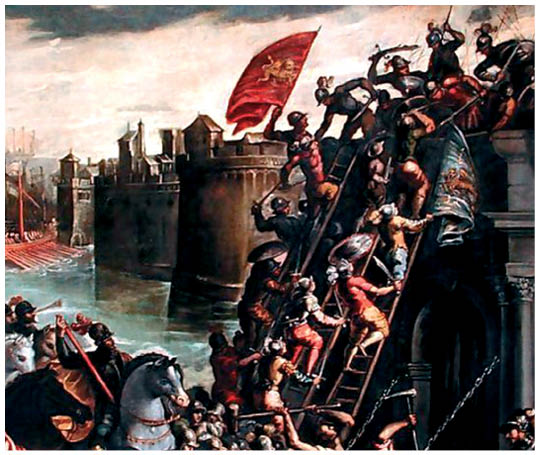
Blood and politics
Meanwhile, the Crusaders completed their preparations for the attack on Zara. Supplies, horses and 300 siege engines were loaded onto the ships. The Crusaders followed, wearing their brilliant armor – the lords at least.
When everything was ready 202 ships sailed from the lagoon of Venice. 62 of them were warships – galleys – 40 transports and 100 cavalry. Of course, the fleet was followed by many smaller vessels. For this reason some chroniclers of the time speak of 480 ships. To the cheers of the crowd, the fleet set sail and left port. In a short time the ships disappeared over the horizon.
Even Dandolo’s luxurious galley was no longer visible. Nevertheless, the departure of the fleet was not without problems. A large transport, the “Violeta” sank, without serious human losses, but leaving a void that cannot be filled. The fleet, however, despite the accident, continued its voyage and, after passing through some Venetian-held ports on the Dalmatian coast, finally arrived outside the walls of Zara on November 10, 1202.
The next morning, the leaders of the Crusade began to inspect the walls. They were particularly impressed by the strength of the city’s fortifications.
In the meantime, the people of Zara had taken their measures. They had blockaded the port of their city with a huge thick chain, were strengthening the defenses of their walls and arming themselves. But the Venetians attacked immediately. Their galleys fell upon the chain and finally broke it. The road to the harbor was opened, and indeed before long the horse-carriages and ferry-boats entered and unloaded their live cargo.
A few hours later the tents and siege engines were set up. The inhabitants of Zara did not attempt to prevent the landing – they did not have the strength to do so. Confident of the success of the forces he commanded, Dandolo did not refuse to receive the envoys of the city, who agreed to surrender it on condition that the besiegers respected their lives and property. The inhabitants of Zara knew that without the assistance of their Hungarian allies it was impossible to withstand the siege. Dadolo listened attentively to the representatives of the townspeople, but refused to give an immediate answer. He told them that he wished first to confer with his allies. This move was his big mistake. Many of the Crusaders, chief among them Simon de Montfort, perceived that the city’s surrender was imminent, and with the pope’s letter in hand, which had finally arrived, informed the city’s representatives of the pope’s prohibition against attack and capture her.
Naturally, the overjoyed delegates returned to their city and prepared to continue their resistance against their Venetian enemies, after Simon assured them that the Crusaders were not going to attack them!
In the meantime Dandolo had met with the Crusader leaders and secured their consent to accept the terms of the surrender of the city. But when he returned to his tent, together with the Frankish rulers, instead of meeting Zara’s representatives, he met Simon de Montfort’s men. One of de Montfort’s followers even threw himself in front of him and said: “I forbid you, by order of the Pope of Rome, to attack this city inhabited by Christians.” An extremely violent scene ensued. The Venetians present rushed at the knight and tried to kill him. But Simon’s intervention saved him. However, the situation had escalated. Dandolo, frantic, screamed at the Frankish rulers that they did not keep their agreement and that because of them he lost the opportunity to capture the city without blood.
On the other hand, Simon’s followers shouted and threatened their leaders that if they attacked the city, the anathema of the Mother Church awaited them.
Once again the Crusader rulers were faced with a dilemma. Soon, however, probably at the suggestion of Villeardouinos, the dilemma was overcome. They would attack the city, even facing the possibility of being excommunicated. Indeed, before long the besiegers began preparations for the attack.
The Venetians tried to convince the inhabitants to surrender, but they did not believe that the French knights would not keep what they had promised them. In order to further prevent the Crusaders from attacking them, they hung images of saints and crosses on their walls.
But their hopes were dashed when the first stones from the siege engines hit them. For five days the besiegers prepared the attack, the French by land and the Venetians by sea. Terrified, the inhabitants again sent an embassy agreeing to surrender their city on the sole condition that their lives be respected. The surrender, on this condition, was accepted, but not kept. When the “Crusaders” entered the city they started looting everything, even the churches. Most of the inhabitants escaped the massacre, but several were slaughtered, women were abused and raped. The leading group of the city was captured by the Venetians and disappeared.
Epilogue – Conclusions
After the capture of Zara the victors, their consciences clear, divided their spoils and settled in the deserted houses of the city. They intended to winter there and sail in the spring for the East. However, over the distribution of the booty, a serious dispute broke out between the Venetians and the Crusaders, which developed into a real battle with over 100 dead and hundreds of wounded, proving the real ideological background of the Crusade.
The fall of Zara was the prelude to the fall of Constantinople by the same barbarians who defiled the name of the Holy Cross of the Lord with their innocent actions.
The Crusades in general and the 4th in particular were largely a campaign to open trade routes and enrich the poor nobles of the West. Of course, there were also pure people, with deep religious feeling, but also others with incredible religious fanaticism, who slaughtered mercilessly in the name of the King of Peace, Christ.
The leaders of the Fourth Crusade, along with the merchant Dandolo, made their intentions clear from the start by taking over a Christian and even Westernized city almost two years before they destroyed Constantinople.


