




The Chinese government made five demands to the United States, including the lifting of the chip export ban and sanctions, during US Treasury Secretary Janet Yellen’s four-day trip to China that ended on Sunday, July 9.
He expressed concerns
China’s finance ministry said in a statement on Monday that it had raised concerns with Yellen about the additional tariffs, corporate sanctions, investment restrictions, export controls and bans on products from the Xinjiang region that the US has imposed on China in recent years, adding that they should take specific actions to address her concerns.
Chinese commentators said the Chinese side scheduled meetings of key economic officials with Yellen, showing Beijing attaches great importance to her visit. They added that Washington clearly knows what to do if it wants China to buy its government bonds.
During her four-day trip that ended Sunday, Yellen met with Premier Li Qiang, Vice Premier He Lifeng, Finance Minister Liu Kun, Party Secretary of the People’s Bank of China (PBoC) Pan Gongsheng , as well as former Vice President Liu He and PBoC Governor Zhu Xiaochuan. In total, he had about 10 hours of discussions with them.
“China’s development is an opportunity, not a challenge, for the US. It is a gain, not a risk,” Chinese Vice Finance Minister Liao Min said in a statement released Monday. Strengthening cooperation between China and the United States it is the practical need and the right choice of the two countries.
Healthy competition
“To achieve a healthy Sino-US economic relationship we must fully respect the legitimate development rights and interests of all parties and conduct healthy competition in accordance with market economic principles and the rules of the World Trade Organization,” he stressed.
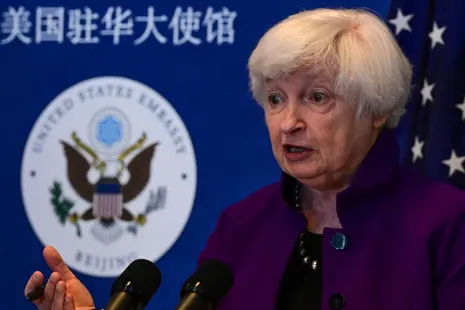
And he added that “Differences should not be a reason for alienation, but rather a driving force for strengthening communication and exchange.”
He also pointed out that China and the US should seek consensus on important issues in the bilateral economic field through sincere exchanges so as to infuse stability and positive energy into their economic relationship.
During Yellen’s trip, Beijing showed its willingness to help solve global challenges such as financial stability, climate change and the debt problems of smaller countries, Liao Min said.
Limitations on technology
Last month, media reports said that Washington would soon announce its plan to ban Nvidia from shipping its A800 and H800 artificial intelligence chips to China, and also later this month to restrict US capital from investing in its high-tech industries.
Yellen told media on Saturday that her administration would listen to China’s complaints about restrictions on US technology exports related to its security. She said the Biden administration would try to avoid unnecessary fallout, but did not indicate any potential changes.
“We will open channels so that they can express concerns about our actions and we can explain and, possibly in some cases, respond to unintended consequences of our actions,” she stressed.
“Reducing risks”
She added that she has tried to explain to Chinese officials that the United States’ strategy of “de-risking” is not the same as “de-coupling” and described her talks with top Chinese officials as “direct , substantial and productive”.
“Even where we disagree, I think there is clear appreciation in the frank and in-depth discussions we’ve had about the opportunities and challenges in our relationship and the better understanding they’ve given us of each country’s actions and intentions,” she said.
And he pointed out that “Overall, I believe that my bilateral meetings – which lasted a total of about 10 hours over two days – served as a step forward in our effort to put the US-China relationship on an excellent footing.”
Yellen announced no deal in major disputes with Chinese officials. She explained that both sides will have more frequent and regular communication.


