



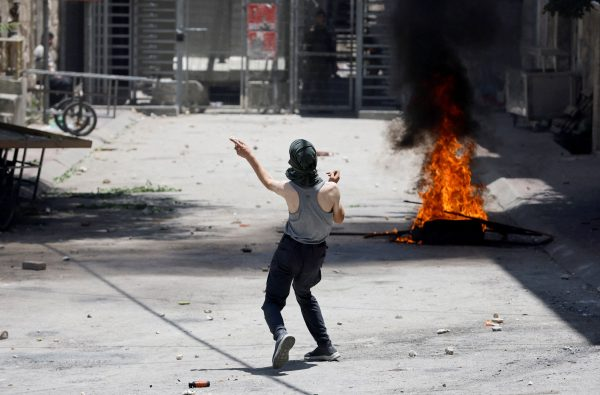
Jenin is not just a city in the occupied West Bank. Including a large refugee camp, it is home to people who have been denied the right to a homeland twice. The first time was when they left their ancestral homes in 1948, in the days of the Nakba, the “catastrophe”, that is, the mass expulsion of Arabs from the area that formed the state of Israel. And a second time from Israel’s systematic refusal to take any step in the direction of the Palestinians obtaining their own state, undermining and effectively abolishing the Oslo agreements.
And things are made even worse by the current far-right government of Benjamin Netanyahu. And the reason is that we now have a government where its officials explicitly say that there can never be any version of a Palestinian state.
The Israeli version of the “one state solution”
Traditionally the debate over the alternatives to the Palestinian issue has been described as a choice between a ‘one-state solution’ and a ‘two-state solution’. The “two-state solution” is the one that was foreseen by the UN as early as 1948, that is, to create two states, one Jewish and one Arab, in historical Palestine, in the area from the Jordan to the sea. This solution is still recognized by the UN resolutions and the Oslo agreements are supposed to have come to this. Essentially, the Palestinian Authority was created as a forerunner of the state and as a transitional political form.
Rather, the “one-state solution” was the historical position of the Palestinian movement, as a proposal for a democratic Palestine in which Jews and Arabs would coexist, which it abandoned like the PLO, the Palestine Liberation Organization, when it accepted the prospect two states. This traditional position remained a point of reference for the Palestinian left and the most radical anti-Zionist Jews.
However, now another version of “one state” is explicitly emerging, which comes from the Israeli extreme right. A typical example is the placement of Bezalel Smotrich, one of the leaders of the Religious Zionist party, which is part of the government coalition, and a minister in the Netanyahu government.

Smotrich argues that it is impossible for Israel as a Jewish State and the Palestinian national demand to coexist, as the demand for a Palestinian state itself undermines the Zionist vision as the demand for an Arab state in Judea and Samaria cannot be accepted ( i.e. the occupied West Bank of the Jordan).
Consequently, for Israeli far-rights like Smotrich, the only solution is for Israel to effectively annex the West Bank, cancel any self-government the Palestinian Authority has, and offer the Palestinians two options: whoever wants to stay as a citizen of the Jewish state; although without voting rights in the Knesset in the first phase only with the right to elect municipal lords. Anyone who doesn’t want to will be helped to immigrate to any Arab state they want.
These views gain particular weight if we consider that we are talking about Israel’s current finance minister, who has been entrusted with many of the administrative tasks concerning the occupied West Bank. Furthermore, we are talking about someone whose home is in an illegal West Bank settlement area and has often been accused of hate speech against Israel’s Arab citizens
This view may sound extreme, but we must not forget that Netanyahu in the recent past has declared as his goal the annexation of the Jordan Valley, i.e. a part of the occupied West Bank.
The continuing deterioration of the situation in the West Bank
It is no coincidence that many describe the situation in the West Bank as a peculiar apartheid regime. The analogy with the South African regime was precisely the formation of a condition where an entire population is de facto considered to have fewer rights and can only exist as a second-class citizen under a condition of oppression and over-exploitation.
This is done in a number of ways. First of all there are the settlements themselves. Since 1967 it has built over 130 settlements and helped build another 140 off-plan facilities. A total of over 700,000 Israeli settlers live in the West Bank, of which 230,000 live in East Jerusalem.
Settlements not only take away a significant portion of the land that was supposed to be intended for the Palestinian state, but also fragment the West Bank itself. Add to this the additional fragmentation brought by the road axes that connect the settlements to each other and to Israel, but also all kinds of fences that are being erected. At the same time undermining any potential for dynamic local economic development, what remains for many Palestinians is to be employed as cheap labor on the other side.
And there doesn’t seem to be any horizon for the situation to improve as settlements continue and the grabbing of Palestinian homes or land continues.

A new more determined generation
All this situation is reasonable to cause reactions. Despite the paralyzing situation in the Palestinian Authority itself, a part of the new generation is looking for a way to resist. What makes the difference from the previous – second – Intifada, is that there is a young potential that seems ready to try dynamic forms of resistance and go to armed action.
This in turn forms a new concern on the Israeli side which is faced with new facts, as this forms a “threat” different from e.g. the Hamas rockets from Gaza, which are mainly taken over by the “Steel Dome”, Israel’s anti-aircraft system.
Against this the option is to escalate Israeli military operations inside the West Bank, including – for the first time in twenty years – airstrikes.
The management of political crisis through military operations
All this is not unrelated to the deep political crisis in Israel itself. The large and prolonged protests against the reform of the judicial system show precisely that Israeli society remains highly divided. Faced with this wave of backlash to his policy, it is no coincidence that Netanyahu is currently favoring aggressive military operations that not only suit the political positions of his government partners, but are also unlikely to provoke opposition reactions.
It is no coincidence that while there are large demonstrations against the government, almost nothing is heard in them about the problems from the ongoing settlement policy or from the new wave of military operations.
The constant impasse
It is clear that with these data there is no real prospect of negotiations. Israel is investing in its military power, the fragmentation of the Palestinian movement and the greatly diminished prestige of the Palestinian Authority. At the same time it tries to form as many “dones” as possible which cancel out any prospect of resolution.
And even if he avoids the formal annexation of the West Bank, mainly because the US would not now want such a gesture that would nullify plans for a rapprochement with the more conservative Arab powers, he is certainly taking steps in that direction.
In addition, it relies on upgraded relations it has with European countries, so that they do not take pro-Palestinian positions. The most notable example is perhaps Germany where a part of the Palestine solidarity movement (that which supports the need for boycotts, sanctions and divestment) is seen as almost anti-Semitic.
But it could be argued that at the same time and de facto it is also moving in the exact opposite direction. The combination between the worsening situation in the West Bank, the ongoing problems in Gaza and the pressure on the Arab-Palestinians of Israel somehow unites all the pieces of the Palestinians. The cancellation of the two-state solution increasingly highlights the issue of what will happen to the one state, which de facto exists from the Jordan to the sea. And in this potential state about half the population is not Jewish. And if one solution is the one sought by the Israeli extreme right and figures like Smotrich, the other is indeed to raise the question of one state in new terms as a democratic solution for the coexistence of Jews and Arabs.

