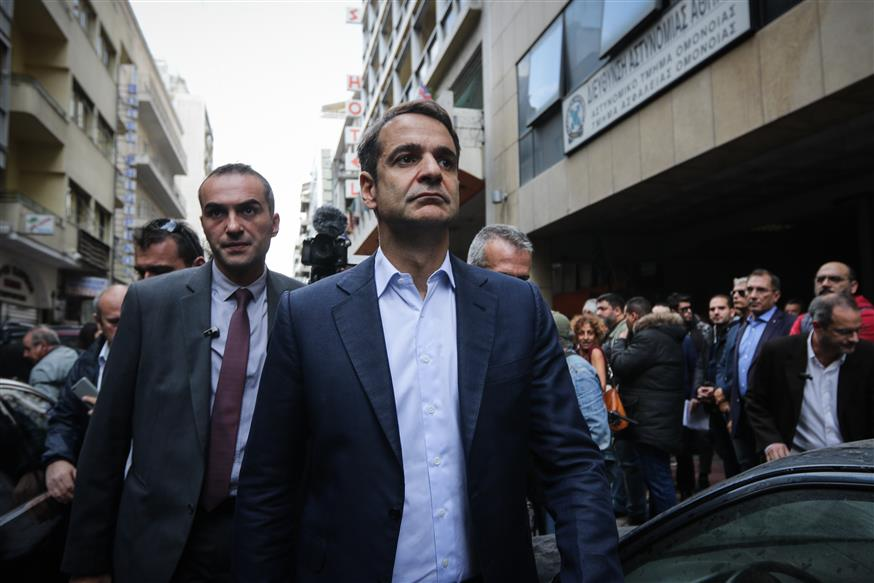
The Prime Minister of Greece, Kyriakos Mitsotakis, and his conservative New Democracy party, do not have one four-year term in front of them, but at least two. Their advantage is overwhelming against the opposition forces which are divided and face serious problems of strategy.
“Governor” Kyriakos Mitsotakis
With his triumphant victory, Mitsotakis achieved the goal he had publicly set for his transformation from prime minister to “governor”. This implies the strengthening of the presidential characteristics of the prime minister in a Parliamentary Democracy. He promoted it – informally – in the previous four years and it is certain that he will continue, strengthened, the same course.
In theory, the stability of the new government over a period of probably eight years offers better possibilities in dealing with chronic economic problems. We will see all this later and based on the choices of Mitsotakis. What we will see in the near future is the strengthening of key negative characteristics of power.
1. “Governor” Mitsotakis will turn the Prime Minister’s Office into an even stronger “presidential” power center away from democratic control. Remember bedbugs and self-interest during the energy crisis to see where this unchecked superpower can lead.
2. The Mitsotakis triumph is at the same time a triumph for his “family” despite the inevitable internal rivalries. Don’t be surprised if you see people trusted by the Prime Minister’s sister Mr. Bakoyannis being appointed as sovereign ministers and then people of Mitsotakis himself. It is also possible that the Prime Minister’s sister, Mr. Bakoyannis, will be made a minister in order to partly remove the family “injustice”, as well as the promotion of the son of the Prime Minister Mitsotakis to an important position of responsibility, after a passage from the office of the Spanish vice-president of the EPP in Brussels.
3. Greece will continue to have a huge and ineffective cabinet. During the administration of Prime Minister Antonis Samaras, there were 40 ministers and deputy ministers, a large figure for a small country. Under Prime Minister Alexis Tsipras they increased to 50 and during the first four years of Prime Minister Mitsotakis they reached 60 within the framework of the small and flexible staff state.
The pressure for a new increase in the number of ministers and deputy ministers is great. Mitsotakis wants to promote in his government modernizers who have no influence in society – such as Anna Diamantopoulou – to supposedly stabilize his dominance in the centrist political space. In essence, he is repaying the favors that the socialists gave him in the past. At the same time, he must support “his own from the party” but also send a message to his party that he covers – in general terms – also the ambitions of the parliamentarians and executives. So the most likely thing is that Greece will have another huge and inefficient government with significant additional costs and a new record of turnover.
Our refutation will be a pleasant surprise, but the related questions will be resolved within the next month.
The new Regime
The characteristics of the new government will be more regime-type than those of the previous Mitsotakis government. The government leadership showed its intentions in the previous four years and having the approval of the Greek people will move more quickly and decisively in the same direction.
After all, with the political dynamics that have developed and the great weakness of the opposition, it is not difficult to predict that the conservative party will again be the big winner of the local and regional self-government elections. This means that it will control all the “levers” of power at the central, regional and local level. As was seen in the parliamentary elections, the various sub-systems operate within the framework of a single whole and thus reinforce interventions and messages.
It is understood that the government will have the support of the more powerful media whose owners appear to be extremely satisfied with the various benefits and facilities and as a rule limit their critical mood in their relations with each other.
In addition to the 90% control of the media, the political control of justice, the systematic violations of the rule of law in order to promote political goals and maintain the suffocating control.
If we add to the above the constant support of big interests – energy oligarchs, banks, funds that manage bad loans amounting to 72 billion euros, large business groups that are subsidized and given loans with government signatures – we realize that the system of balances and checks that should characterize modern democracies has been disturbed. No one knows when and how we will return to a more balanced state.
Economic crash landing
One of the reasons for the impressive prevalence of Mitsotakis is the image of the efficient administrator who provides solutions to the problems of the economy.
This doesn’t come out of nowhere. The main characteristic of economic developments has been the explosion of spending in the context of dealing with Covid-19 and the energy crisis, but essentially with a complicated and clientelistic logic.
The destabilization that seemed to be coming in 2021 with the so-called twin deficits was averted in 2022. There was impressive growth in the economy due to the abundance of money provided, a drastic reduction in the budget deficit with a jump in consumption tax revenues and a reduction in public debt as a percentage of GDP. of GDP, aided by high inflation.
Thus, the government went to the elections with a favorable economic situation, a fact that strengthened Mitsotakis and the ND.
But behind this showcase of pre-election success we have the worsening of structural problems as shown by the multiplication of the current account deficit, in relation to the performance of the Tsipras government. “Helicopter” money cannot continue at the Greek and European level. The big interests have strengthened their position in the economy and its malfunctions, such as the high energy costs that undermine international competitiveness and the interest rate volatility that increases the operating costs, especially of small and medium enterprises. Greece holds the record in the eurozone for the spread between extremely high lending rates and near-zero deposit rates.
The strengthening of consumption, private and public with plenty of money, the return of the rhythm to the levels of 2019 and the fever of the real estate create for many a sense of satisfaction and expectations.
In our opinion, however, a hard economic landing is coming due to the combination of the structural problems of the economy and negative international developments.
Greek society in social, political and economic “degradation”
The list of problems is endless:
- Demographic decline with deaths now exceeding births by 40,000 – 50,000 per year.
- Abandonment of entire regions by their populations, some of which are considered of strategic importance.
- Substantial dismantling of the already problematic National Health System and record deaths from the pandemic per million inhabitants, in western southern Europe.
- Continued degradation of education and prolongation of the brain drain that limits the potential of the Greek economy.
- Worsening of all statistics related to risk of poverty and social exclusion:
- Inequality of income and wealth,
- High degree of difficulty of the new generation in terms of professional and family start-up.
According to the narrative that has been imposed, none of this matters much as long as certain key economic indicators are doing well even when doped up with plenty of public money.
It is about the great fallacy of the system of power and also of those who trust it with their vote. We believe that there is a risk that the social situation will get out of control and that those who are currently sleepwalking towards a generalized social crisis will be faced with an unprecedented bill in the coming years.