



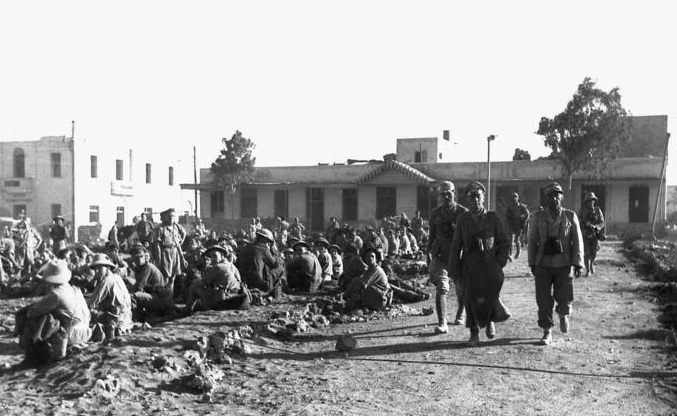
The small coastal city of Tobruk in eastern Libya gained great strategic importance during the battle for the desert in World War II. Originally under Italian command, it was captured by the British Army (Western Desert Force) in January 1941, who knew its importance as the only deep harbor in the area that could accommodate large merchant ships.
Upon his arrival in Africa, German Field Marshal Rommel immediately realized two things: that desert warfare was fundamentally a motorized force, and that having supply stations to operate voraciously on armored resources was the key to success.
His first surprise attack at the end of March, he reached near Tobruk and pressed towards it but failed to capture it. Thus began the first siege of Tobruk, which lasted almost eight months, but the Australian soldiers, described by German propaganda as “trapped mice”, held their ground by digging deep shelters in the rocks around the heavily bombed city. Together they kept the nickname “Tobruk mice”.
In November, the British Operation Crusader managed to reunite with the Tobruk garrison. But in May 1942, the Axis leadership decided on a broad operation in North Africa to invade Egypt and capture Suez.
Two essential moves in this direction were the capture of Tobruk and Malta. The first would provide Rommel with the supply port he needed and the second would definitively eliminate the “abscess” of Malta. From where British ships and aircraft sank much of the German and Italian convoys, filled with valuable supplies.

On June 14, Rommel launched his attack, pushing back the advanced British units, and three days later he began to press hard on Tobruk. The latter was defended by an Indian brigade, a tank brigade (the British still distinguished tanks into infantry and cavalry) and support units. Although the Allies were well entrenched, the German-Italian general attack of 20 June had it all: heavy artillery barrage, sniper infiltrations, tank advances and heavy air cover.
The need to finish Tobruk immediately in order to concentrate on Malta in the coming days made the German staffs particularly burdensome. By the end of the day, 132 German and Italian tanks had broken through the British perimeters and were pouring into the city. The British forces prepared for a coordinated withdrawal to El Alamein, but in the morning hours General Hendrik Klopper of the 2nd South African Infantry Division decided that the effort, which would have many casualties, was not worth the effort and surrendered with the entire garrison. Some 35,000 British, Indians and South Africans are captured, some without even firing a rifle.
At 05:00 Rommel will enter the town square and set up his headquarters at the Hotel Tobruk. For his success he will be promoted to field marshal, the youngest German general to attain the rank. For the British it was a great blow, not only strategically, since the African Armored Army was gaining the foothold it needed to knock on the gates of Egypt, but also because it was another dishonorable surrender, after that of Singapore.

