




Russia will remain an adversary for the foreseeable future and is likely to continue to rearm and rebuild large-scale conventional forces once the fighting in Ukraine stops. To counter this, a combination of dispersion and ground-based air defense will be required. The optimal mix will vary depending on each Air Force’s current configuration, equipment, and resources.
Most people believe that all European countries have fighter jets. You will see in the following analysis that nothing is ever that simple, and especially that the very definition of fighter aviation is complex.
First we need to define what we mean by Europe! To put it simply, we will only consider countries that are geographically in Europe or institutionally, i.e. belong to the European Union. Two countries can then create problems because they straddle Europe and Asia: Russia and Turkey. If the former will be addressed and not the latter, it is because Moscow is geographically a European capital while Ankara in the same sense, is an Asian capital.
Separation by tier
Tier 1: European countries without an aerial component: Andorra, Kosovo, Liechtenstein, Monaco, San Marino and Vatican City. Notably, five of them are also completely landlocked states.
Tier 2: European countries with an air component but without fighters and/or ground attack aircraft such as Agusta-Bell AB-205, Eurocopter AS.532 Cougar: Albania, Bosnia-Herzegovina, Cyprus Ireland, Latvia Luxembourg North Macedonia, Moldova Montenegro, Slovakia and Slovenia
Tier 3: European countries with ground attack aircraft but no fighter: Note that no European country reaches tier 3.
Tier 4: European countries with fighter aircraft, including fighter jets and ground attack aircraft: Bulgaria ( Mikoyan MiG-29A Fulcrum , Sukhoi Su-25K Frogfoot ), Croatia ( Mikoyan-Gurevitch MiG-21Bis Fishbed ) and Ukraine ( Mikoyan MiG-29A Fulcrum, Sukhoi Su-24 Fencer).
Tier 5: European countries with multi-role combat aircraft such as Eurofighter EF-2000 Typhoon, Dassault Aviation Rafale, General Dynamics F-16C/D Fighting Falcon, Saab JAS 39C/D Gripen, Mikoyan MiG-31 Foxhound and Sukhoi Su-35 Flanker : Germany, Austria, Belgium, Belarus, Spain, Finland, France, Greece, Hungary, Poland, Portugal, Romania, Russia, Serbia, Sweden, Switzerland and Czech Republic.
Tier 6: European countries with stealth multi-role combat aircraft – the Lockheed-Martin F-35A Lightning II stands out: Norway, the Netherlands and and the United Kingdom.
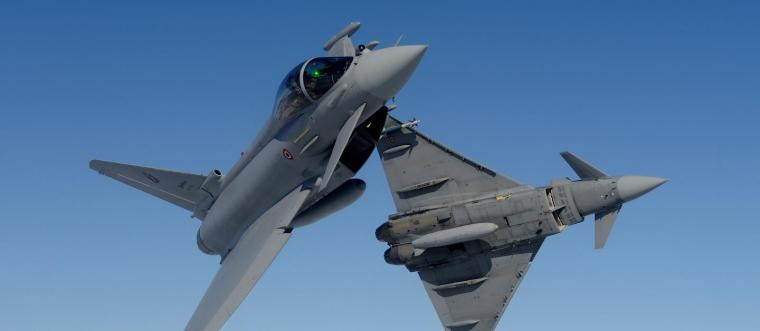
You will inevitably have noticed that the Dassault Aviation Rafale and Lockheed-Martin F-35A/B Lightning II have significantly changed the European aviation landscape. Proof is Croatia which will soon go from level 4 to level 5. Then there is a real gap between the nations in levels 1 and 2 and those in levels 4, 5 and 6. It must be seen that at the moment some European countries are at levels lower than what they should be aiming for, due to their solidarity with Ukraine.
With a Rafale Squadron, with 84 F-16 block 52+, the “backbone” of the Hellenic Air Force, modernized in Viper configuration, Greece gains a serious advantage and is an irreplaceable operational arm against any threat that may face the NATO at the European level.
It should be mentioned that, Greece will acquire super weapons with the completion of the purchase of the French Rafale, the modernization of the F-16 and the future purchase of F-35 fighters.
From the above, it is understood that some nations have supplied attack aircraft and fighters to Ukraine which is at war with Russia. A Russia that would have been ranked Tier 6 if it had been able to prove that the Sukhoi Su-57 Felon is combat-worthy and currently operational…But it always fails.

