In military helicopters, there is behind them a whole construction philosophy, with special requirements and specifications, which aims at significant resistance on the battlefield and thus at their survival. Here, however, it is important to see exactly what military helicopter means and what its differences are with civil and “militarized” helicopters respectively.
We certainly do not forget that on February 24, 2022 -unfortunately- the large-scale war, after almost 80 years of peace, came again to Europe. Since then we have seen many photos and videos of dozens of helicopter losses, mostly Russian. Highlighting again the absolute need for helicopters used in the Armed Forces and having a combat mission, to incorporate very special features. So let’s examine what “military helicopter technology” means by comparing some of the specifications for civilian versus military helicopters.
Military specifications (MIL-STD) require high resistance to impacts of specific calibers, resistance to much higher accelerations, special safety and invulnerability features, greater resistance to heavy landings, special locations for the fuel tanks and of course stricter tests. So developing a military helicopter is a very demanding business and requires experience from numerous operations in different theaters around the globe. Here the design based on the “form follows function” principle must prevail. Here are some examples:
- The requirements for separation of engines (with shielding, so that the destruction of one does not affect the other), flight controls, and fuel and hydraulic circuits (so that they are not all lost in the same blow) are significant, imposing and a particular, more flattened form in their group (as they are further apart). We see this e.g. and on the UH-60 and NH90.
- The need for resistance to gunshots leads to high strength robust structures armored with titanium and special aluminum alloys.
- The structure is reinforced as it has to ensure robustness but also flexibility in deformation.
- The requirements for high resistance to falling to the ground or impacting obstacles, lead to specialized solutions of vessel structure, rotors, fuselages and dynamic components.
- Special anti-corrosion treatments are applied to the surfaces of the structural elements, to free them from the obligation of continuous inspections for rust. This dramatically increases availability without ongoing costly maintenance.
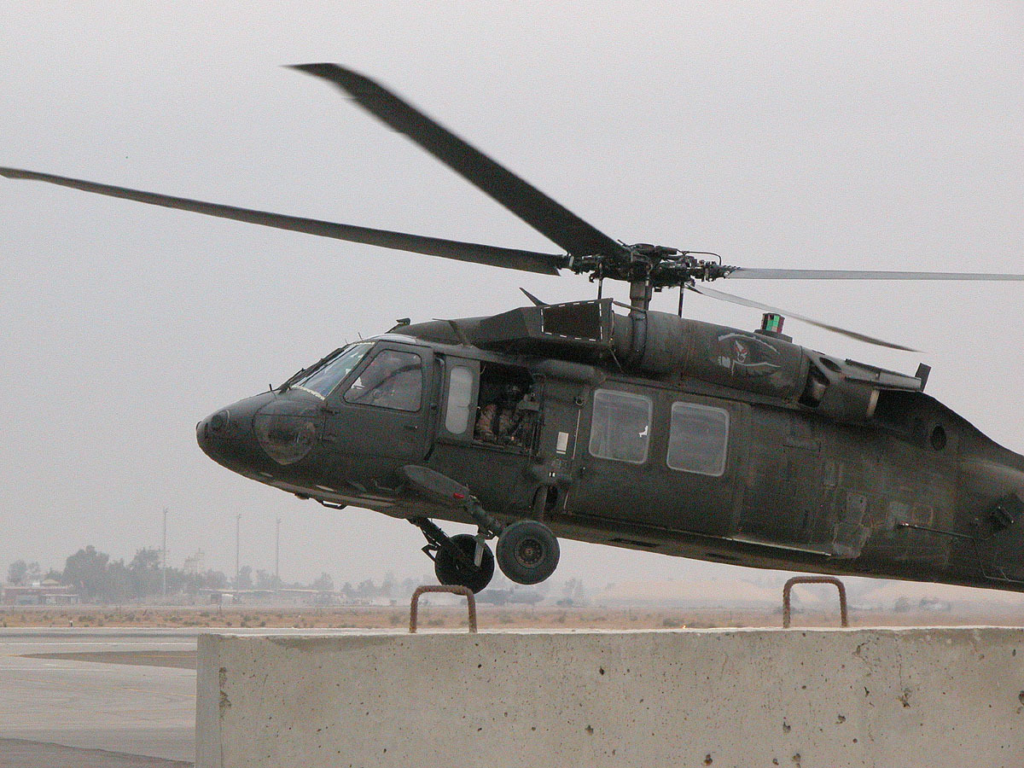
- The rotor control systems must be dual and fail safe (ie the failure of one does not affect the others).
- Suspended components (transmission, rotor mounts, engines, landing gear) must be durable, but must not enter the cabin space even in the heaviest landing or drop.
- Fuel must not be stored under the feet of passengers to prevent it from igniting in a crash landing.
- The windshield must withstand a large bird impact without collapsing.
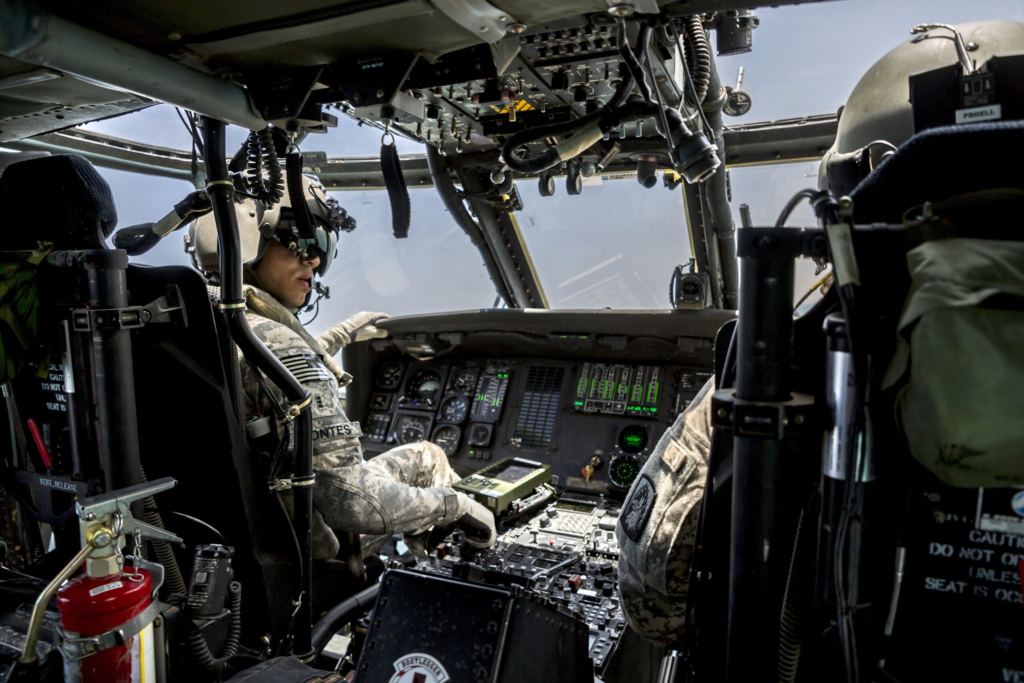
- The active vibration control system is mandatory to protect electronic devices – such as those specialized for combat missions – and to avoid strain on passengers.
- Before installation of any type of machine gun (cabin or attached to the boat) a special long-term check for possible cracks in the structure of the helicopter from the shock of recoil must be done. All of the above and many more complex or detailed must be predicted and tested in the field and be able to be corrected in a reasonable time so that there are no hot spots. The so-called “diseases” of each type of helicopter.
Still, the design must have high safety factors at every point and at the same time allow easy and quick redesign of subsystems and components without problems in the structure or the dynamic accessories and above all without changing the flying characteristics of the helicopter. In this way the vessel remains modern and technologically advanced since it allows for its upgrade, but above all safe and easy to live with its users for a long time.
The main conclusion is that military specifications must be built into the helicopter from the very beginning of its design. Today in production in NATO countries there are only five types of strictly military helicopters: AH-64, CH-47, CH-53, UH-60 and NH90. Of course, one can make interventions and upgrades to give extra endurance and capabilities to a civil helicopter, thus achieving its “militarization”, but it is not fully “military”. And it’s different to throw a helicopter into the heat of all-out combat than to use it primarily as a transport, for reconnaissance, for support missions, or in low-medium intensity fields.
During the Vietnam War, US forces used helicopters extensively to transport troops and equipment to the front lines. From the Army’s First Cavalry Division and the 101st Airborne Division, to Marine Corps units, everyone boarded them, mostly in UH-1s. While special forces groups used them to penetrate deep into hostile territories such as Laos or Cambodia.
Unfortunately, this massive use came at a high human cost: of the 11,827 helicopters deployed in Vietnam, 5,086 were shot down or crashed in combat – with more than 2,700 soldiers and crew killed in UH-1 downs or accidents alone. So the UH-60, the successor to the UH-1 (began to replace it since the 1980s), was created as a result of the lessons learned from the Vietnam War. As the conflict in Southeast Asia highlighted the effectiveness of helicopters in modern warfare, it also highlighted their high vulnerability.
So the Black Hawk was designed from scratch, with new specifications. The same thing happened with the replacement of the AH-1 Cobra attack helicopter, the AH-64. Thus were created the two almost “century-old” helicopters of the American Army, the AH-64 Apache & UH-60 Black Hawk (the CH-47 predates the Vietnam era).
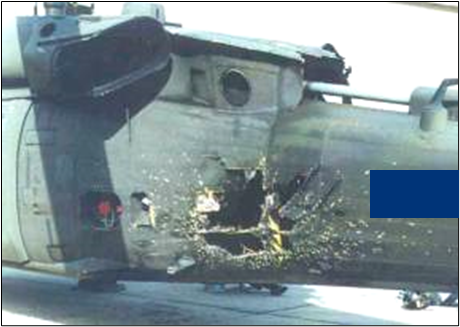
The adjacent photo is typical of what a combat helicopter means. This particular UH-60A has taken a heavy hit, but the incident has ended at its base, as the helicopter has arrived there. The following photos show the same incident. Importantly, the axis that transmits motion to the caudal helix remained intact and functional. This is what allowed the helicopter, albeit battered, to return. The fact that this particular one was repaired and returned to service (thanks to the design allowing for such extensive repairs) is beside the point. The important thing is that no member was lost and it was not shot down. Let’s look at a worse case scenario:
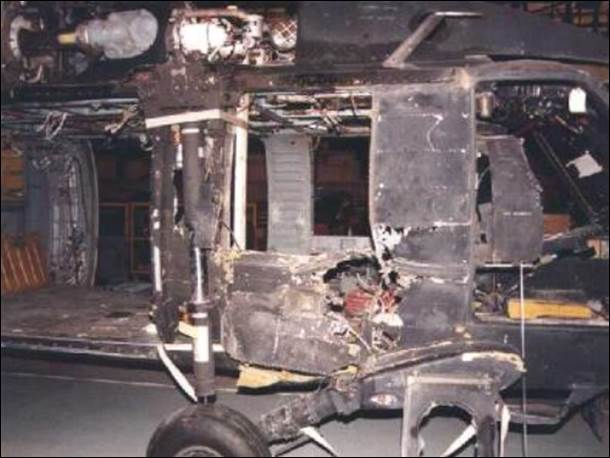
The above helicopter was seen in the well-known incident in Somalia in 1993 (Battle of Mogadishu), one of the most difficult situations combat helicopters have ever found. In it two Black Hawks were shot down by RPGs, as the poorly planned mission forced them to fly for a long time at very low altitude in broad daylight, almost hovering, over the city of Mogadishu, in an area full of enemy militia members who continuously fired at their. Yet another, also hit by an RPG, managed to return, rescuing the crew. His condition is obvious.
We’re focusing on the spindle fins, as shown above. Here you can see the construction reinforcements of the cabin, so that in the event of an impact, structural failure is prevented. Of course, “miraculous” structure and construction does not exist in any helicopter or aircraft, but the military specifications offer the greatest possible chance of rescue and survival. And in Mogadishu, where there were survivors in the downed helicopters, this was evident despite the destruction. Of course, the durability is not only for hits from enemy weapons, but also from various flight safety incidents, which, if nothing else, should be handled as best as possible.
We hope that with the above the differences between the military, civilian and “militarized” helicopter have been understood.