As the Earth’s population rises, the phenomenon of climate change has deteriorated due to the overconsumption of goods and mainly consumer products from industrial and technologically advanced countries. Developed and emerging economies have been reinforcing their annual overall production and productivity rather than theιρ occasional declining fluctuations in GDP and economic activity.
As a result, the effects on the environment (soil, sea, air) and the εarth’s climate are deteriorating. The overpopulation of the earth needs more and more basic nutritional goods and products to be consumed. The agricultural sector in most countries and continents of the planet is the feeder of this consumption and nourishment of the world’s population.
The only countries and generally the only continent that exhibits low agricultural productivity compared to the rest of the continents are the African countries and Africa in general.
by Thanos S. Chonthrogiannis
It is prohibited by intellectual property law or in any way illegal use of this article, with heavy civil and criminal penalties for the offender.
The reasons for the delay of the African Green Revolution

Photo by USAID Africa Bureau
https://en.wikipedia.org/wiki/Public_domain
This finding has nothing to do with the African farmers themselves and their undeniable hard work, but mainly with the fact that Africans farmers cannot afford to obtain fertilizers, and in particular they cannot obtain strong resistant to cultivation of seeds that protect their crops from diseases, drought and more generally from extreme environmental phenomena.
Only with these new types of resistant seeds in their possession are Africans farmers able to multiply the size of their crops independently of the diseases and weather and environmental conditions that can affect their production.
The key element, in addition to all others such as applying modern ways of cultivation, is the super-resistant seeds used in modern agricultural cultivation. It is a common activity that Africans growers retain seeds from their previous production to use in the cultivation of the next season.
But the real revolution in the size of their agricultural production will be achieved when most African farmers use their hybrid seeds crops.
The low current levels of agricultural production in African countries
After the end of the Second World War (1939-1945) and in the 1960 the Green Revolution appeared with large quantities of agricultural production and after scientists first delivered to farmers resilient varieties of maize, wheat and rice created in laboratories.
Specifically, the Green Revolution was first achieved with the cultivation of the hybrid maize, then with the high-performance “semi-dwarf wheat”, and then with the high performance «short statured rice” cultivars and later with the cultivation of sorghum and alfalfa.
From this and only fact the agricultural production was launched both in Asia and in Latin America, thus making farmers economically self-sufficient and the populations able to solve the problem of hunger and starvation.
Unfortunately, however, even today the Green Revolution has not reached Africa and it does not allow both African farmers and their countries to multiply their production and reach production levels that had reached the decade of 1960 Asia and Latin America.
Figure 1 shows the production in thousands of tons per year in wheat and in two other basic agricultural products highly necessary for the nourishment of the population such as rice (Figure 2) and other coarse grains (Figure 3) by examining the period 2010-2018 (Data source: OECD-FAO). In these Figures we observe comparing the production of the World’s most developed economy USA, with the EU, China and the countries of Sub-Saharan Africa.
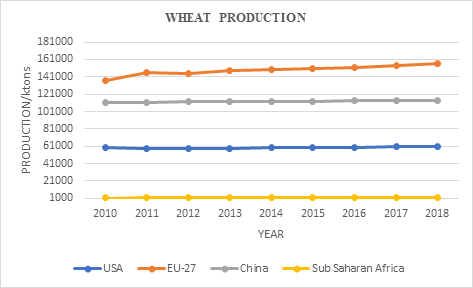
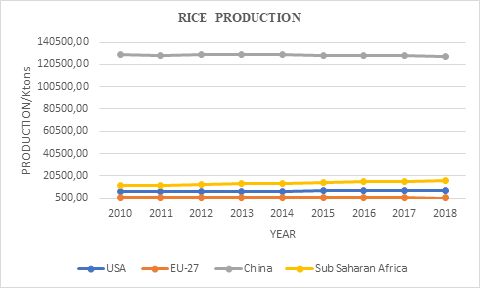
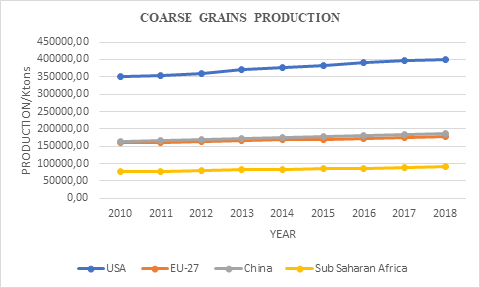
We are seeing from the above that the Sub-Saharan African countries such as Kenya, Uganda, Chad, the Republic of Congo, Nigeria etc. that only in the rice production outweigh the US and the EU and since these two countries (US and EU) use the rice as a key import product from China in order to export their other products to China.
In the production of wheat and other coarse grains the Sub-Saharan African countries have very little production from the other countries concerned.
The reasons for low level of agricultural production on the African continent
Certainly, the hybrid seeds are very expensive to obtain from most African farmers when they are very difficult to obtain from the poorest African states of countries such as Chad, Uganda etc. On the other hand, Kenya can use hybrid seeds but fails to increase its production.
Of course, due to the different and extreme environmental conditions that vary from region to region even within the same country, there should be specialized hybrid seeds per crop that consider both the arable land and climatic conditions.
In general, it has been found that high-yielding seeds in several African countries do not always perform and this is mainly due to moving many batches of fake hybrid seeds in the markets of African countries.
In the Graphs below we can observe the total yield of the land measured in tons per hectare of arable land in the basic agricultural products such as wheat, maize, rice and other coarse grains in the aforementioned countries (USA, EU, China) and the African continent as a whole.
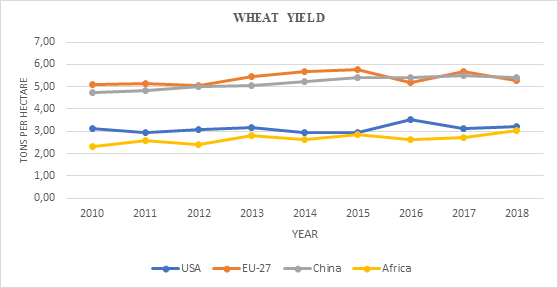
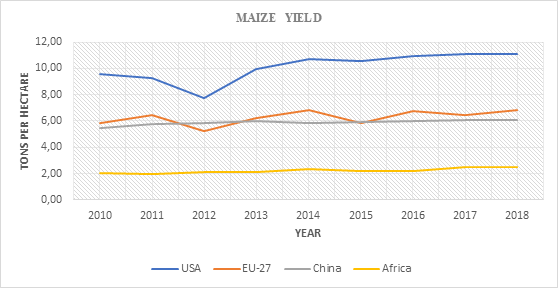
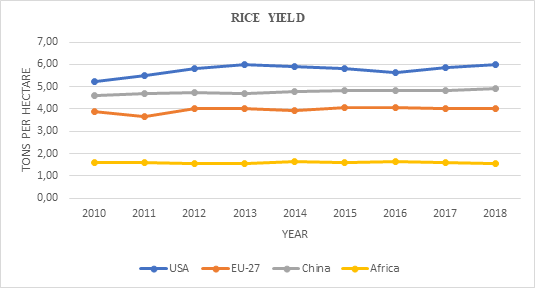
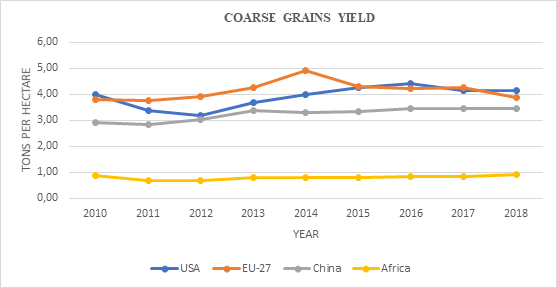
So, we observe in above Graphs 1, 2, 3, 4 that yields-production of crops per hectare of land for both wheat but mainly for maize, rice and coarse grains on the African continent fall largely short from other countries. This is mainly due to the non-usability of modern hybrid seeds by most African farmers in their crops.
At the same time, however, we can also see the potential of agricultural production in Africa if these modern hybrid seeds are used in their crops.
Solutions for African farmers and African countries
To learn, however, an African farmer to distinguish and understand whether the cultivated seeds he buys are hybrid seeds or not and for which the appropriate seeds are for the area in which he cultivates he will need education, training but most importantly, he will need the state of his country to direct him.
But the fact that many African states do not have the resources to buy such seeds in order to create a domestic modern seeds market demonstrates that other strategies should be implemented.
In particular, the African Union should act and agree on uniform structures and institutions that allow a huge market for rural cultivation to be created.
1. The aim should be to avoid monopoly situations in the entire African hybrid seeds market.
2. The African Union should create a joint fund that will finance the entire hybrid seeds market. Each African state will contribute according to its GDP to this fund and the size of the contribution will be as stable (e.g. 1.5% of annual GDP) for all the states of the Union.
3. They should be given low-interest rates/subsidized interest rate loans to the farmers to buy hybrid seeds and fertilizers in order to choose the crop they want to cultivate. The repayment of the loan should commence after three years and have a minimum of twelve years repayment period.
4. For every arable land in Africa, an agronomic study should show what potential the arable land has and what are the best and most efficient types of crops per arable land, facilitating the farmer to make his own choice.
5. It should be agreed a common for all time frame for seed sale approval throughout Africa.
6. Improvement of the process of time approval for the sale of seeds with this time to reach twelve months maximum.
7. The governments of African countries should not buy seeds and then distribute them to their farmers.
8. Full liberalisation of the seed market by allowing genetically modified crops, and since they have been used in other countries such as USA, China etc.
In this way a common rural African market with the dynamics of its 1billion people-citizens will attract all the companies of the world in the agricultural sector by creating this free market all the conditions of competition that will keep the prices to the hybrid seeds at low levels.