Self-employment is higher for men than women in the European Union, with the gap widening in older age groups.
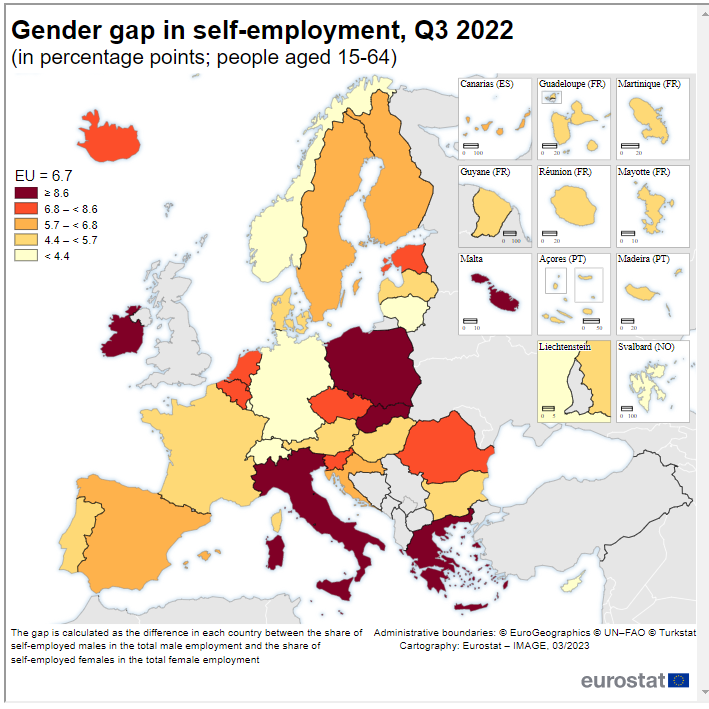
In fact, Greece is the EU country in which the largest difference between men and women is recorded as a percentage of self-employed among the total number of employees. The above results from Eurostat data according to which in the third quarter of 2022, 16.1% of employed men were self-employed compared to 9.4% of women.
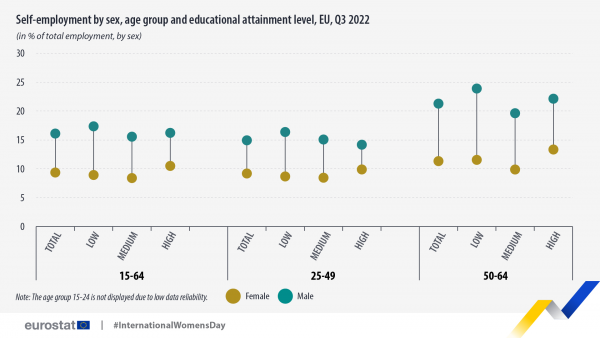
Over the same period, the self-employed gender gap in 15-64 year olds was largest among workers with a low level of education (8.4 percentage points), followed by those with a medium level of education (7.2 points) or high level of education (5.8 percentage points);
This gap between self-employed men and women widened with age, with a gap of 5.7 percentage points among 25-49 year olds, rising to 9.9 percentage points for 50-64 year olds.
Also, 21.3% of working men aged 50-64 were self-employed compared to 14.9% of men aged 25-49. Among working women aged 50-64, 11.3% were self-employed, compared to 9.2% for women aged 25-49.
Based on educational attainment, the gender gap for the self-employed was largest (12.4 percentage points) in the low-educated 50-64 age group, where 23.9% of employed men were self-employed compared to 11.5% of the women.
The difference in self-employment rates between the two sexes was smaller in the highly educated 25-49 age group (4.3 percentage points): 14.2% of employed men were self-employed, compared to 9.9% of women.
The biggest gap in Greece
At country level, the largest gender gaps in self-employment in the third quarter of 2022 were recorded in Greece (12.2 percentage points), Slovakia (11.3 percentage points) and Malta (10.6 percentage points), all with values above 10 percentage points.
Conversely, the smallest differences were recorded in Cyprus (1.4 percentage points), Luxembourg (2.2 percentage points) and Lithuania (3.7 percentage points).