


The first amphibious operation by US Marines takes place during the Battle of Nassau in the American Revolution. The US was not yet a state, and the marines were a battalion-level unit, established in November 1775 for the planned invasion of Nova Scotia, but the landing there of strong British and Hessian (German mercenary) forces canceled the plans .
The marines were a group that neither General Washington wished to incorporate into the army nor the small rebel navy could absorb. Many wanted to see this “experiment” ended and the men divided between the army and navy who needed riflemen and sailors respectively. However, in February 1776 the opportunity presented itself that would save the future Marine Corps.
Starting the war against the British, General Washington asked Congress for 400 barrels of gunpowder. Instead he received not even 40. With each of his soldiers having a maximum of 20 cartridges at their disposal, he had to find gunpowder immediately. Someone on his staff noticed that on the nearby island of New Providence, in the British Bahamas, there was a sufficient quantity.
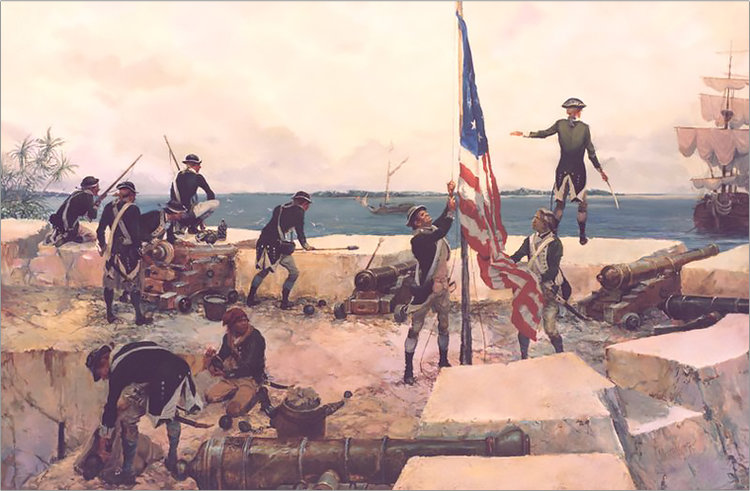
Thus, on February 17, six light American ships sailed to occupy the gunpowder storehouse of the fortress city of Nassau, the capital of the island. After an unsuccessful action on March 1, the rebels, at the suggestion of Captain John Paul Jones, landed at night on an unguarded coast and after entering the Montagu fort “liberating” about 160 barrels of gunpowder, advanced the next day to the town, which they took by surprise. In this way, the 210 marines with the help of rebel sailors “drained” the silicon stores of Nassau (and the cellar of the captain, if we believe his claims) achieving the first successful mission of the corps.