



With the air campaign against Iraq underway since January 16, 1991, dismantling the air defense system and dismembering Iraqi units on the border, General Norman Schwarzkopf’s staff decided that the time had come to begin the ground operations of the First Gulf War.
The operation, originally named “Desert Sword” and later changed to “Desert Sabre”, envisaged the attack of two reinforced Army Corps from the Saudi-Iraqi border with the aim of destroying Iraqi forces and liberating Kuwait. The objectives of the campaign were clear, a result of pressure from top military leaders in the US – which constituted the main lever and strength of the Allied forces – to avoid “Vietnam”-style situations, where a nebulous objective would be adjusted by the situation, leading to endless war engagement. The purpose of the war remained the liberation of Kuwait and to strike a blow at Iraq that would deter it from future expansionist thoughts, not its total occupation and occupation or the overthrow of Saddam Hussein’s regime.

On 24 February, the XVIII Airborne Corps (82nd and 101st Airborne Divisions, 24th Motorized Infantry Division, 6th French Light Armored with support from the US 3rd Armored Cavalry Regiment and the 16th and 18th Army Aviation Brigades) and the VII Mechanized Corps (1st Motorized Infantry Division , 1st Armored Cavalry Division, 1st and 3rd Armored Divisions, British 1st Armored Division, supported by the 2nd Armored Cavalry Regiment and the 11th Army Air Brigade) moved on a 480 km front with one end in the tri-national Saudi-Iraqi- Kuwait and the other in the Iraqi desert to the west.
A further significant force consisting of motorized units from Saudi Arabia, Syria (9th TTHM) and Egypt (3rd M/F and 4th TTH Divisions) was deployed on the right flank of the two Corps, while on the Saudi-Kuwaiti border to their right , the 1st and 2nd US Marine Divisions were deployed with the support of the 1st Armored Brigade/2nd Marine Expeditionary Force (I Marine Expeditionary Force) and an allied Arab force (with troops from Saudi Arabia, Oman, UAE with the core of the Saudi 10th Motorized Brigade).

In a classic move of combined air-ground motorized operations, the allied forces penetrated deep into enemy territory avoiding zones where the Iraqis had organized themselves defensively, leaving them to the “care” of the artillery and air force. The left wing forces made a massive overrun, isolating the Iraqi reserve forces to face the Iraqi motorized strategic reserves and the Republican Guard. At the same time, airborne forces with 300 helicopters were deep in Iraqi territory establishing the advanced base ‘Cobra’.
Then with the help of light motorized forces and air assets, they put the central Iraqi retreat routes under constant fire, decimating them and denying any enemy communication and redeployment. At the same time, Marine forces and allied Arab forces were entering Kuwait from the south, driving out the Iraqi occupation forces. British and American forces, having completed the small part of the encirclement, would soon enter Kuwait from the north to assist in this task.
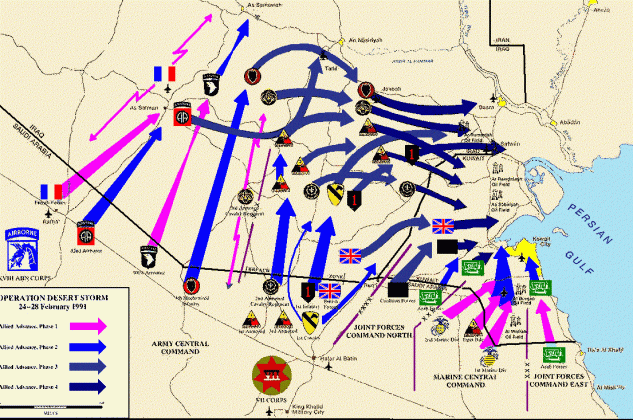
The operation lasted approximately 100 hours and was a lesson in the use of motorized forces in cooperation with air support forces. Of course, the air campaign that had preceded it contributed greatly to the destruction of the air defense and communications network between the Iraqi units, but again the armored forces of the Alliance did not walk in any case and in several cases had to fight hard (battles 73 Easting, Al Busayyah, Phase Line Bullet, Norfolk, Medina Ridge, Kuwait International Airport, Rumaila). While the VII M/K Corps alone was responsible for the destruction of 12 Iraqi divisions, 1,300 tanks, 1,200 armored vehicles, 285 artillery pieces and 100 anti-aircraft systems, and the capture of 22,000 enemy soldiers.
From the moment the so-called “Schwarzkopf maneuver” was completed, the backbone of the Iraqi forces was broken and the Iraqi soldiers, cut off for days, frozen, without food and under psychological pressure, began to surrender en masse. On February 28, President Bush, considering the objectives of the campaign achieved, announced the armistice. The once mighty Iraqi army, crushed, was allowed to retreat inland while Saddam Hussein’s regime would face a series of internal turmoil and rebellions.
The Allies were delighted. All the ominous predictions circulating about the campaign had been disproved and the new weapons and tactics of the American Forces proved invincible. The unrest inside Iraq was seen as enough to topple the dictator Hussein – once an ally of the West in the battle for dominance in the Middle East – or at least keep him busy so that he would not again pose a security risk in the region.
The weapons of war (Patriot missiles, M-1 Abrams tanks, MLRS rocket launchers, Apache helicopters, smart bombs, F-15 and F-16 fighters) will become extremely popular among allies and friends. As for Iraq, Saddam Hussein’s regime will manage to survive with its northern and southern borders sealed off in demilitarized No-Fly Zones for another 12 years, until the next war.

