

Joe Biden was the only major Western leader who had not visited Kiev. This actually created a negative image, which counts even more given that the US has unceremoniously entered the election cycle set for the 2024 elections.
After all, the Republicans had already made negative references to the fact that Biden had not yet been on the territory of Ukraine to express in a direct way his solidarity and support for the government of Kiev.
In addition, Biden wanted to send a clear message ahead of Putin’s much-anticipated speech on Tuesday, February 21, to the Russian Duma, which will also mark the presentation of Russia’s targeting of the war beyond.
He thus chose the “bold” move of moving into a war zone, although there are indications that there was prior communication with the Russian side to avoid any action that would actually jeopardize his security.

In essence
But the subject of the image, of optics in the idiom of the American political economy was not the only one, nor the dominant one. Even if we stick to symbols, the US needed to send the message that it has not shifted in terms of its Ukrainian policy.
Let’s not forget that February 24 marks one year since Russia launched its “special military operation” against Ukraine. The war certainly did not develop as originally planned by the Kremlin who believed that an initial show of force, including the presence of large units near Kiev itself, would force the Ukrainian government into capitulation. But it did not develop into the crushing of Russia, which is supposed to be the request of the West, which in the meantime has provided a huge amount of military aid to Ukraine.
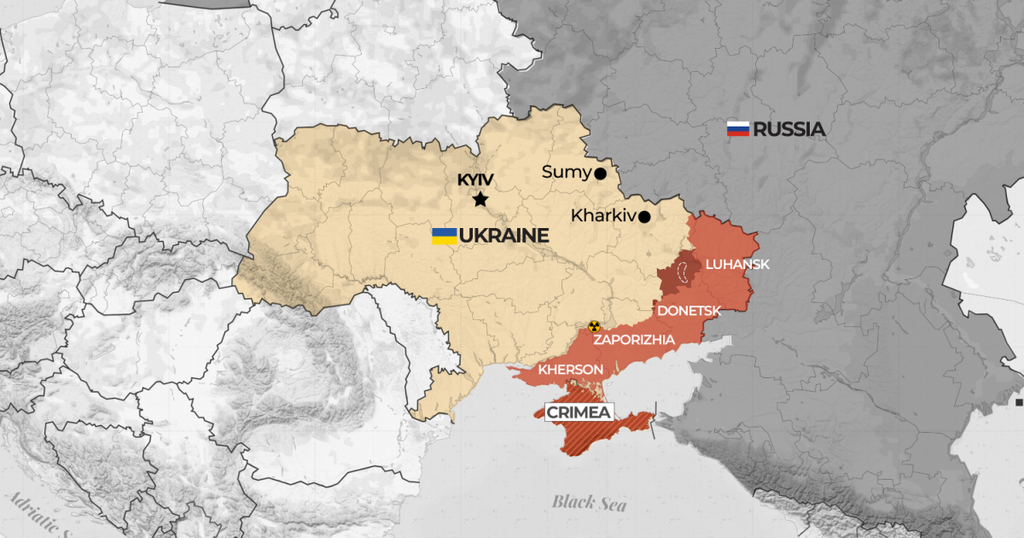
On the contrary, Russia has managed to expand the areas it controls and which it has formally incorporated into its territory and at the same time engages in a systematic war of attrition at the expense of Ukraine, at the same time that the Ukrainian forces are also pursuing this at the expense of the Russians by unleashing thousands artillery shells every day.
At this turning point, the Ukrainian side has made it clear that the only way to prevent a major Russian counter-offensive (which would rely on the reinforcement of Russian forces from the partial mobilization that Moscow has undertaken) is to receive even more reinforcements in equipment from the west. This means the requirement for sophisticated heavy tanks, fighter jets and a large volume of ammunition.
The United States has already provided Ukraine with $27.5 billion in defense aid to Ukraine, while Congress has approved a total of $113 billion in aid (humanitarian, economic, and military), of which $6.6 was for fiscal year 2022 of the 37, 7 in fiscal year 2023 and the rest for the following years.
At the same time, the US has put a lot of pressure on its allies to provide significant military aid to Ukraine, with the most notable example being the pressure for both Germany and other countries to send Leopard heavy tanks.
In fact, President Biden, speaking in Kiev, underlined that in the next few days a new aid package of 500 million dollars will be sent, emphasizing that it will include ammunition, Javelin anti-tank missiles and self-propelled guns, thus also responding to the problem that has arisen with a possible shortage of ammunition for the Ukrainian Armed Forces.
However, President Zelensky himself has spoken of discussing with President Biden the deployment of longer-range missiles, which the US has so far avoided, as it would mean more direct targeting of Russian positions far behind the front lines, which would could be perceived as more direct aggression against Russia rather than simply strengthening Ukrainian defenses. We note that the British government has already stated that it will send longer-range weapons.

Where symbolism ends
But what remains to be seen is what Biden’s visit meant in relation to the big debate that has opened up in the West about whether and how there can be a peace process.
Officially, the position of the West is identical to the position of the Ukrainian government, which maintains that victory in this war means defeating the Russian forces and possibly relinquishing the territories they have occupied since 2014. However, regarding the second goal, it does not seem for there to be full agreement, as several Western governments have almost explicitly made it clear that they realize that recapturing Crimea is not possible.
This central line of Russia’s defeat and retreat at least as far as the 2014 “contact line” or even further back does not appear to have been explicitly revised. Ultimately, in the eyes of several American foreign policy planners, such a Russian defeat, which may be combined with a potential crisis of the power system around Putin, would lead to a more weakened Russia on the international stage, while nullifying and the possibility of a greater convergence with China (which increasingly appears to the US as the great threat).
However, around this center line questions have begun to arise as to how feasible it is. Russia may not have had the results it wanted in the first phase of the war, or it may not have been able to withstand some of the Ukrainian counterattacks at the weakest points on the front, but it has not collapsed either. Instead, he looks capable of making territorial gains if he tries new big offensive moves.
This means that the West’s response, if it is to prevent such an eventuality, will have to be to arm Ukraine with weapons systems and ammunition on a much larger scale than it does today.
But this now means a cost that is starting to put real pressure on Western governments, whether they admit it or not. The cost is primarily economic, but it is also political, because a prolonged war is a war that gradually begins to be unable to be justified and legalized as easily, especially when, let us not forget this, we are talking about a war that escalates uncontrollably increases the risk of using nuclear weapons.
And already, although the official rhetoric has not changed, various US allies have made it clear that how this war will end should be considered, while this question seems to be being discussed within the US itself. Already in the fall, Republican officials such as the current speaker of the House of Representatives, Kevin McCarthy, have emphasized that they disagree with a “blank check” rationale for supporting Ukraine.
Whether President Biden went to Kiev to open this discussion with President Zelensky, we do not know. But, entering the second year of the war, this discussion about a peace process will become even more urgent.