



The Corsican lion had in the early 1800s managed to dominate the European continent by moving his army in every direction and defeating his enemies in a series of decisive battles: in 1805 he defeated the Austrians at Ulm and later that year the Russians and Austrians at Austerlitz. In 1806 he crushed the Prussians successively at Jena-Auerstad, Pretzlau and Lübeck. In 1807 it was Russia’s turn again.
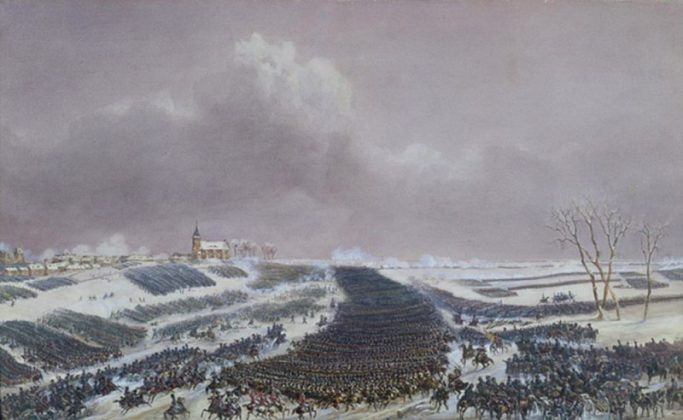
The Russian army moved into the area of East Prussia under the command of the German general Bennigsen (in the service of the Tsar). Maneuvering to cut him off, Napoleon found himself pursuing him eastwards until they met at the village of Aylau.
The battle was fought in winter and under a severe snowstorm, contrary to the customs of the time. The conflict was fierce. Losses on both sides amounted to 25-35 thousand men, although the actual numbers are impossible to confirm. Constant attacks and counter-attacks made the battle inconclusive. The stormy impetuosity of the French was offset by the Russians with almost superhuman discipline and stoicism.
At the end of the second day, Napoleon unleashed his cavalry by sweeping the Russian left with an advance of 10,700 cavalry under the dashing field marshal Myra. After this Bennigsen chose to retreat into the night, leaving Napoleon master of a bloody field. Napoleon’s “victory” had cost a lot, mainly in the field of impressions. Aylau was the first time that the French army under Napoleon himself failed to win a decisive result, “dazzling” the emperor’s star of invincibility.
For Bennigsen, there was a deafening disapproval of his unhooking, but it dissipated shortly after when Czar Alexander awarded him the Apostle Andrew medal – the most important decoration in Russia – and the message “you are destined to defeat the invincible”. , also giving him a sum of money annually. Ailau’s field remained a depressing sight that broke even the most hardened. Marshal Ney blurted out: “Quel massacre! Et sans résultat” (what a massacre! And without result).
The battle of Eylau in 1807 has a peculiarity
It is the first battle of the Napoleonic wars in which the French Imperial Guard actively participates and prevents the looming victory of the Russians, who in the first hours of the battle broke through the center of the French line…
On Napoleon’s order, the infantry units of the Guard (Grenadiers a pied….Chasseurs a pied) attack the Russians through the village cemetery and after a deadly hand-to-hand battle they manage to push the Russian infantry back to their original positions…saving me this attack the entire French line.
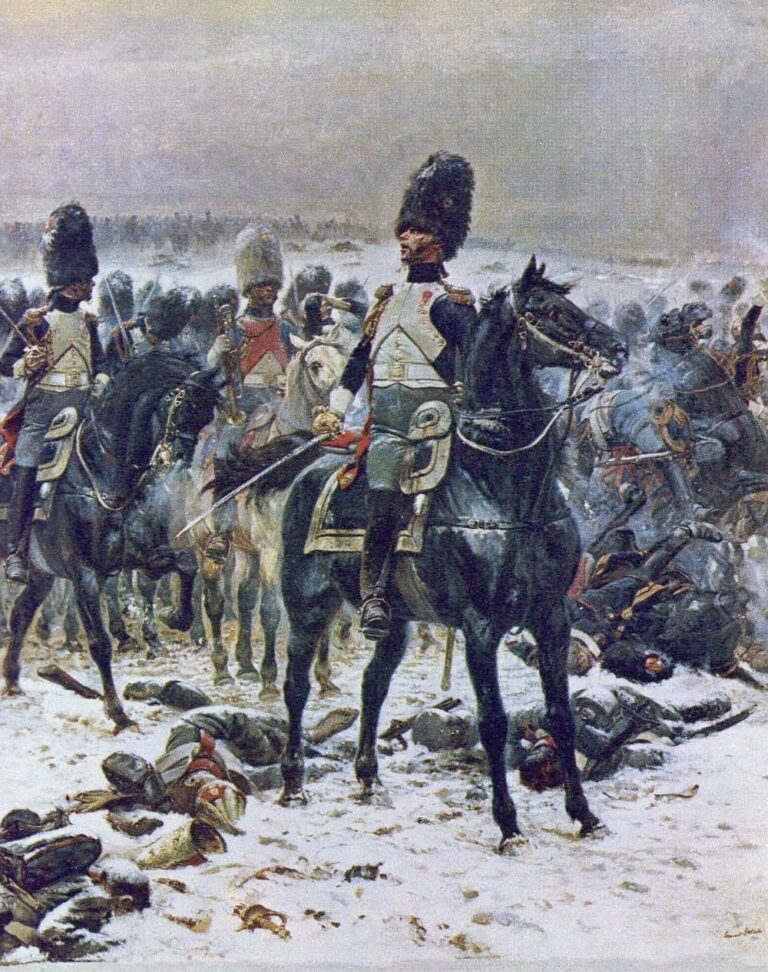
A little later, the cavalry of the Guard, the Grenadiers a cheval… (whose uniforms we see in the first photo of the article) were also involved, which it should be noted that they all had black horses, which were large to be able to “lift” the beastly built men of this unit.
The Eylau Cemetery massacre is not the only occasion on which Napoleon’s Imperial Guard engaged in hand-to-hand combat with the enemy.
The same will be repeated at the Battle of Waterloo in 1815, when the Young Guard with parts of the Old Guard will hold the Prussians for hours inside the cemetery of the village of Plancenoit, to the east of the battlefield.
Never before in the history of the Napoleonic wars did the Emperor endanger his precious Guards….luck had it that on both occasions the battles were fought in….cemeteries


