Part-time jobs in modern societies and economies give an employment exit to several citizens who cannot for personal, family and other reasons work in jobs with the full-time regime. It is a common occurrence to take part-time jobs mainly for women due to family responsibilities, while men in overwhelming proportion undertake work with the status of full employment.
It is prohibited by intellectual property law or in any way illegal use of this article, with heavy civil and criminal penalties for the offender.
The unofficial establishment of the Part-time jobs’ regime
In the Western world, the forced mass entry of women into the labour market during the World War II, due to the fact that the largest proportion of men were in the battlefields, was liked by companies and generally by services creating the conditions for the subsequent absorption of women and after the expiry of the WWII in full-time and part-time jobs respectively.
It has been and is customary for women especially after the birth of their children and, in fact, their burden of family obligations to take up jobs with the part-time regime.
But in the present era of the 21st century, part-time jobs are not only for women, who, as a majority, in times of recession are the usual “victims” of reducing staff in companies because the spouse works, but it is the main alternative for men and youth to not be able to find a full-time job.
Inequalities and distortions from part-time work
At the same time, however, for those citizens who opt for part-time employment as a way of working, whether their choice is based on a forced (involuntary) choice or a personal (voluntary) choice of better staff and working time management, they are created against them inequalities and distortions in relation to the citizens who work under the full-time regime.
These inequalities are summarized in salaries, insurance and pension rights, in the development of their working lives-careers, in employment education, in job insecurity, etc.
At the same time, are created the bases for distortions in the social security and pension system, without us missing the limitation of demand and consumption in the economy and with what this means for tax revenues, the profits of business, etc.
The chart below that includes the rich countries of the West shows us that over the past four years, the part-time regime has been consolidated into 1/5 of the total workforce of these countries, except for Australia and Switzerland that the part-time regime is approaching 1/2 and 1/3 respectively of employment on the total workforce of these countries. Part-time employment is defined as the work that takes place less than 35 hours per week.
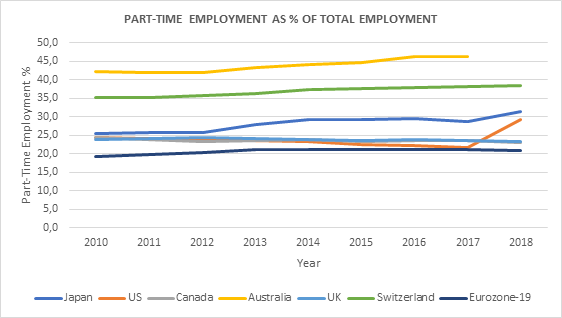
But when it comes to youth (youth is the age of 15-24 years) after the financial crisis of 2008 part-time rates have soared to the highest heights that in some countries are almost the only way of working for youth in these countries.
For example, in Australia the youth only works under part-time employment, while in Canada and in the US more than 95% and 85% respectively of their youth work under the part-time regime. In Japan, 50% of their youth work under part-time employment. The corresponding figure in the Eurozone-19 reaches 33% as a way of youth employment.

If we exclude the American labour market where the prospect of changing employer is not something unusual or rare for American workers, job insecurity as well as flexible forms of employment are a status of more than three decades in the US, when unemployment rates are low and less than 5% annually in recent years.
In such a type of labour market as that of the USA, which display long-term low-level unemployment rates, it is considered that full-time conditions prevail. In other EU member countries, the percentage increase in part-time work reflects a growing trend in job insecurity, particularly in countries such as Britain, Spain, France, Italy, Greece, etc.
In these countries and more generally in most countries of the Eurozone and the EU, Part-time work is not the same as in the USA. In addition to the fact that unemployment in the EU is higher than in the US, in the European labour culture, the start of a clerical relationship has always been identified as a career concept, and private employees often received their first pension from their original employer.
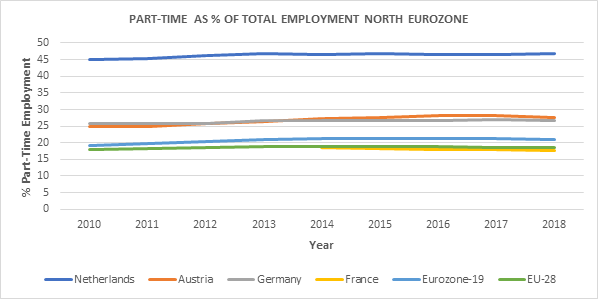
In the above graph we see that part-time employment in the workforce (25-64 years) for the North Eurozone and the EU respectively holds a higher percentage than the Euro-19 and EU-28 average (excluding France which is gradually approaching European average).
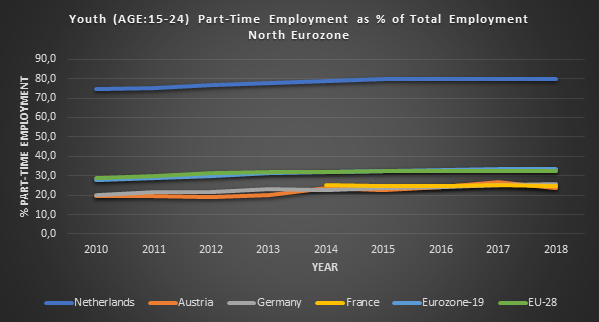
The corresponding part-time employment rates for youth are overwhelmingly high for the Netherlands (> 80%) while for the rest of the member-countries it is almost 1/3 as a form of youth employment (see graph below).
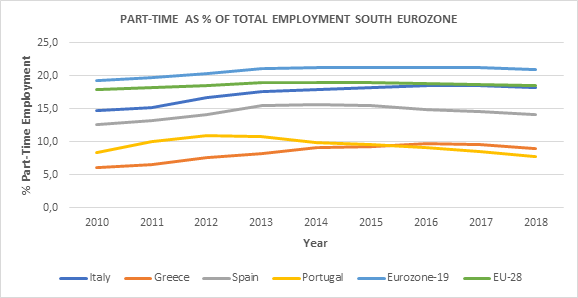
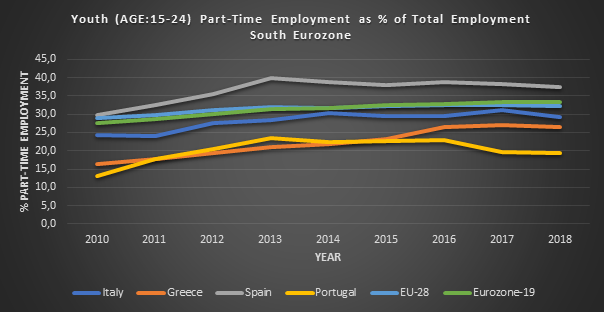
In the Southern Eurozone, part-time rates on the total workforce are lower than those in the Northern Eurozone and lower than the average European term outside Italy that the percentages of part-time employment approach the average European term (see the graph below).
However, the corresponding part-time employment rates for youth for the Southern Eurozone member-countries soared to high heights due to the financial crisis of 2008, where in some cases they arrived at 42% (Spain) as a way of working for youth on of its overall way of employment (see the diagram below).
If we exclude Netherlands who is the world’s part-time champion (see above graphs) where part-time workers are strictly protected in their labour rights in all other EU and Eurozone member-counties accordingly, this is not the case. Part-time employment is considered a forced exit from unemployment for most citizens who choose it.
The problems that are created by part-time work
Both in the Netherlands and in all Eurozone and EU member-countries the problems created by part-time work are:
1. The increasing expansion (gap) between the amount of pension payments received by those who work with the full-time and part-employment regime equally.
2. Lower payments per hour of work for part-time workers in relation to their colleagues in full employment. Moreover, they are not receiving allowances for their work and have little chance of finding a full-time job both in the same company and in other companies. This is because a part-time employee cannot fully use his abilities-skills.
3. Minimum job training opportunities (if there is any in the company) in relation to full-time employees.
4. Usually a part-time job is also a ‘bad’ job because it is not covered by labour rights (The Netherlands is an exception where labour rights for part-time work are strong, protecting the workers of this category).
5. Wage increases are not given when someone is working on part-time work.
6. Part-time work is usually chosen with the prospect of short-term duration until something better is found in a full-time job, but over the years it is very difficult for someone to move from a part-time job to a better job of full employment.
7. In more general terms both employees and youth, and especially the youth of university graduates, choosing a part-time job believe that their careers will be destroyed. That is why they tailor their personal expenses to low spending levels because they believe that they can lose their part-time job as well.
Youth is the most dynamic part both of companies’ and economies as consumers, and they are always targeted by advertisers’ campaigns. For a wide range of products, it is clearly more important the young people from the middle ages (35-54 years) who have acquired family and corresponding obligations and are more wary of their consumer purchases. While ages over 55 years are completely indifferent to advertisers.
As part-time workers belong to low incomes (less than €20000 annually) the ever-increasing increase in this category of employees increases the overall order of citizens with low incomes who shrink in constantly demand and consumption in the economy.
In this way it seems that the companies which produce large-scale consumer products should be pressuring governments to diminish the number of low-income (part-time) employees in order to be able more consumers to be able to buy their products.
In fact, this is not the case, because companies can, from their portfolio of transferable securities, achieve capital gains that exceed the retail profits from the sales of their products.
Additional advantages that companies derive from the use of part-time workers:
- They can increase productivity in times of high demand with minimum labour costs.
- When demand for the products produced is reduced then these workers can be dismissed without compensation in relation to full-time workers.
- In labour-intensive companies where workers work more than 48 hours a week, part-time workers can have a complementary role in the rest of the full-time workers without decreasing the levels of productivity.
What needs to be changed to avoid inequalities between employees
Governments should institutionalise a labour framework where there will be:
1. Full and equal Labour (working) rights for part-time employees in relation to full-time employees.
2. For both full-time and part-time employees for the same work, payments and corresponding social security contributions will be calculated by the hour and will be the same for the same job tasks. In this case, companies will have an incentive to invest in the training of these employees because they will not be second – class employees.
3. The only difference that will exist between full-time and part-time employees will be that part-time employees will not receive compensation when they leave their employment. That will be their only attractiveness.