




With special missiles against unmanned surface vessels the Royal Navy AW159 units and helicopters. The attack of two surface units of the Russian Navy recently (Admiral Makarov -Project 11356R– and the minesweeper “Ivan Golubets” – Project 266M), by unmanned fast-suicide Ukrainian vessels (USVs) in Sevastopol, Crimea, confirms the significant differentiation they introduce and in surface operations the unmanned vessels (Unmanned Surface Vehicles). Suicidal and non-suicidal. The tribute that follows proves that modern naval forces are adapting with maximum speed to this new operational data.
One of the most important differences, one of the most important new facts if you will, is the early detection of USVs by surface units and then engaging them before they are within range to allow them to launch their weapons. That is, while suicidal USVs approach the target ship at the maximum possible cruising speed they can develop, with the aim of causing damage by impacting one side of it and detonating the payload they are carrying, AUSVs (Armed USVs) carrying missiles surface – surface, they act from short or medium distances, with the risk of acting and escaping undetected.
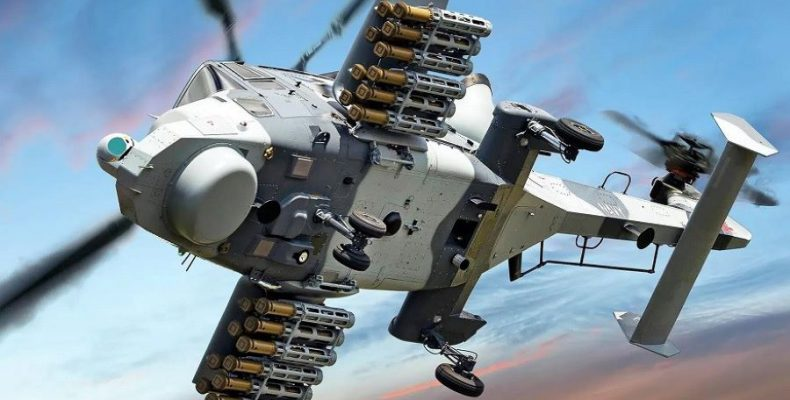
Armed AUSVs therefore have the ability to operate from a distance and even hidden behind rocky islands, bays and other natural and man-made obstacles. That is, they can even hit ships that are docked!
While in the field of effectively countering and intercepting attacks by unmanned aircraft and drones or swarms of drones, significant progress and developments have already been made in Europe in terms of the defense of surface units, the British Navy (Royal Navy) is leading the way in USV threat interception, recently successfully completing a series of flight tests of the AW159 Wildcat naval cooperation helicopter, loaded with a large number (20!) of Martlet laser-guided air-to-surface missiles.
In the same tests, the AW159 was evaluated for behavior and performance with different payload configurations, consisting of the larger Sea Venom air-to-surface missiles. Both new anti-ship missiles have already been tested through launches, against surface targets of different sizes and cruise speeds, at different distances and under different conditions.
The AW159 helicopter used for these tests operated for a period of approximately one month from the flight deck of the RFA (Royal Fleet Auxiliary) Argus, and was equipped with recording systems as well as telemetry systems. The RFA Argus sailed during this period initially in the Atlantic, between the Canary Islands and Cape Verde, covering a total of 8,000 miles. The support ship then sailed to the Mediterranean, in search of different weather and warmer temperatures. Which are known to degrade the performance of any aircraft.
On this trip, the specially equipped AW159 flew a total of 87 hours, performing 894 landings and landings, day and night, under varying conditions of temperature, humidity, wind and sea state, with different weapon load configurations. All data recorded on the helicopter’s flight behavior and actual performance will be used to develop helicopter operations procedures for the type, loaded with Martlet and Sea Venom air-to-surface missiles.
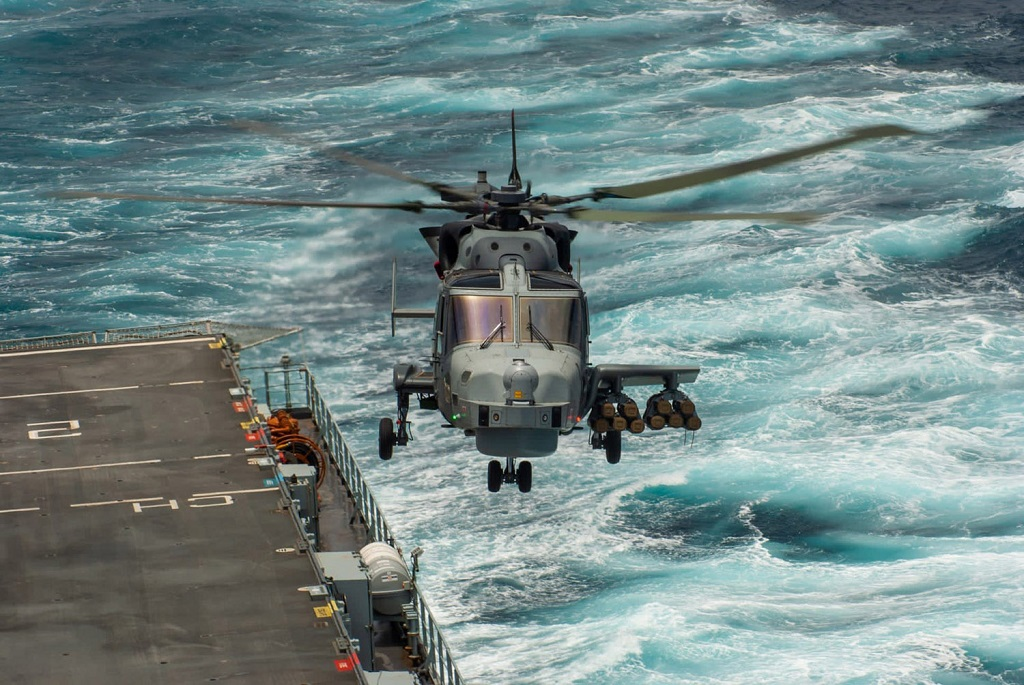
Operations from all major surface units of the RN. Frigates (Type 26), destroyers (Type 45), auxiliary vessels, but also from the flight deck of the two Queen Elizabeth-class aircraft carriers.
The process of integrating and certifying the new anti-ship missiles in Royal Navy helicopters
As part of the replacement of the Royal Navy’s Lynx (1982-2017) helicopters carrying the Sea Skua anti-ship missiles, the launch of the Future Anti Surface Guided Weapon (FASGW) program was announced in 2008 to replace the weapon in question. In a second year, the program included the development of two missiles. One that would be intended for the destruction of small manned and unmanned surface vessels ((FASGW (L) – Light) and a second (FASGW [H) – Heavy) developed in cooperation with France, under the responsibility and general supervision of MBDA .
Thus arose the small Martlet (FASGW [L)) and the larger Sea Venom (FASGW [H]) which will also enter service in the French Navy as ANL (Anti – Navire Leger). We will deal with the development of these two new anti-ship missiles and their characteristics in a separate section, since there is extremely interesting information related to their integration into the Agusta Westland 159 Wildcat HMA (Helicopter Maritime Attack).
Among the most important, perhaps, is that they will be carried suspended on new detachable wings which in turn were designed and tested as part of a £90 million program undertaken by Leonardo in 2014. The first flight tests of these wings took place in July 2019 where they were found to produce 360kg of lift. These wings, which are made of aluminum alloy and carbon fiber, limit the drag produced by the rockets and, by extension, the strain on the main rotor and fuel consumption, when the helicopter flies straight and horizontally.
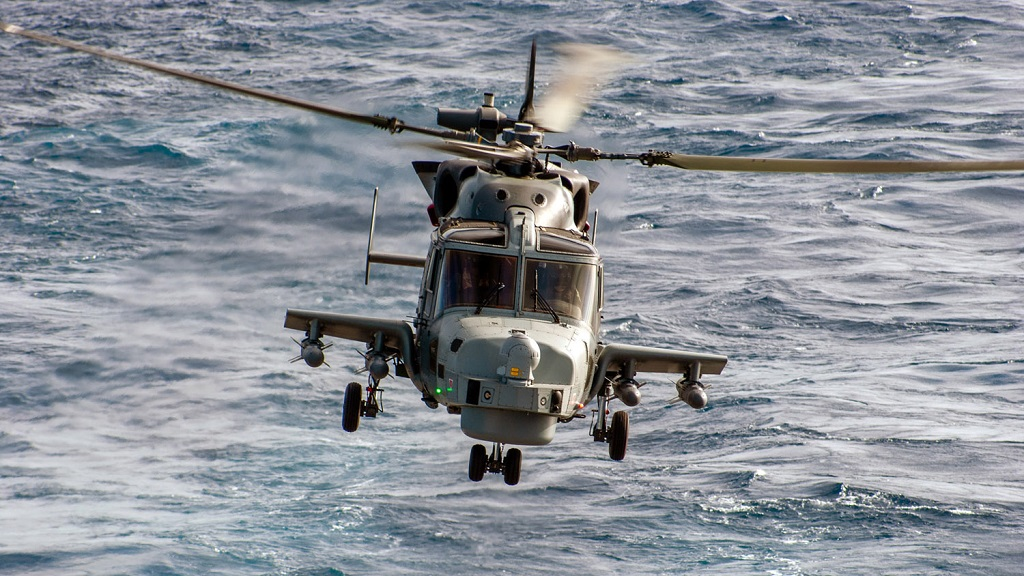
Each Martlet missile weighs only 13 kg, so 20 such missiles can be carried. The heavier (120 kg) Sea Venom limits the carrying capacity to four units. Both missiles will have entered service with the RN by the end of 2024 at the latest. Not only on AW159 helicopters, but on all RN surface units in conjunction with 30mm guns.
So the process of intercepting USV and AUSV attacks has been started for at least a decade, both by the RN and the French Navy. Through the development of new missile systems and their integration into flying platforms and surface vessels.
