“Soft diplomacy”, “soft approach”, “loud approach” and “avoid megaphone diplomacy” have all been employed as strategies to “close” the case against WikiLeaks founder Julian Assange. In situations like his, the best form of diplomacy is the one that produces results most favorable to the citizen involved while keeping him safe and healthy (at the end of analysis you could see part of the documents).
However, government documents obtained this week by DeclassifiedAus under the Freedom of Information (FOI) Act from the Attorney General show that Australia’s new Labor Government is certainly not ruling out the physical extradition of Assange from the United Kingdom to the United States. States, nor does it give any indication of how it might deal with possible consequences from it.
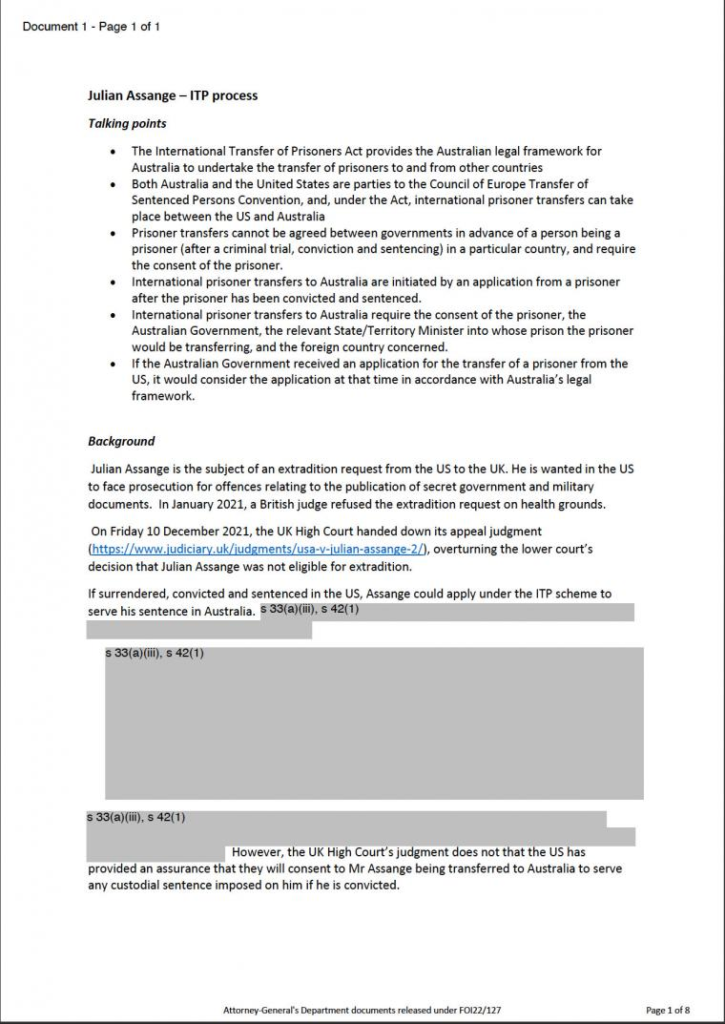
The FOI documents obtained include ‘Talking Points’ prepared for Attorney General Mark Dreyfus on 2 June 2022 entitled ‘Julian Assange – International Detainee Transfer Process – Talking Points and Background’. They point out that:
- Prisoner transfers cannot be agreed between governments before a person has been convicted (after a criminal trial and conviction) in a particular country and the prisoner’s consent is required.
- International prisoner transfers to Australia are initiated by a prisoner’s application after the prisoner has been sentenced.
- If extradited and convicted in the US, Assange could apply under the ITP system to serve his sentence in Australia.

After some corrections, the document continues: However, the UK High Court ruling notes that the US has provided an assurance that it will consent to Mr Assange’s transfer to Australia to serve any custodial sentence if convicted.
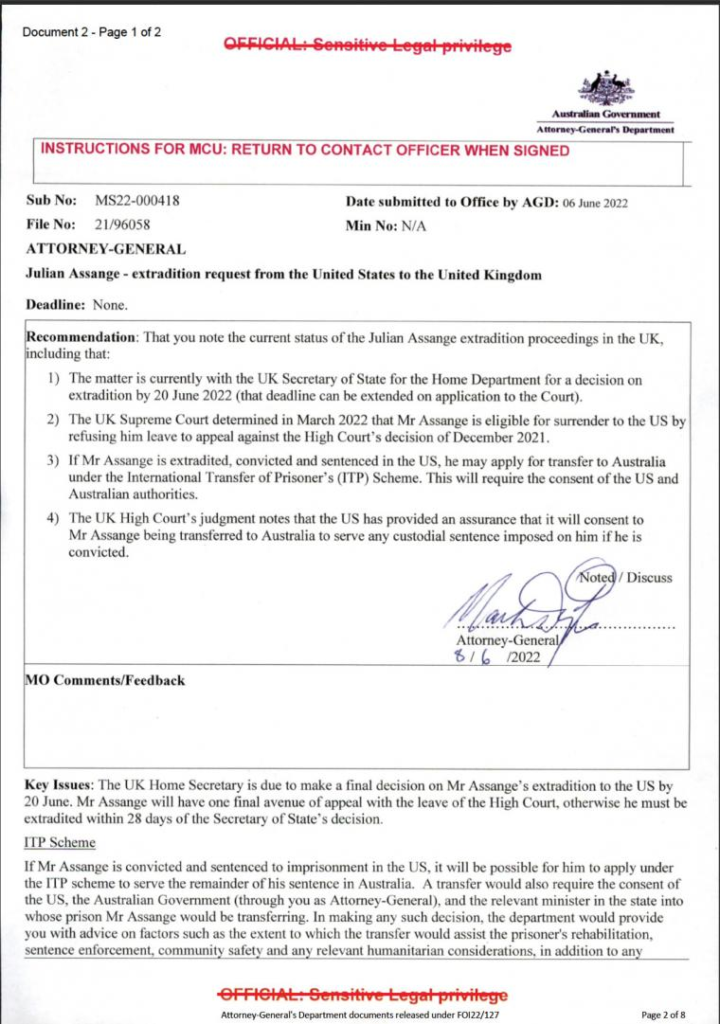
The FOI documents also show that on June 8, 2022, the Attorney General, Mark Dreyfus, signed a “Ministerial Submission” titled “Julian Assange – extradition request from the United States to the United Kingdom”, which advised the Attorney General to note a current status of Julian Assange’s extradition proceedings in the UK, including:
- The matter is currently with the UK Secretary of State for the Home Office for a decision on extradition by 20 June 2022 (this deadline may be extended on application to the Court).
- The UK High Court ruled in March 2022 that Mr Assange was eligible to be extradited to the US, refusing to appeal the December 2021 High Court decision.
- If Mr Assange is extradited, tried and convicted in the US, he can apply for transfer to Australia under the International Transfer of Prisoner’s Scheme. This will require the consent of the US and Australian authorities.
The UK High Court ruling noted that the US had given assurances that it would consent to Mr Assange’s transfer to Australia to serve any custodial sentence if convicted. Obviously, one of the main risks to be considered by the Australian government is the risk of suicide.

He considered that there were a number of known risk factors that indicated a very high risk of suicide, including the intensity of Mr Assange’s suicidal preoccupation and the extent of his preparations. Significantly, he said: “I am as certain as a psychiatrist can be that, if extradition to the United States is imminent [emphasis added], Mr. Assange will find a way to kill himself.”
If extradition alone is a trigger for suicide, then any discussions about where Assange can be housed on US soil before and after trial and under what restraints become completely irrelevant.
The presence of lengthy formalities in the documents may indicate that, despite the medical evidence, the government has not ruled out Assange’s extradition to US soil.
The imprecise language of the Labor government’s statements about using “quiet diplomacy” to “bring the matter to an end”, rather than clearly stating what they are seeking, may be giving false hope to the Australian public. Without advancing its “quiet diplomacy” on non-negotiable terms in the US, withdrawing the fees may not even be considered.
If extradited from the UK and then tried and convicted in the US, Assange faces a total of up to 175 years in prison. His charges carry a maximum sentence of 10 years in prison for each count of violating the US Espionage Act of 1917 and a maximum sentence of five years for the single count of conspiracy to commit computer hacking.

One can see why a plea to an offense carrying a lower maximum term, such as conspiracy to commit computer hacking, with a non-parole period and a sentence to be served in Australia, would be attractive to a new government keen to avoid offending an ally and says she is willing to “end the matter” on negotiated terms without government announcements.
Australian government should clarify to the Australian people what the statements made in the United States or “quiet diplomacy” actually involve.
We are certainly entitled to see that the government has done as much to secure Assange’s freedom from our supposed “great ally” as it has for other “political prisoners” of non-allied regimes, such as Peter Greste jailed in Egypt and Kylie Moore- Gilbert was imprisoned in Iran.
“Quiet diplomacy” does not mean weak diplomacy.
Australia urges in no uncertain terms the United States to prioritize human rights and freedom of the press over any vendetta based on US intelligence or domestic political considerations and to drop the case against Assange entirely.