It has been almost three weeks since Russian President Vladimir Putin launched his invasion of Ukraine, but it is still unclear why he did it and what he hopes to achieve. Many analysts, commentators and government officials have put forward more than a dozen theories to explain Putin’s actions, motives and goals.
The Liberal Globe will present a collection of eight different but complementary geopolitical theories, which try to explain why Putin invaded Ukraine:
1. The reconstruction of the Russian Empire
The most common explanation for Russia’s invasion of Ukraine is that Putin, inflamed by dissatisfaction with the collapse of the Soviet Empire, is determined to restore Russia (generally considered a regional power) as a major world-class power. .
According to this theory, Putin aims to regain control of the 14 post-Soviet states – often referred to as Russia’s “proxies” – that became independent after the collapse of the Soviet Union in 1991. This is part of a broader reconstruction plan. of the Russian Empire, which was territorially even more expansive than the Soviet Empire.
The theory of the Russian Empire states that Putin’s invasion of Georgia in 2008 and Crimea in 2014, as well as his decision in 2015 to intervene militarily in Syria, were all part of a strategy to restore Russia’s geopolitical position, and erode the rules of US-based international order.
Those who believe Putin is trying to restore Russia as a major power say that once he gains control of Ukraine, he will turn his attention to other former Soviet republics, including the Baltic states, Estonia, Latvia and Lithuania, and finally Bulgaria. even Poland. Putin’s ultimate goal, they say, is to oust the United States from Europe, create an exclusive sphere of great power for Russia on the continent, and dominate the European security order.
2. Buffer Zone
Many analysts attribute the Russian invasion of Ukraine to geopolitics, which seeks to explain the behavior of states through the prism of geography.
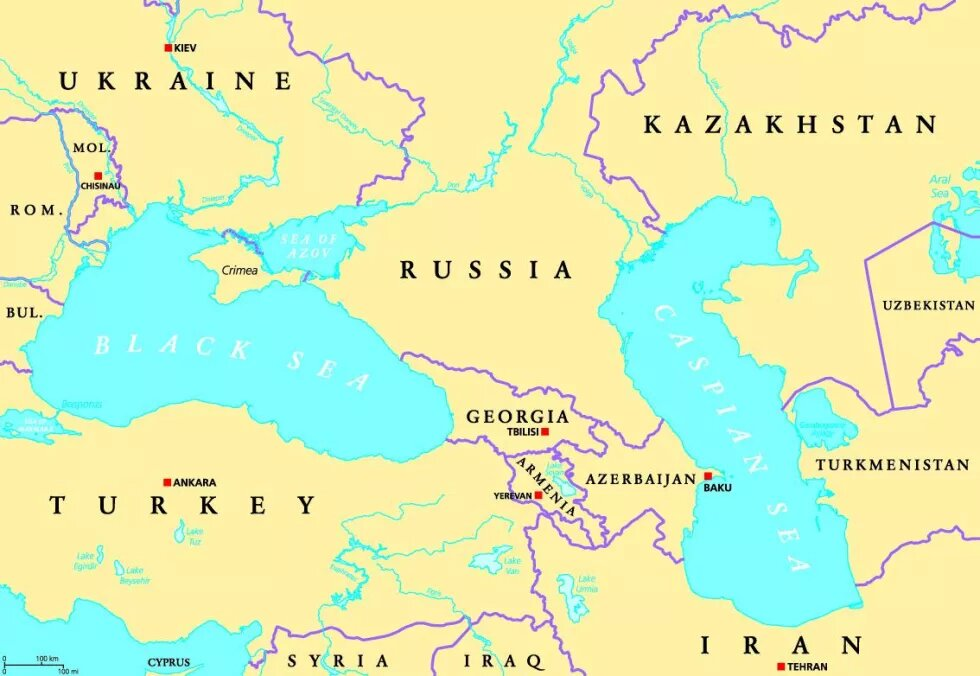
Most of western Russia is located on the Russian Plain, a vast mountainless region that stretches over 4,000,000 square kilometers (1.5 million square miles). Also called the Eastern European Plain, the vast plain poses an acute security problem in Russia: an enemy army invading from Central or Eastern Europe would encounter few geographical barriers to reach the Russian heart. In other words, Russia, because of its geography, is particularly difficult to defend.
Veteran geopolitical analyst Robert Kaplan wrote that geography is the starting point for understanding anything else about Russia:
“Russia remains free and authoritarian because, unlike Britain and the United States, it is not an island nation, but a vast continent with few geographical features that protect it from invasion. “Putin’s aggression ultimately stems from this fundamental geographical insecurity.”
Most of the countries of the former Warsaw Pact are now members of NATO. This leaves Belarus, Moldova and Ukraine, strategically located between Russia and the West, as the only Eastern European countries left to function as Russian neutral states. Some analysts say Russia’s perceived need for a security stockpile is a key factor in Putin’s decision to invade Ukraine.
3. Independent Ukraine
Closely intertwined with theories of empire-building and geopolitics is Putin’s obsession with overthrowing Ukrainian sovereignty. Putin argues that Ukraine has been part of Russia for centuries and that its independence in August 1991 was a historic mistake. Ukraine, he claims, has no right to exist. Putin has repeatedly downgraded or denied Ukraine’s right to state and sovereignty.
4. ΝΑΤΟ
This theory holds that Putin invaded Ukraine to prevent it from joining NATO. The Russian president has repeatedly called on the West to guarantee “immediately” that Ukraine will not be allowed to join NATO or the European Union.
An ardent supporter of this view is the American theorist of international relations John Mearsheimer, who, in a controversial essay, “Why the crisis in Ukraine is the fault of the West,” argued that NATO’s expansion to the east prompted Putin to act. militarily against Ukraine.
Putin’s position on NATO enlargement changed radically after the 2004 Orange Revolution, which was triggered by Moscow’s attempt to steal Ukraine’s presidential election. A mass pro-democracy uprising eventually led to the defeat of Putin’s preferred candidate, Viktor Yanukovych, who eventually became president of Ukraine in 2010 but was ousted by the Euromaidan “revolution” in 2014.
It should also be noted that Putin claims that NATO has broken its official promises made in the 1990s that the alliance will not expand eastward.
5. Democracy as a threat to the authoritarian Russian regime
This theory holds that Ukraine, a thriving democracy, is an existential threat to Putin’s authoritarian model of government. The continuation of a sovereign, free and democratic Ukraine aligned with the West could inspire the Russian people to demand the same.
Ukraine expert Taras Kuzio reports:
“Putin remains haunted by the wave of pro-democracy uprisings that swept Eastern Europe in the late 1980s, paving the way for the subsequent Soviet collapse. “He sees the newly formed Ukrainian republic as an immediate challenge to his own authoritarian regime and recognizes that Ukraine’s historic proximity to Russia makes this threat particularly acute.”
6. The Energy of Ukraine
Ukraine has the second largest known gas reserves – more than one trillion cubic meters – of gas in Europe after Russia. These reserves, under the Black Sea, are concentrated around the Crimean peninsula. In addition, large shale gas deposits have been discovered in eastern Ukraine, around Kharkiv and Donetsk.
According to this theory, Putin annexed Crimea to prevent Ukraine from becoming a major supplier of oil and gas to Europe and, therefore, to challenge Russia’s energy superiority.
According to this theory, Russia’s invasion of Ukraine is aimed at forcing Kyiv to formally recognize Crimea as Russian, and to recognize the autonomous republics of Donetsk and Luhansk as independent states, so that Moscow can legally secure the control of natural resources in these areas.
7. Water as a Source of Life
On February 24, the first day of the Russian invasion of Ukraine, Russian troops restored water flow to a strategically important canal connecting the Dnieper River with Russian-controlled Crimea. Ukraine blocked the Soviet-era northern Crimean canal, which covers 85% of Crimea’s water needs, after Russia annexed the peninsula in 2014.
The shortage of water has resulted in a massive decline in agricultural production on the peninsula and has forced Russia to spend billions of rubles each year on water supply from the mainland to sustain the Crimean population. Even if Russian troops eventually withdraw from Ukraine, Russia is likely to maintain permanent control over the entire 400-kilometer-long northern Crimean canal to ensure that there are no further interruptions in Crimea’s water supply.
8. Survival of the Putin regime
This theory holds that the 69-year-old Putin, who has been in power since 2000, seeks the ongoing military conflict as a way to remain popular with the Russian public. Some analysts believe that after the public uprisings in Belarus and Kazakhstan, Putin decided to invade Ukraine for fear of losing power.
In an interview with Politico, Bill Browder, the American businessman who leads the Magnitsky Global Justice Campaign, said Putin felt the need to look strong at all times:
“I do not think this war is for NATO, I do not think this war is for the Ukrainian people or the EU or even Ukraine. This war is about starting a war to stay in power. Putin is a dictator, and he is a dictator whose intention is to stay in power for the rest of his physical life. “He told himself that writing is on the wall for him unless he does something dramatic.”