


Since the period of the Ribbentrop-Molotov Pact, which paved the way for World War II, the Baltic republics have been experiencing an international political drama. They were first conquered by the Soviets as part of the division of Central and Northern Europe by Hitler and Stalin, then conquered by the Germans and then “liberated” by the Soviets.
The small Republics entered a big night with persecution, crime, concentration camps, population degradation, forced Russification, which ended with the collapse of the Soviet Union.
With this historic experience, Estonians, Latvians and Lithuanians are able to read the Kremlin’s strategy correctly and accurately predict Putin’s every move. The problem is that the other Europeans, who did not feel the same pressure until the Russian invasion of Ukraine, did not pay any attention to their analyzes and warnings.
It is characteristic that Lithuania joined NATO in 2004, but its accession was purely symbolic until 2017. At that time, the first combat-ready NATO military units were deployed in its territories in response to the annexation of Crimea by Russia.
These forces are still limited and of a defensive nature. They are not a threat to Russia or an attempt to encircle NATO, as Putin claims. They are just sending the message that Lithuania is covered by the US-NATO guarantee and that if Putin applies the method he applied to Georgia and Ukraine, he will find the Alliance against him, according to Article 5 of its statute which provides that an attack on one member is equivalent to attacking all its members.
Some members of the Alliance may want to “interpret” this article, but it is clear that the US will not leave room for misinterpretation. In a depressing international politics, the only positive perspective has to do with documenting the external threat posed by European unity and a new European beginning.
The international credibility of the EU is limited
Vladimir Putin’s aggressive move further curtailed the European Union’s international credibility. It has shown that there is a huge political-military vacuum behind the Europeans’ many words of solidarity and democratic and European development in the “Eastern Neighborhood” countries, which include Georgia, Belarus and Ukraine.
European solidarity is given generously on a verbal level and this can lead to misinterpretations and tragedies. In its economic solidarity, the EU is always sparing, so it does not make a difference to the peoples to whom it is addressed. The Ukrainians made the big decision to turn away from Russia and towards the EU. in 2014 and since then they have been undergoing one IMF “consolidation” program after another. It is obvious that if the EU had effectively supported the Ukrainian economy the possibilities for Russian intervention would be much more limited.
At the political-military level, the EU it is much worse than financial. He has denied any military aid to Ukraine, saying it would facilitate Putin’s plans. Eventually, Ukraine was left defenseless, and some offers of “defense-military” assistance sparked outrage and laughter at the same time. German rebels have suggested to Ukrainian President Zelensky that he be provided with 5,000 military helmets and a functioning campaign hospital.
It took UK intervention for the Ukrainians to acquire remarkable anti-tank weapons systems at the last minute. After the departure of the UK. from the EU there is no serious military force in the EU. capable of acting as a deterrent to Russia.
France, which has military capabilities and the ability to project power outside its territories, is currently traumatized by its politico-military failure in sub-Saharan Africa and especially in Mali. Moreover, French political thought remains influenced by General de Gaulle’s desire for a Europe from the Atlantic to the Urals. The result was that Macron was trapped in a pre-election political dialogue with Putin while there are strong political forces, such as Le Pen’s party, that insist on working with Russia regardless of Putin’s aspirations.
France also has its own… Schroeder in the person of the former center-right Prime Minister Figion. He suffered a humiliating defeat in the 2017 presidential election, when financial scandals involving him were revealed and he is now consoling, like Schroeder, as a top executive of the Russian energy giants.
With Russia’s invasion of Ukraine, the EU’s verbal political guarantees proved to be substanceless, which drastically limits its international credibility.
Energy dependence on Russian gas and oil
The EU is unable to deal effectively with Russian aggression because it is energy dependent on Russian gas and oil. It has gone so far as to advertise sweeping economic sanctions against Russia, excluding the A and Z energy for the operation of Russian oligarchic kleptocracy and the financing of Putin’s war effort.
In general, the EU covers 38% of its gas needs from Russia. At the same time, it imports 3.5-4 million barrels of Russian oil per day. This means that the EU of 27 finances the Russian system of power and its expansion with 5 to 7 billion euros per week. Putin is much better prepared today to face possible severe EU economic sanctions. than in 2014.
At the time, the international fuel cycle was not on the rise, Russia did not have the $ 600-650 billion in foreign exchange reserves it has today, and it still has productive gaps in its economy, especially in the agricultural sector, which it filled by responding to sanctions following integration. and annexation of Crimea. In addition, eight years ago it did not develop much of its economic and energy cooperation with China.
And while Russia has strengthened its resilience to international financial sanctions, compared to 2014, the EU did everything it could to increase its energy dependence on Russia. The Germans fought a hard economic and political battle for the construction of the NordStream 2 gas pipeline despite objections from Poles, Latvians, Estonians and Lithuanians who warned of the consequences and strong protests from the Americans.
And the Ukrainians, the victims of Russian expansion, opposed the construction of NordStream 2 on the grounds that it would generously fund Putin’s expansion strategy and deprive Ukraine of billions of dollars in annual revenue from former Russian allies. .Ε. via Ukraine. The combination of a lack of strategy of German politicians and, in some cases, their personal selfishness created a terrible energy dependence on the EU. from Russia that untied Putin’s hands.
He moved aggressively knowing that at this stage the Europeans need him financially more than he’s need them and that the great difficulties he will face will be in the long run. It relies on the European Babel, the outraged consumers – voters and the electoral cycle of the various European governments to fall on deaf ears.
The initial reactions of European politicians, a combination of harsh statements with no practical significance and lukewarm economic sanctions, seem to justify his basic assessment. As if that were not enough, the EU has done nothing substantial for major infrastructure projects that would reduce energy dependence on Russia. It is indicative that even today the Baltic Republics import most of the gas they need from Russia, while they also depend on it for electricity issues.
And in the case of EastMed, dealing with the EU it was frustrating. Instead of promoting an infrastructure project that would reduce dependence on Russian gas, he gave priority to the project’s necessarily difficult finances and Turkish objections.
The Green Transition
The European Union has approached the complete strategic impasse with the so-called green transition. It has decided to set the example of reducing greenhouse gas emissions without having made a serious calculation of the strategic impact of its choices. As far as Russia is concerned, Europe’s dependence on natural gas has increased, which is why the European Commission was forced to turn 180 degrees, deciding that natural gas should be subsidized as a “green” investment.
It is essentially an imported fossil fuel that is also used to fund Putin’s expansionist policies. These are all “details” for those who are strategizing at European level. EU energy nudity exposed in recent months and its enormous dependence on natural gas has led to a multiplication of the cost of natural gas production, dragging up wholesale electricity prices. European households and businesses were faced with a “tsunami” of precision which was reinforced by the “green” European choices.
The so-called green inflation has already been created, which turns the citizens against a well-thought-out green transition, while the international situation has given Putin the opportunity to strike militarily at a time when he feels and is economically strong.
Putin could not strike in 2020 when the pandemic had pushed down international gas and oil prices. At the beginning of 2022, however, the economic conditions were ideal for an attack on Ukraine since the recovery of the international economy, some problems in international oil production and the “green” mistakes of the EU. they had given him the ultimate economic, energy advantage.
The debate is over what economic sanctions the EU may impose. in Russia, while it should be about how the EU will get rid of Russian gas and oil over a period of months so that it does not suffer economic consequences from Putin’s tactics.
The issue of EU defense
Russia has behind it twenty years of serious military preparation. It drew the right conclusions from its weakness in Afghanistan and the first war in Chechnya.
In the first phase, he reorganized the army, reducing waste and corruption. In the second phase, it dramatically increased military spending, emphasizing the modernization of traditional weapons systems that can be deployed rapidly on the battlefield. The war against Georgia, the campaign in Syria, and various formal and informal military operations in Libya and other African countries have boosted the confidence of its armed forces and widely used paramilitary forces, such as the much-discussed Wagner Company.
For their part, EU member states they did everything they could to reduce defense spending. The bad example was set by Germany, which did not honor its NATO commitment to increase its defense spending to 2% of GDP. They are still below 1.5% of GDP and the rise of the Greens to power is a guarantee that Germany’s defense effort will remain extremely relaxed.
The von der Leyen Commission also moved in this climate. We must not forget that von der Leyen was Secretary of Defense in the Merkel government. The minimal, symbolic defense funds approved by the Juncker Commission in the context of promoting European defense cooperation have also been dramatically reduced at the request of the European Council, especially the so-called frugal ones, and at the initiative of the von der Leyen Commission.
Putin can be blamed for many things, but he is certainly experienced and well-read. A former KGB officer in what was then East Germany, he is well acquainted with the German mentality and has studied the many European weaknesses.
During the years that he was preparing militarily for the great attack he launched, he observed the Europeans limiting their defense effort and treating it as an item in the national or European budget that should not be substantially increased or even reduced in the name of … fiscal stability.
From the very… fiscal stability the Europeans lost the much more important geopolitical stability. They will now find that the cost of strengthening their defenses has been minimal in relation to the financial burdens they will suffer, for various reasons, due to Russia’s aggression.
We are dealing with a huge strategic failure of the EU. leading to a more serious European crisis than the previous ones. Due to the inability of the Europeans to reach an agreement and the lack of a meaningful strategy that characterizes the most powerful member states of the European Union, we have reached the point where Russia – whose economy is comparable to that of Italy – imposes its military-political rules on EU.
US warranty limits
This unacceptable European relaxation in political, economic and moral terms is based on the assessment that the EU covered by the US-NATO guarantee. In the event that Russia moves against us, there will be an immediate and dynamic response from the US and NATO.
The guarantee exists and is strong. But it is the duty of the Europeans to make it stronger, not to rest by sending the bill to the US. There are significant changes from the past in terms of the US guarantee, which require Europeans to take their full share of the responsibility and provide incentives to the US for a stronger European presence.
1. Since Trump’s four years, the “America first” view has prevailed in much of American public opinion. This view is reinforced as long as Europeans avoid a serious increase in their defense spending, based on joint NATO decisions. American taxpayers justifiably conclude that they are raising an economic burden that Europeans are avoiding, although it concerns them much more directly.
2. Putin’s Russia is not a key strategic opponent for the United States, despite its efforts to emerge as the heir to the Soviet empire. Russia has lost many of the characteristics that make a country a superpower. For example, it has lagged far behind economically and technologically, its economy and exports are heavily dependent on exports of gas, oil and ores of strategic importance. It does not have the characteristics of a mature developed economy that can support the ambitions of a superpower.
In the American perception, the main strategic opponent is China and not Russia. This sets out their priorities, it is something that Europeans must finally take into account.
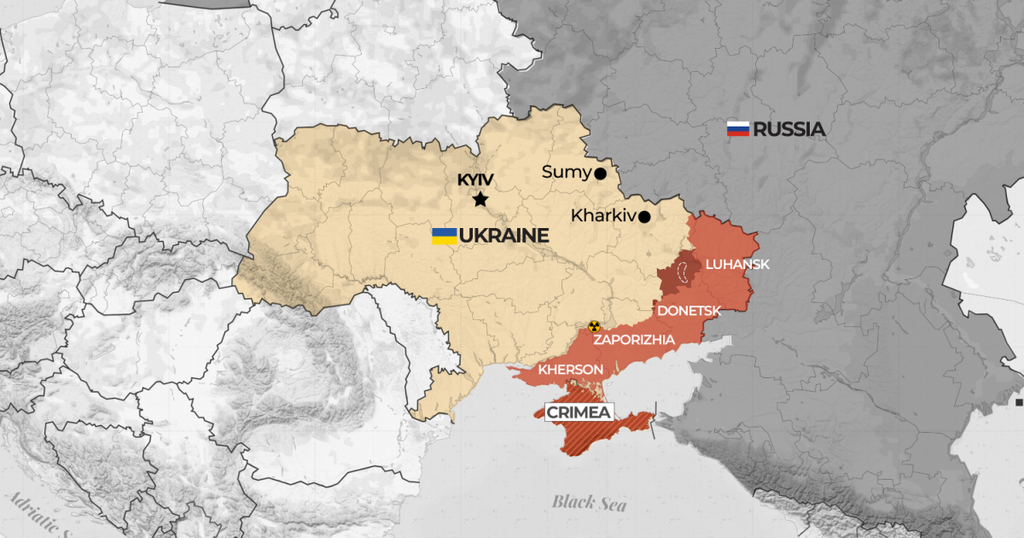
The Americans may not conclude that Putin made a major strategic mistake by attacking Ukraine because the Russian economy is unable to sustain Kremlin-controlled countries and territories, such as parts of Georgia, Crimea and its territory. Donbas, additional parts of Ukraine, all of Belarus, Transnistria. It is possible that the Americans will allow Putin’s European adventures to turn into economic hemorrhage over time that will destabilize the regime.
Therefore, Europeans must take the initiative and prove to the Americans that they will strengthen their NATO presence in order to strengthen the European commitment of the United States, despite the fact that the countries that Putin is attacking are not covered by NATO guarantees. .
3. After the great sacrifices they made for the Europeans in World War I, American public opinion was opposed to US involvement in World War II. It took the Japanese attack on Pearl Harbor to enable President Roosevelt to put the United States at war with Nazi Germany, fascist Italy, and militaristic Japan.
Biden makes it clear in all his statements that the US is not going to get involved in the Russia-Ukraine military confrontation with a certain defeat of Ukraine. Such an action was opposed by American public opinion as the US has a clear military superiority over Russia, but the latter is still a nuclear superpower and is deploying its troops on European soil.
Despite the good political mood of the Americans with their strong NATO commitment, it is clear that they will not rush to do the work of European partners. The latter must stop moving between political gossip and economic-political-military inaction and take on their responsibilities.
Russia’s attack on Ukraine is also the beginning of perhaps the most important existential crisis in the European Union.


