




On November 14, 2026, the Chinese company COMAC (Commercial Aircraft Corporation of China) conducted the first crewed test flight of the CE-25A—a 10-ton, fully electric transport-category aircraft designed for short-haul passenger services. The test took place in the Binzhou area of Shandong Province and marks a new milestone in China’s efforts to develop electric aircraft for commercial transport.
The CE-25A is a conventional fixed-wing aircraft, rather than an eVTOL (electric vertical take-off and landing) vehicle. It is designed to carry up to 19 passengers and features a maximum take-off weight of 10 tons, a cruising speed of approximately 300 km/h, an operational altitude of 2,400 meters, and an estimated range of 400 kilometers. These specifications place it in the category of small regional aircraft, with potential applications for short commercial routes between neighboring cities.
The aircraft utilizes a fully electric propulsion system, featuring a distributed arrangement of ducted fans positioned along the wings. The development is being carried out with the participation of CATL (in the battery sector), Shanghai Jiao Tong University, and other Chinese research and industrial entities.
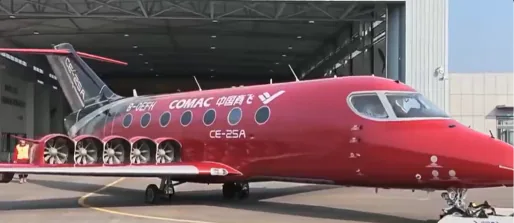
The test on November 14th involved two operators and a flight test engineer. The entire process lasted approximately 58 minutes—with 16–17 minutes spent in flight—covering a distance of about 60 kilometers. According to the information released, the systems functioned as intended, and the data collected met the test expectations.
This program is of particular interest because it seeks to extend electric propulsion beyond the category of small experimental aircraft and air taxis, applying it instead to a platform designed for standard regional air services. However, the limited energy density of current battery technology remains a major obstacle to increasing the range and payload capacity of fully electric aircraft.
