


American voters are sending a message to Silicon Valley: We will not foot the bill for the energy costs of artificial intelligence.
This political shift threatens the investment model of tech giants, just as these companies are borrowing hundreds of billions to build the infrastructure for the new digital economy.
The artificial intelligence bubble might not burst due to a technological failure, nor because of the emergence of a rival model that topples the current industry leaders.
Instead, it could burst because of something far simpler—and far more political: the refusal of local communities to surrender their land, water, and electricity to power Silicon Valley’s data centers.
The message from the American elections on November 3, 2026, is striking
In 40 out of 41 local ballot measures concerning the development of data centers, voters opted to restrict them. The outcomes included outright bans, partial prohibitions, temporary moratoriums, stricter zoning regulations, and requirements for resident consent for large-scale projects.
At the same time, proposals that would have facilitated the construction of new facilities were rejected. This is not a fringe environmental protest. It is a political uprising against an investment plan that, until recently, was presented as inevitable.
Artificial intelligence promised to transform the economy, labor, education, and productivity. Yet, for this to happen, it required a massive expansion of its physical infrastructure: millions of processors, enormous facilities, electrical grids, and vast quantities of water.
Citizens are beginning to pose a question that the market has avoided: who is footing the bill?
Electricity Becomes a Political Issue
The discontent has a concrete economic basis. Data centers consume vast quantities of electricity and water, while local communities worry that their expansion will drive up household utility bills, strain power grids, and deplete available water resources.
In Texas, where the growth of data centers has become strategically important to the tech industry, the debate over water has emerged as a central election issue.
Clayton Tucker, who was elected as the state’s Agriculture Commissioner, stated that opposition to data centers played a decisive role in his victory. Ranchers and rural communities are concerned about the depletion of water reserves.
The Associated Press also reported that more than $380 million was spent on television advertisements referencing data centers during the election campaign.
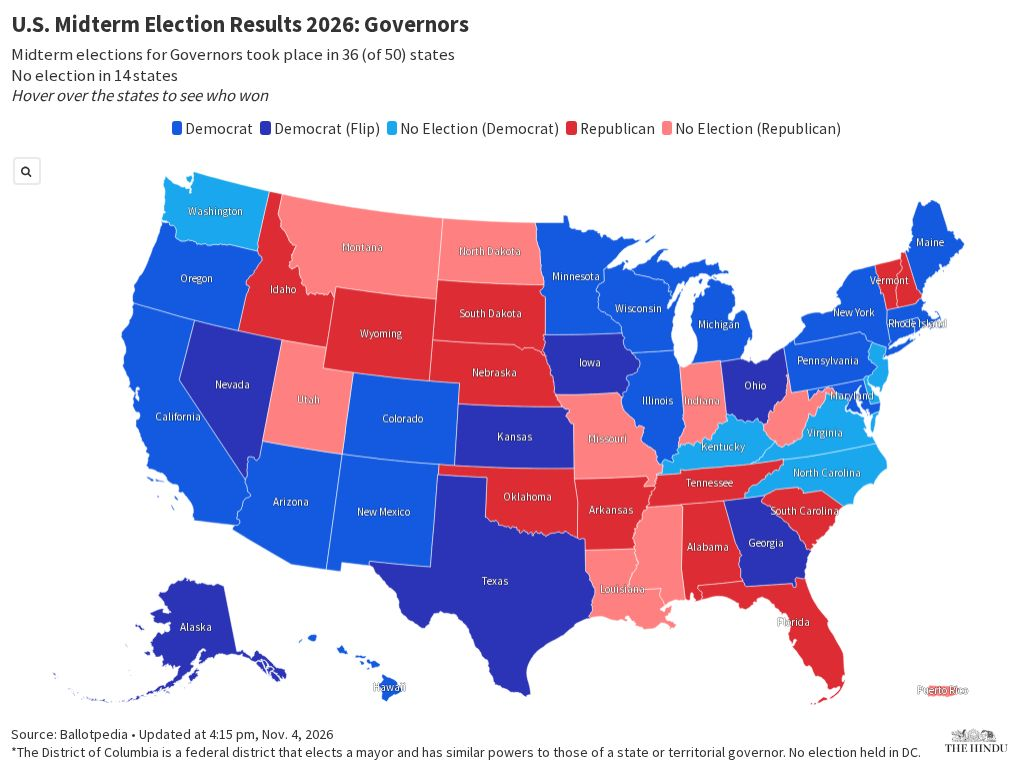
Opposition to their unchecked growth has become part of the broader political discourse surrounding the cost of living. The political dimension is even more significant. Of the 34 winning gubernatorial candidates in races where a winner has been declared, 32 had expressed support for stricter regulation or restrictions on data centers, according to data from Data Center Watch.
Meta has been forced to publicly acknowledge that building new facilities in the U.S. will become more difficult. Dina Powell McCormick, a president at the company, stated that tech giants are now more seriously considering the possibility of building infrastructure outside of U.S. territory.
This represents the first crack in the AI business model: while companies may possess capital, processors, and customers, they cannot construct facilities without land, permits, electricity, and social acceptance.
Wall Street Recognizes Political Risk
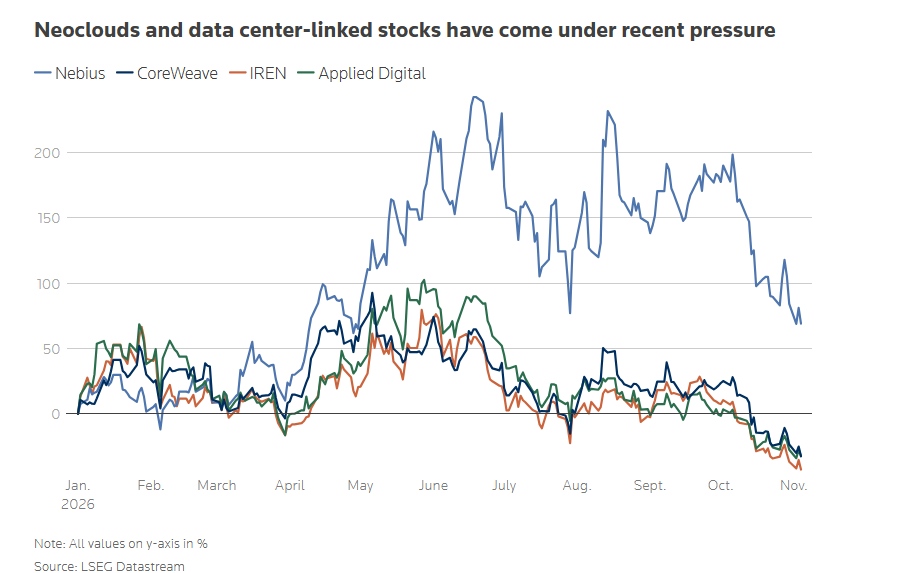
The market reaction was immediate. On Thursday, November 5—the day after the elections—tech stocks experienced their sharpest single-day decline since the pandemic era.
The Nasdaq fell by more than 1,340 points, or 5.2%, during intraday trading, with the loss in market capitalization exceeding $3 trillion.
The Philadelphia Semiconductor Sector index, which tracks major semiconductor companies, also saw a significant drop. The losses for individual stocks are telling:
- Nvidia fell by approximately 8% on Thursday (Nov 5), while its shares lost nearly 9% over a five-day period.
- Meta fell by 3.4%.
- Microsoft lost 2.8%.
- CoreWeave dropped 17% over a five-day span.
- Nebius lost 15%.
- IREN recorded a decline of nearly 10%.
The latter three companies are particularly exposed to the development of computing infrastructure and to expectations of sustained growth in demand driven by artificial intelligence. The distinction between major platforms and these newer infrastructure-focused companies is critical. Amazon, Microsoft, and Alphabet have developed vast operations, diversified revenue streams, and significant cash flows.
CoreWeave and other specialized AI cloud service providers are far more dependent on continued market expansion, ongoing funding, and the high utilization of their facilities.
If the construction of new data centers is delayed, it is not merely a matter of losing future sales; the very financial rationale underpinning these investments could be called into question.
The growth in capital expenditures within the tech sector may peak in 2027—sooner than previous forecasts, which pointed to 2028 or 2029.
It is also estimated that 10% to 20% of the 800–1,000 data centers currently planned in the U.S. could either be canceled or face significant, extended delays. This does not yet amount to an “AI collapse.”
However, it does represent the first serious challenge to the assumption that this investment-driven expansion can continue indefinitely, free from political or social obstacles.
The Bill for Hundreds of Billions of Dollars
The most concerning aspect is not merely the decline in stock market valuations; it is the manner in which this technological expansion is being financed.
For years, major Silicon Valley firms funded their investments primarily through their own massive cash reserves.
Now, however, the scale of capital required has become so vast that they are increasingly turning to bond markets, equity capital raises, banks, and private investment funds.
The combined capital expenditures of these tech giants are projected to exceed $730 billion by 2026. A July 2026 report on financial stability & the recent from the Bank of England reveals the true magnitude of the issue.
The five major players examined—Meta, Alphabet, Amazon, Microsoft, and Oracle—accounted for just 3% of the total US investment-grade corporate debt at the end of 2025. By early May 2026, however, they already accounted for more than 15% of all new debt issuance since the beginning of the year. Even more striking is Barclays’ estimate: approximately $240 billion of the investment requirements for major AI companies in 2026 will be financed through the issuance of investment-grade bonds.
The largest borrower
To put the scale into perspective, the six largest U.S. banks typically issue a combined total of $150–$170 billion in senior debt annually.
The technology sector is thus emerging as one of the largest borrowers in the U.S. economy. The same report notes that financing via private credit is also on the rise.
According to an OECD estimate, the share of private credit in financing AI investments grew from 9% in 2024 to 34% in 2025.
This is a crucial detail. The bubble is not limited to overvalued stocks; it encompasses an entire web of loans, bonds, securitizations, special purpose vehicles, and financing arrangements—all predicated on the assumption that the demand for computing power will continue to grow.
Oracle: the quintessential example
The case of Oracle is perhaps the most revealing. On November 2, the company announced that it would raise a total of $20 billion through a combination of stock and bond issuance to fund the expansion of its AI and cloud infrastructure.
Approximately $10 billion will be generated from the sale of shares, and another $10 billion from debt issuance. The offering includes bonds with maturities ranging from 2029 to 2046, carrying interest rates between 7% and 8.65%.
As of August 31, 2026, the company held total liabilities—comprising notes and other forms of debt—amounting to $125.34 billion. Its revenue for the 2026 fiscal year totaled $67.36 billion.
In other words, its debt has become highly significant relative to the scale of its operations. The stock market reacted negatively to the financing announcement; shares fell 8.8% on November 2 to $119.22, bringing the year-to-date decline to approximately 39%.
Oracle is not a company lacking actual revenue or customers. However, it serves as a prime example of the risk that arises when a company attempts to finance a massive infrastructure expansion with the expectation that future revenues will justify current obligations.
If data centers are delayed, if customers scale back their orders, or if the return on investment proves lower than anticipated, servicing the debt becomes significantly more difficult.
The Risk of Financial Contagion
The Bank of England warns of an even more serious risk: the mismatch between the duration of debt and the economic lifespan of technological infrastructure.
Bonds used to finance the construction of buildings and facilities often have a maturity exceeding ten years.
However, processors and computing power systems can become obsolete much faster, as new generations of chips render previous ones less competitive.
Consequently, a facility might carry a long-term debt obligation, while its equipment is no longer efficient enough to attract clients.
The central bank also points out that a decline in free cash flows among major technology companies makes them increasingly dependent on favorable refinancing conditions.
Simply put, it is no longer enough to just build a data center. It must remain occupied, generate revenue, and ensure the repayment of the liabilities incurred for its construction.
If this fails to happen, the losses will not be confined to shareholders. They will spread to bondholders, private credit funds, infrastructure financiers, and potentially to broader segments of the financial market.
The bubble could burst due to the real economy
This is the essence of the political conflict.
Artificial intelligence has been sold to the markets as the next great productivity revolution. Investors have valued companies based on expectations of massive future revenues, while governments have treated the construction of data centers as a strategic national priority.
Yet, this technological revolution does not take place in some digital ether. It requires electrical grids, land, water, transformers, cables, and enormous investments in physical infrastructure.
And all of this exists within real societies—comprising real residents, real needs, and real utility bills.
The backlash at the ballot box highlights a contradiction: tech giants seek to privatize the profits from AI, while societies fear they will end up bearing a large share of the costs associated with its development.
If citizens demand stricter licensing requirements, guarantees regarding electricity costs, transparency in water consumption, and the elimination of tax privileges, the economic model for data centers will change fundamentally.
Companies will no longer be able to plan investments by taking for granted access to cheap energy and unlimited land. They should factor in delays, political risk, higher financing costs, and potentially lower returns.
This is particularly risky for smaller infrastructure companies, which have limited cash reserves and are more dependent on continuous access to capital markets.
This is not the end of AI. Is it the end of unchecked expansion?
It would be a mistake to assume that artificial intelligence will disappear simply because voters are pushing back against data centers. The technology already has real-world applications, enterprise clients, and significant potential for boosting productivity.
The real question is whether stock market expectations and the investments already made can be justified by actual revenue and the economy’s potential.
Political backlash could accelerate this reassessment. The market will need to distinguish between companies with sustainable business models and those that rely primarily on continuous capital raising and the assumption that demand will grow forever.
The AI bubble does not necessarily require a major technological failure to burst. It would only take a scenario where data centers cannot be built quickly enough, energy costs rise, borrowing becomes more difficult, and projected profits fail to cover investment costs.
November 3, 2026, may prove to be a landmark date—not because Americans voted against artificial intelligence, but because they voted against the notion that technological development can be imposed upon local communities without their consent.
Silicon Valley believed the future was theirs to build. The voters responded that the future also passes through their own ballot boxes.
And this could prove far more dangerous for the AI bubble than any competing algorithm.