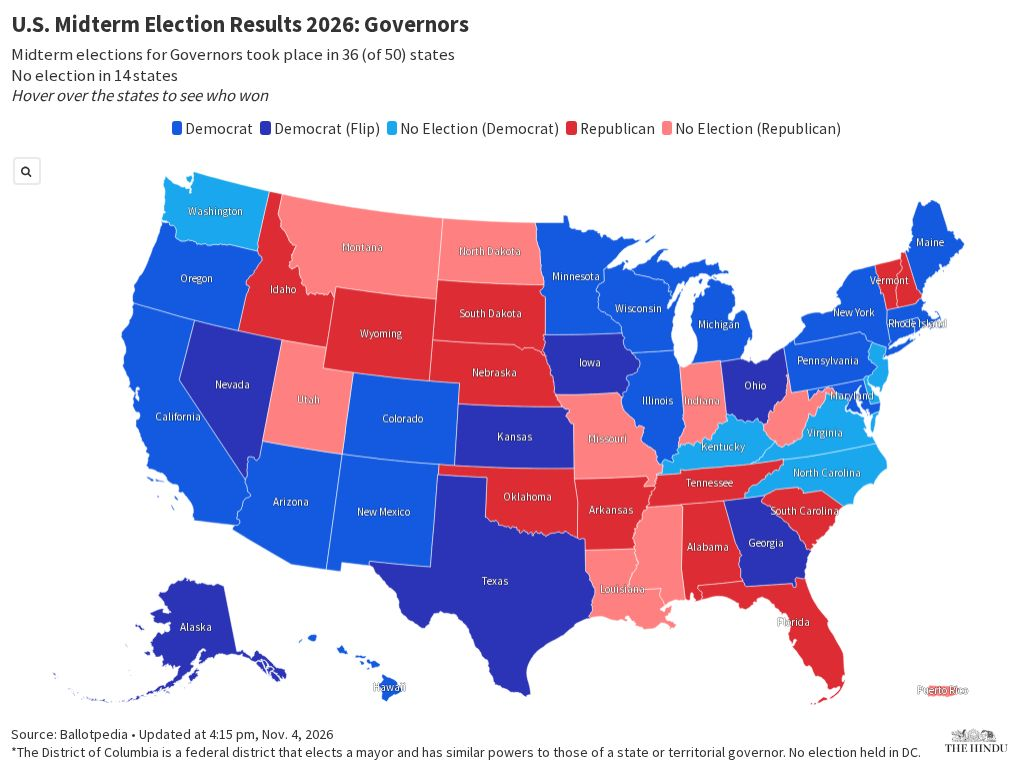
The “midterm elections” in the US have taken place. While some vote counts are still being finalized, the outcome will not change. It is certain that the Democrats, holding a very strong majority, will control the House of Representatives, and it is all but certain that they will control the Senate as well.
This result comes as no surprise; signs of an impending defeat for Trump had been emerging for a long time and were abundantly clear. He was the only one who refused to see them—even though nearly his entire administration had warned him.
It is no coincidence that Vice President Vance has already distanced himself, stating that the war with Iran and the administration’s relationship with Israel are to blame for the defeat. Rubio is preparing to step down and lay the groundwork for his own presidential bid. Hegseth—the drunkard—is bearing the brunt of the criticism, with Republicans calling for his head.
And what about Trump? He posted a message claiming, “I wasn’t on the ballot; if I had been, I would have won by a landslide.” According to him, everyone else is at fault—except for him.
Any aide who dared to warn him about the disastrous policies he was pursuing was cast out—and ridiculed. He was all but labeled a traitor. He was certainly branded an antisemite and a Nazi. Yet, according to some, Trump bears no responsibility whatsoever for the defeat.
Trump is undoubtedly making political history in the United States—no one can deny that. He is the only president to have faced roughly 90 criminal charges. He is also the president who secured perhaps the most resounding victory against the Democrats—and did so while seeking a second term.
Yet, he is also the man who suffered a crushing defeat in the midterm elections less than a year after his own victory! Furthermore, he is likely the only president to have lost the support of both of his vice presidents!
During his first term, Pence became his sworn enemy; now, in his second term, Vance—barely a year after the election—is already distancing himself.
The only constant in the Trump saga is his support for Israel. For its sake, he initiated a war with Iran. He failed to eliminate the “evil mullahs,” but he did succeed in destroying the trust of his own voters—not by destroying Tehran, but by shattering his two most significant campaign promises: “an end to endless wars” and “America First.”
Political analysts in both the U.S. and Europe agree on several points regarding the outcome of the midterm elections. First, they concur that voters who supported Trump in the presidential election have now punished him for his political inconsistency by casting their ballots for the Democrats.
They also agree that a primary driver of voter backlash was the failure of his economic policy—a policy that effectively evaporated into a series of persistent yet ineffective tariffs, treated as if they were some sort of “magic pill.”
Another factor was his blind support for Israel. Furthermore, his aggressive, “piratical” approach toward Venezuela—along with his inability to bring an end to the war in Ukraine (despite his repeated claims that he could resolve it within 24 hours)—also had a significant negative impact.
The reaction of the U.S. electorate is, in a sense, a healthy one: it is withdrawing support from a president who never stops lying—a president who insists he “won” regarding Iran, even as the rest of America feels embarrassed by the defeat.
On the other hand, the electorate has shifted its support to the Democrats—even though it is all but certain that, had they defeated Trump in the presidential election, they would have pursued the exact same policies that he did! At this point, the structural problem of democracy also emerges:
The fact that Trump lost is a positive, but the fact that the Democrats won is a negative.