


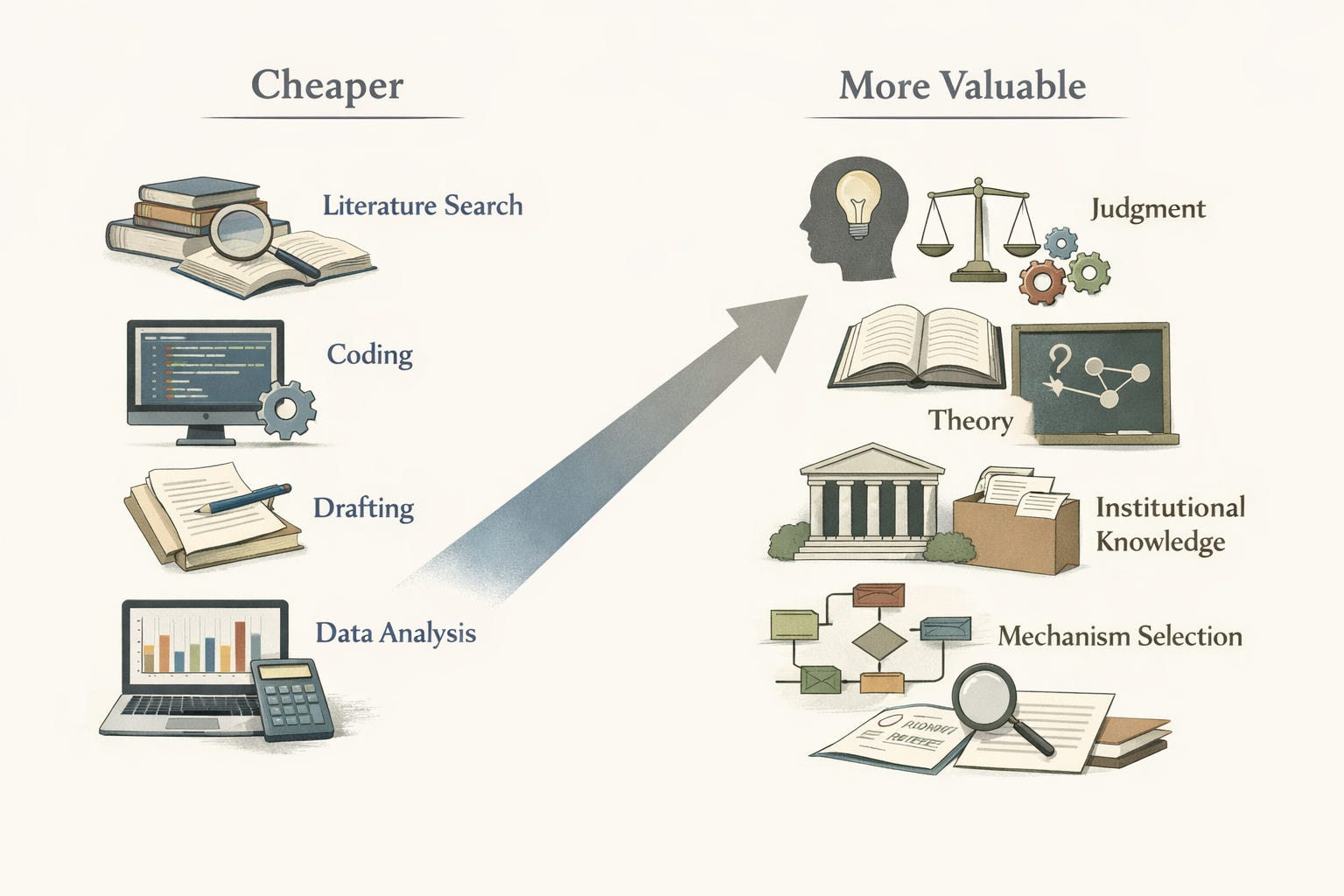
The term AI refers to a flexible set of technological and programming methods for designing computational systems capable of performing tasks that typically require human intelligence—such as learning, contextual understanding, drawing inferences, problem-solving, and decision-making.
Economics and AI
In economics, AI enhances empirical analysis and market forecasting. For instance, machine learning methods can help improve unemployment forecasts.
Specifically, in traditional econometric models, students use their own judgment to pre-select explanatory variables and define the nature of their relationship with unemployment.
A machine learning model, however, can examine more complex correlations among a broader range of determinants, such as job vacancies, business expectations, and consumer confidence.
Subsequently, students will compare the different models to gain a deeper understanding of the distinction between predictive capacity and economic or causal interpretation.
Law and AI
In the field of law, AI offers new possibilities for studying judicial decisions and identifying potential biases. For instance, students can employ sentiment analysis to investigate whether the way judicial texts describe litigants reveals systematic differences based on the litigants’ racial, ethnic, or social identity.
While the uncovering of such linguistic patterns does not automatically prove the existence of judicial bias, it can nonetheless serve as a basis for further legal and institutional reflection.
In this way, students utilize technology to examine critical questions concerning equality before the law, the impartiality of judicial proceedings, and the manifestation of unconscious or institutional biases within judicial practice.
Political Science and AI
In political science, AI significantly expands the analysis of political discourse. For instance, through natural language processing, parliamentary debates can be examined over the course of decades for every EU country.
Specifically, students can determine whether issues such as income inequality or human rights are framed differently, depending on the global context or partisan identities.
Furthermore, the characterization of political discourse enhances economic analyses concerning the labor market, the welfare state, and global developments.
International Relations and AI
In international relations, AI methods facilitate the study of diplomatic communication and foreign policy.
For example, students can compare—using textual similarity—thousands of speeches delivered by states at the United Nations General Assembly to examine how those states approach an international problem.
Specifically, they can determine whether the emphasis in rhetoric regarding climate change is shifting from international cooperation toward economic competitiveness.
Subsequently, economic theory and international relations theory can explore whether these shifts are linked to changes in national interests, international norms, or the geopolitical environment.
Scientists and students in the aforementioned scientific fields can employ AI methods in their research work, while remaining mindful of significant dimensions of AI—such as the ethical use of technologies, the democratization of knowledge, and the safeguarding of individual freedoms and democratic institutions.