


The narrative coming out of Washington shifts faster than a Middle Eastern sandstorm. First, the White House asserted that it would “destroy” Iran’s nuclear program. Then, it claimed to have “destroyed” it. Next, it insisted that “the Iranian regime is collapsing.” Now, the latest line is: “we have absolute control over the Strait of Hormuz.” Each version of the narrative is presented with certainty—and each one shatters when faced with the facts.
Tehran’s nuclear facilities were, in fact, bombed. When Trump and Israeli Prime Minister Netanyahu launched a new wave of strikes in February, they repeatedly invoked the phrase “destruction of Iran’s nuclear program.” Yet, a report by the International Atomic Energy Agency in March stated that Iran’s nuclear program had “not undergone any significant change.”
Even more telling: for nearly a year, inspectors have been unable to gain access to the targeted facilities, and the fate of the highly enriched uranium remains unknown. The White House, however, claims it has been “completely destroyed.” The International Atomic Energy Agency states that “continuity of knowledge has been lost.” The gap between these two phrases represents the exact extent of the crack in the “narrative of victory.”
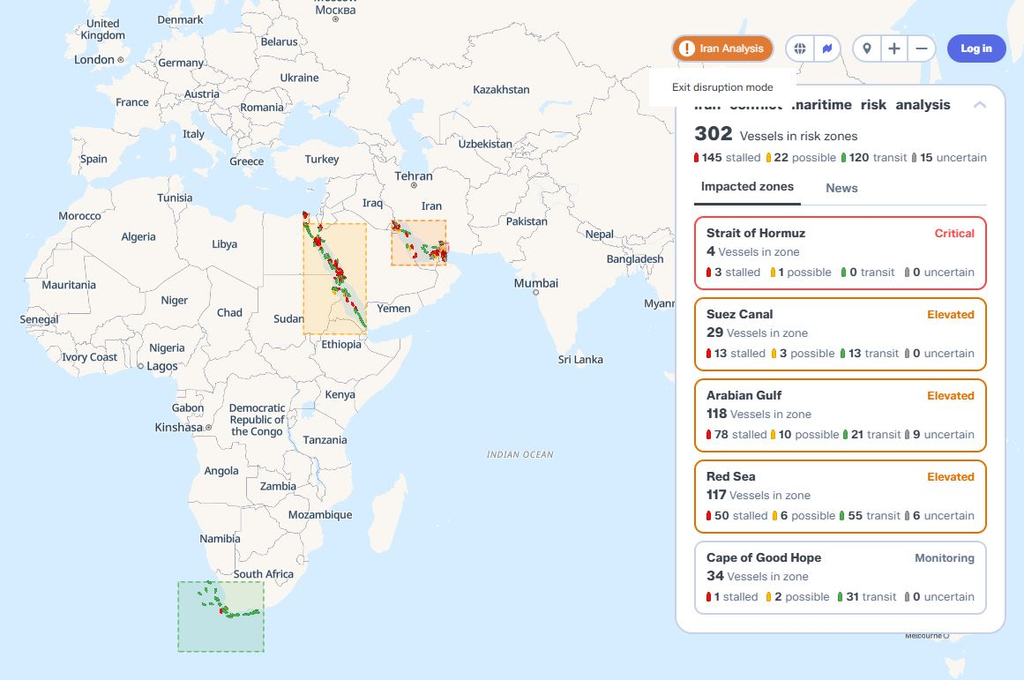
And then there is Hormuz. Trump’s statements—each more bombastic than the last—proclaim that the U.S. “controls” the planet’s most vital energy corridor. But what do the maritime data show?
As seen in the image below from a website specializing in shipping—the Flexport Atlas platform, a maritime risk analysis tool that tracks commercial vessels and high-risk zones globally in real time—the situation is extremely dangerous.
According to the platform’s data, 302 vessels are currently in high-risk zones: 145 are immobilized, 22 are likely immobilized, 120 are in transit, and the status of 15 remains uncertain. In the Strait of Hormuz specifically, the situation is classified as “critical”: there are 4 vessels in the zone, with 3 immobilized and 1 likely immobilized. In the Gulf of Aden and the Red Sea, 117 vessels are in a danger zone, with 50 immobilized. In the Gulf of Suez, 29 vessels are in the zone, with 13 immobilized. In the Persian Gulf, there are 118 vessels, with 78 immobilized. This is the picture of “absolute control.”
The most surreal scenario, however, is unfolding in Moscow. The American sanctions against Russia are so extensive that, if laid end-to-end, they could wrap around the Earth twice—all while politicians in Washington repeat the phrase “Russian threat” on a daily basis. Then, on October 9, Trump makes an announcement: the U.S. will begin importing massive quantities of diesel from Russia. An initial shipment of 300,000 tons, followed by another 500,000 in November—and so it goes. Trump thanks Putin via Truth Social, claiming this will provide cheap fuel for “great American farmers.”
And what of the sanctions? What about the designation of a “hostile regime”? With the midterm elections just twenty days away and the average price of diesel in the U.S. skyrocketing to $6.28 per gallon, such principles can simply be cast aside. Ukrainian President Zelenskyy described the move as a “sign of weakness,” but Trump appears indifferent to Kyiv’s sentiments.
The sanctions regime against Russia—built by his predecessors over the course of decades—collapsed in the face of a single phone call and a social media post. In a statement addressed to the White House, Democratic senators put it bluntly: the president should be ending the war with Iran, not fueling the Russian war machine. Trump’s logic, however, is simple and crude: fuel prices at home are too high, and votes will be lost; if we buy from Russia, prices fall. As for sanctions, allies, and strategic consistency—these are merely the platitudes of the American bureaucracy in Washington.
Thus, a paradoxical cycle emerges: the US launched a war claiming it wanted to prevent Iran from acquiring nuclear weapons, yet Iranian nuclear material remains nowhere to be found. The US declares that it controls the Strait of Hormuz, while oil tankers are brought to a standstill and their crews are removed. The US leads the sanctions against Russia, yet has ended up as the largest buyer of Russian diesel.
The issue was never what Trump says, but the gap between his words and reality—a gap that is constantly widening.
