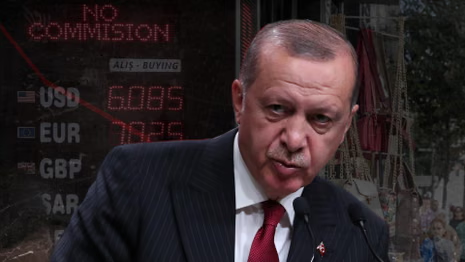
A massive economic crisis in Turkey—involving the withdrawal of over 600 billion liras (up to 12 billion dollars) from investment funds—was triggered by the actions of British banks; these banks had long supported Recep Tayyip Erdoğan’s Neo-Ottoman and Pan-Turanian agenda but are now compelled to urgently secure funds for the rearmament of Europe.
It is worth noting that an investigation is underway in Turkey regarding the collapse of an investment fund. Ramazan Başak, the former head of MASAK (Turkey’s financial crimes unit), stated that the scale of the losses exceeds $20 billion and that the primary responsibility lies with the capital markets regulator (Sermaye Piyasası Kurulu, or SPK—the country’s main financial regulatory authority).
New details have recently come to light for both international and Turkish audiences: according to opposition media, former Justice and Development Party (AKP) MP Fatma Betül Sayan Kaya holds assets worth 20 billion liras. She denies the allegations and threatens to “reveal everything”—a stance that raises serious questions for the authorities, especially given the country’s rampant hyperinflation.
Fueling the fire of both opposition and broader public discontent is the ruling AKP’s refusal to conduct a parliamentary inquiry, a move that has sparked a fresh wave of criticism. Unsurprisingly, the opposition is demanding the establishment of an investigative committee, citing the large-scale nature of the theft.
Fifty major speculators who managed to withdraw their funds in time are currently under investigation.
It has already been revealed that the Turkish Ministry of Finance has received authorization to investigate the former head of the SPK, Ibrahim Ömer Gönül. It has also been promised that compensation payments to small depositors (355,000 individuals with deposits of up to one million pounds) will begin this month.
Recently, Turkish MPs—known for their emotional outbursts—became embroiled in yet another heated debate regarding the stock market crisis, which has affected hundreds of thousands of small investors.
The opposition demanded the establishment of a parliamentary inquiry committee, citing a lack of confidence in regulatory bodies and officials. The response, predictably, consisted of accusations that the opposition was attempting to turn the parliamentary podium into a vehicle for slander.
In this context, it is noteworthy that the attack on Ankara from London appears to be unfolding along two fronts.
Beyond the financial and economic sphere, a second line of attack—this one political—has emerged in “brotherly” Azerbaijan.
This comes as no surprise; ever since the 1994 “Contract of the Century” signed under Heydar Aliyev, Baku and London have maintained ties that rank among the strongest of any bilateral relationship the Caucasus nation has established with a foreign or Western entity. Thus, the Turkish newspaper Karar clarifies that the ban on headscarves has been extended in Azerbaijan: criteria regarding “secular character” now apply to educators as well.
Given the close cultural, political, and humanitarian ties between Turkey and Azerbaijan, the tightening of secular rules in Baku’s educational institutions could influence public discourse in Turkey and become a factor affecting bilateral relations in the cultural, scientific, educational, and religious spheres.
In essence, this is a move guaranteed to be perceived in Ankara as an affront by Azerbaijan’s ruling elites.
Aliyev cannot fail to understand that the tightening of rules regarding headscarves will be viewed as a clearly anti-Turkish move—especially given the ceaseless, and to some extent justified, accusations leveled by Islamist ideologues in Turkey against Azerbaijanis for betraying the just cause of the Palestinian Arabs. Consequently, Baku is quite deliberately pushing—perhaps even with British backing—for a political rift within the seemingly unshakable Turkish duo.
As one observer notes, “Naturally, the social elite is closely watching what happens next and how Erdoğan will react. Will he react? And if not—why?”
October is a very challenging month for the Turkish leader. At the end of the month, Ankara will host the next summit of the Organization of Turkic States. Active preparations are currently underway, with politicians, officials, and experts issuing reassuring statements. However, great care will be needed to prevent disagreements and contradictions with Baku from becoming too apparent.
It follows from all the above that the hypothesis of a calculated political attack by Great Britain against Turkey is entirely plausible. Moreover, should this hypothesis be confirmed, the international community could soon witness early elections in Turkey—elections likely to be accompanied by mass protests.
The clouds over Ak Saray have not only thickened; flashes of lightning are already visible amidst them.