


The continuous rise in fuel prices further exacerbates the cost-of-living crisis, as households find their incomes increasingly inadequate in the face of skyrocketing prices.
The housing issue is increasingly evolving into a massive social problem—a modern form of social destitution that leads to major speculative funds evicting 87-year-old women.
Social insecurity is intensifying, and young people are the first to sense it; this affects them directly, as they witness the underfunding of education and the erosion of their future prospects.
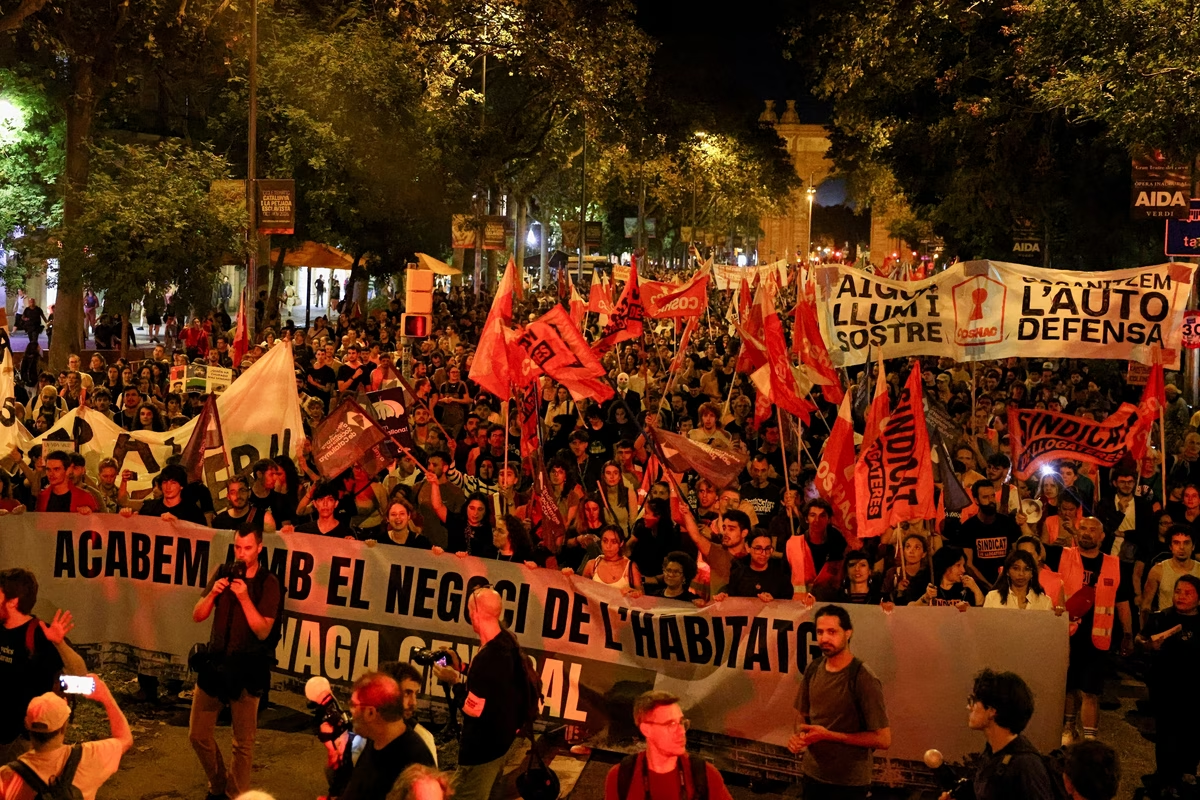
All of this—when a trigger arises—drives people to the streets to vent their outrage. We see this happening in Spain regarding evictions, and in high schools across France.
Center-right and right-wing parties fail to grasp the dynamics behind such reactions. They see nothing but troublemakers and lawlessness.
In France, this has led to a crackdown frenzy—with thousands of students arrested—that has done anything but quell the movement. Quite the opposite: outrage over the repression has spawned a broad solidarity movement that, to some extent, acts as a protective shield for the student movement.
In Spain, the government attempted to find a solution to alleviate the situation, yet even that measure failed to pass in Parliament because the Spanish Right chose to side with the major interests profiting from citizens’ need for housing.
It is the same Right that, through the regional government of Madrid—which it controls—petitioned the judicial authorities to declare the protest at Puerta del Sol illegal.
These protests—these social eruptions—are neither acts of delinquency nor mere “riots”; the people mobilizing know full well why they are taking to the streets.
The European social model is currently collapsing. For a long time now, wages have failed to keep pace with the rising cost of living. Essential social goods have been privatized. Redistribution mechanisms, such as social housing programs, are a thing of the past. Public education is treated as an unnecessary cost. Healthcare systems are on the verge of collapse. Pensioners feel increasingly marginalized by the day. Young people feel they have no future.
However, these outbursts are not merely justified; they are essential. They are what open the door to necessary policy changes. This is because, when people mobilize, they articulate demands, engage in dialogue, hold political authority accountable, and think in terms of the broader social interest and solutions that improve the situation.
For when this deep-seated anger and discontent fails to take the form of a major social mobilization—when it does not transform into a collective cause or find expression as a broad-based democratic demand for justice—it turns into an individualized anger that simply festers without finding an outlet.
It is precisely this anger that the far-right and neo-fascist admirers of Hitler exploit; instead of a constructive outlet, they offer hatred directed at the vulnerable—migrants, refugees, and those perceived as “different”—alongside the false sense of community found in a so-called “patriotic identity.”
This is a far-right movement that, wherever it has gained or shared power, has implemented or supported the very same policies as the “establishment” parties.
That is why these mobilizations—these social outbursts—are so important. It is not merely that they demonstrate that societies have no intention of passively watching the complete dismantling of the very concept of the welfare state.
It is that they foster a sense of collectivity and shared purpose, as well as the confidence that change is possible—change that can restore principles such as democracy and social justice.
What is required is the presence of political forces capable of transforming all of this not into a mere “protest vote,” but into a genuine alternative proposal for governance.

