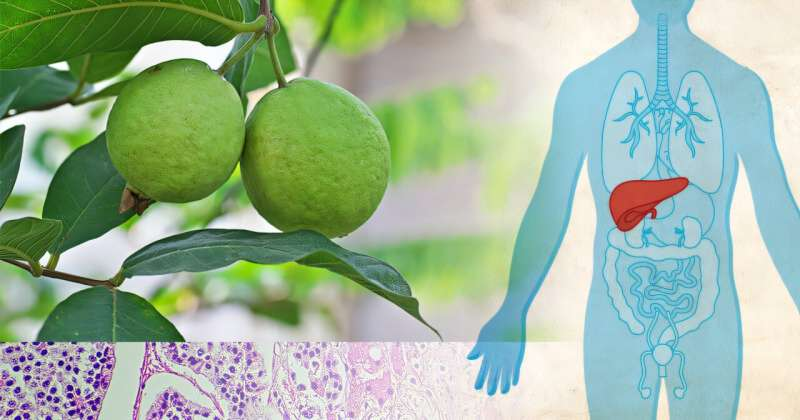


A team of chemists from the University of Delaware in the US has succeeded in synthesizing molecules from the guava plant in the laboratory that demonstrate potent activity against liver cancer.
Guava, a nutrient-rich exotic fruit, contains natural substances that exhibit anti-cancer properties. Professor William Chain and his research team developed an innovative synthetic process that enables the production of these molecules at low cost and in large quantities, eliminating the need for mass harvesting of the plant itself.
The method, published in Angewandte Chemie, (“Enantioselective Total Synthesis of (–)-Psiguadial A“) provides scientists worldwide with a “recipe” for replicating the molecules in the laboratory. This paves the way for further research and collaboration, as well as potential new treatments that are more accessible to patients.
Why is this important?
Liver cancer is one of the deadliest forms of cancer.
The statistics are alarming:
It is estimated that one in 125 people worldwide will be diagnosed with liver or bile duct cancer during their lifetime.
In the US alone, more than 42,000 new cases and over 30,000 deaths are expected to be recorded in 2025.
Current five-year survival rates for advanced stages do not exceed 15%.
This makes the discovery by the University of Delaware particularly significant, as it could lead to treatments that are both more effective and more cost-efficient.
What the researchers say
“The majority of approved drugs are based on natural molecules,” explains Professor Chain. “The problem is that we lack sufficient natural resources to produce them on a large scale. With our method, chemists can follow our ‘recipe’ and create the molecules themselves.”
Dr. Liam O’Grady, the study’s lead author, adds: “We have blazed a new trail. Now, other scientists can explore it, find shortcuts, and improve the method.” “This is the most exciting part.”
From the willow tree that gave us aspirin to the guava, which may pave the way for new anti-cancer drugs, nature continues to reveal secrets of immense importance to our health. The University of Delaware discovery is not yet a cure, but it represents a promising step for the future of oncology and brings us closer to the idea that a tropical fruit could help in the fight against one of the world’s deadliest cancers.