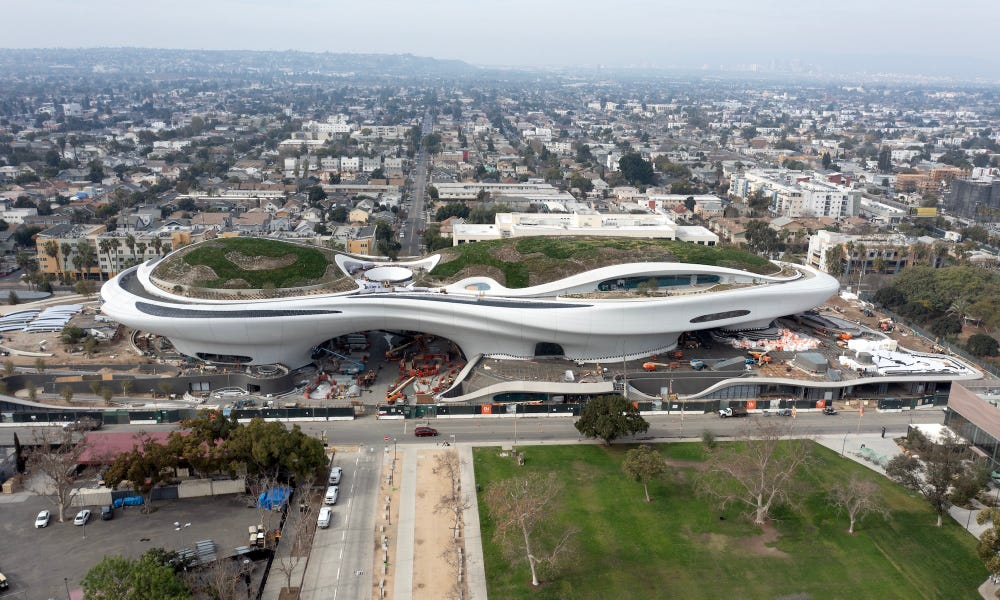
When the bold, asymmetrical curves of the building—now home to the world’s first museum of its kind—”touched down” in Los Angeles’s Exposition Park, everyone wondered exactly what the art of storytelling entails.
And as it turns out, the person best suited to answer is the museum’s founder himself: the American filmmaker who, over several decades, has transported millions of viewers to distant galaxies via the Star Wars saga and captivated them with the adventures of Indiana Jones.
According to the multi-award-winning director, screenwriter, and producer George Lucas, storytelling is the art that takes us on a journey through narrative. In his view, this is a journey that began tens of thousands of years ago—in prehistoric times—when cave paintings were the only medium available for humans to tell the stories they wished to share.
These paintings are among the museum’s impressive exhibits—part of a concept Lucas spent nearly twenty years developing, one that continued to expand and evolve even as the spectacular building and its galleries took shape and rose up amidst the area’s other museums.
With the opening scheduled for September 22, fans and non-fans alike are eager to step into yet another dreamlike universe crafted by the creator of one of cinema history’s most successful franchises.
They look forward to admiring everything from murals and paintings to comics, photographs, and film archives—works that honor illustrators and concept artists while, above all, highlighting the impact of narrative art on culture, imagination, and universal human connection.
Indeed, gazing at the first photos of the Lucas Museum of Narrative Art, one might well imagine it to be another of the extraordinary spaceships born of the director’s imagination, inviting us to explore his unique narrative.
Yet, according to Ma Yansong—architect and founder of the Beijing-based, globally active firm MAD—this structure, which appears to hover in mid-air, tells a different story: it is a giant cloud complemented by a torrential downpour cascading from the fountain-waterfall onto the lawn on the north side.
Beyond its inspired and bold architectural design—which draws visitors into a playful interplay of imagination and optical illusion—the highly anticipated museum offers the chance to share in the experience without even purchasing an admission ticket.
The public green spaces feature an amphitheater, sprawling gardens, and numerous artworks, as well as a fountain crowned by the figures of the legendary Master Yoda and the adorable Grogu—a clear nod to the evolution of the Star Wars narrative over time.
Access to the Education Wing will also be permitted without a ticket via one of the two main entrances; visitors will pass beneath a full-scale replica of the famous Naboo Starfighter from Star Wars: Episode I – The Phantom Menace (1999) to reach the free-access library.
Here, gentle wooden curves envelop the space’s three levels, which are lined with bookshelves housing a diverse range of titles—spanning everything from the history of Industrial Light & Magic (Lucas’s visual effects company) to the complete, provocative body of work by Austrian painter Egon Schiele. Opposite the atrium formed at the level of a central gallery lies the museum’s main wing; at its entrance, the first thing one sees is three cylindrical elevators—featuring a design so futuristic they look as if they came straight out of the Death Star—with Yansong himself describing the experience of using them as a “departure from reality.”
Before using them to explore the museum’s five floors, it is worth visiting the two state-of-the-art screening rooms—where films are shown throughout the museum’s operating hours—as well as the exhibition titled “The History of Narrative Art.”
And while the journey here begins with cave paintings, the final result is revealed on the fourth floor, in the special “Star Wars in Motion” gallery. Fans of the blockbuster film series will be thrilled to see up close the costumes from the first six Star Wars movies, the iconic life-size Podracer flown by Anakin in The Phantom Menace, and the original R2-D2 unit from the 1977 film Star Wars: Episode IV – A New Hope.
Almost every display is accompanied by original concept art from renowned artists such as Ralph McQuarrie, capturing and revealing the genesis of famous scenes and characters—from their initial, static forms to their final incarnations.
The museum’s remaining galleries are grouped according to diverse and interesting criteria. Some are dedicated to artists such as Norman Rockwell, featuring an impressive collection of his iconic works, while others—where visitors are greeted by a bronze statue of Indiana Jones—are organized by theme, such as fantasy, science fiction, and adventure.
Among the approximately 40,000 exhibits, a shot from the Beatles’ legendary Abbey Road album photo session holds a special place, as does an original Banksy stencil in the mural section.
With additional sections based on social themes—such as school, children’s literature, sports, and urban life (the latter including anti-war propaganda dating back to 1971)—every collection and department of the Museum of Narrative Art aims to demonstrate how storytelling through images has permeated every aspect of our lives.
“The best way to understand narrative art is to experience it.”