
The nightmare of the debt crisis is returning to European bond markets. It is not manifesting as the dramatic crisis of 2010–2012 or the threat of a eurozone breakup, but rather through a different mechanism:
- higher interest rates,
- more expensive debt servicing,
- low growth, and
- increasing difficulty for governments in convincing investors that they can stabilize their public finances.
Two of the eurozone’s largest economies—France and Italy—are now at the center of this situation. France currently serves as the most striking example.
France
Two of the eurozone’s largest economies—France and Italy—are now at the center of this situation. France currently serves as the most striking example.
The French Finance Ministry projects that public debt will surge to 119.3% of GDP in 2026, up from 115.7% in 2025, and continue rising to 121.7% in 2027. In 2019, prior to the pandemic, this figure stood below 100% of GDP.
At the same time, France’s fiscal deficit is expected to end 2026 at 5.4% of GDP, despite government efforts to curb it. Prime Minister Sébastien Lecornu has announced a €54 billion cost-saving program for the 2027 budget in an effort to halt this deterioration.
The problem is that the cuts must pass through a deeply divided parliament at a time when social pressure regarding the cost of living is mounting. And the markets have already sent their own signal.
On Friday (September 18), the spread between the French 10-year bond and the German Bund exceeded one percentage point—a level not seen since the Eurozone debt crisis.
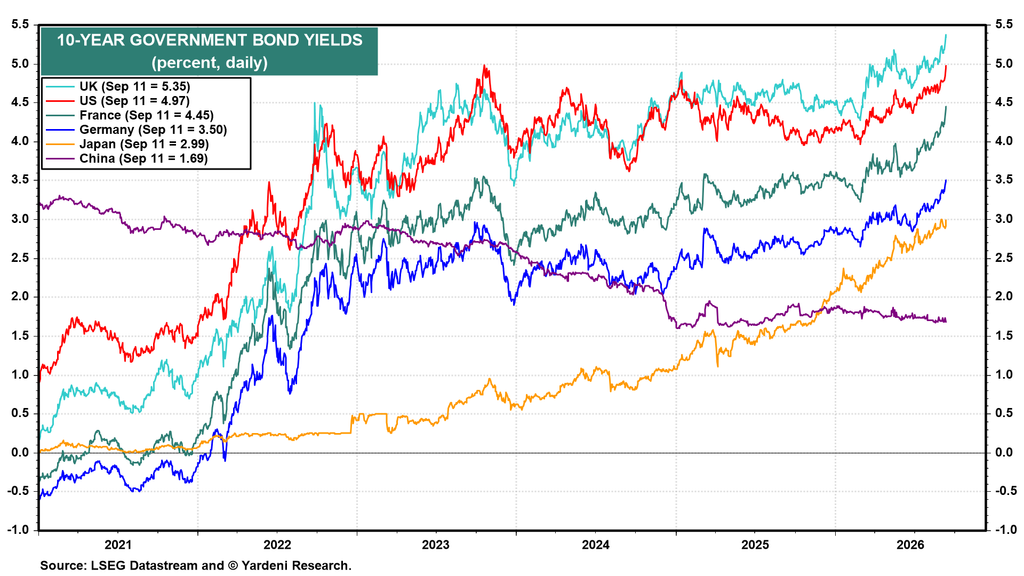
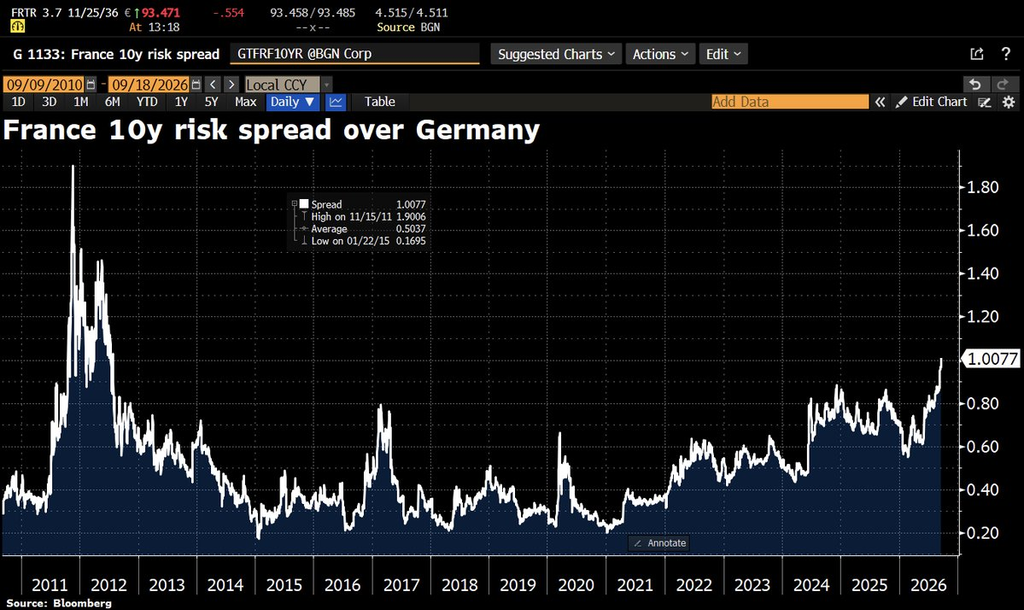
The yield on the French 10-year bond reached approximately 4.46%, as investors demand higher compensation for holding French debt.
Italy
Italy has a larger debt burden—but a smaller deficit. Italy’s situation is different, and perhaps for that very reason, even more interesting.
Rome is entering this same period with a much larger stock of debt. Public debt is projected to reach nearly 139% of GDP by 2026—a level that, according to Economy Minister Giancarlo Giorgetti, will make Italy the most indebted country in the eurozone (surpassing Greece).
He warned on September 18 that debt-servicing costs are rising at an “alarming rate.” However, there is a crucial difference compared to France: Italy’s fiscal deficit is much lower.
Rome is targeting a deficit below 3% of GDP while seeking an early exit from the European Union’s excessive deficit procedure. This implies that the market is not looking solely at the absolute level of debt.
It also evaluates deficit trends, economic growth, financing costs, and each government’s ability to present a credible fiscal strategy. Nevertheless, Italy’s borrowing costs are rising. In a recent auction, the yield on the 3-year BTP reached 3.43%—a high since June 2024—while the 7-year bond settled at 3.98%, its highest level since November 2023.

The shared problem: costlier money
The common factor between France and Italy is not merely their high debt levels; it is that both countries are facing rising borrowing costs during a period of low growth.
Germany, which serves as the benchmark for the Eurozone government bond market, saw the yield on its 10-year Bund touch 3.57% on September 15—the highest level since June 2009. Even after yields retreated, the German 10-year bond remained around 3.50%. This development is particularly significant for highly indebted countries.
The higher the yield at which public debt is refinanced, the greater the interest burden on the state budget becomes over time.
Moreover, the situation could become even more difficult if energy prices remain high. Markets have raised their expectations for further ECB interest rate hikes following the rise in energy prices, while ECB Vice-President Boris Vujčić warned that monetary policy must assess economic data holistically, rather than focusing solely on the trajectory of oil and natural gas prices.
It is not 2011 yet—but the markets are baring their teeth
The current situation differs significantly from the debt crisis of the previous decade. The eurozone now possesses different institutions and safeguard mechanisms, while the ECB has tools at its disposal that did not exist during the last crisis. However, this does not mean the problem is negligible.
At the heart of the current pressure lies the fact that the era of “free money” from the previous decade is over. Governments must now finance massive debt stocks in an environment where investors demand higher yields.
France faces the need for major spending cuts while its deficit remains above 5% of GDP. Italy carries an even heavier debt burden and is seeing its servicing costs rise. And underlying all this is a third factor: growth.
The lower an economy’s nominal growth rate relative to the interest rate at which the state borrows, the harder it becomes to stabilize the debt-to-GDP ratio.
Thus, the new challenge facing Southern Europe is not necessarily a crisis on the scale of 2012. It is something more gradual and, potentially, more persistent: the return of debt costs as a central constraint on economic policy.
And this time, the problem is not confined to the South. The rise in government bond yields has become a European and global phenomenon. The difference is that countries already carrying the heaviest debt burdens have far less room to absorb the shock.
France is now clearly seeing this reflected in its bond spread. Italy sees it in its debt-servicing costs. For the markets, the question is not whether Europe is reverting to the situation of 2011; rather, it is how long governments can manage debt levels of 120%–140% of GDP when money is no longer cheap.
Double upgrade from Moody’s and Scope Ratings boosts Greece
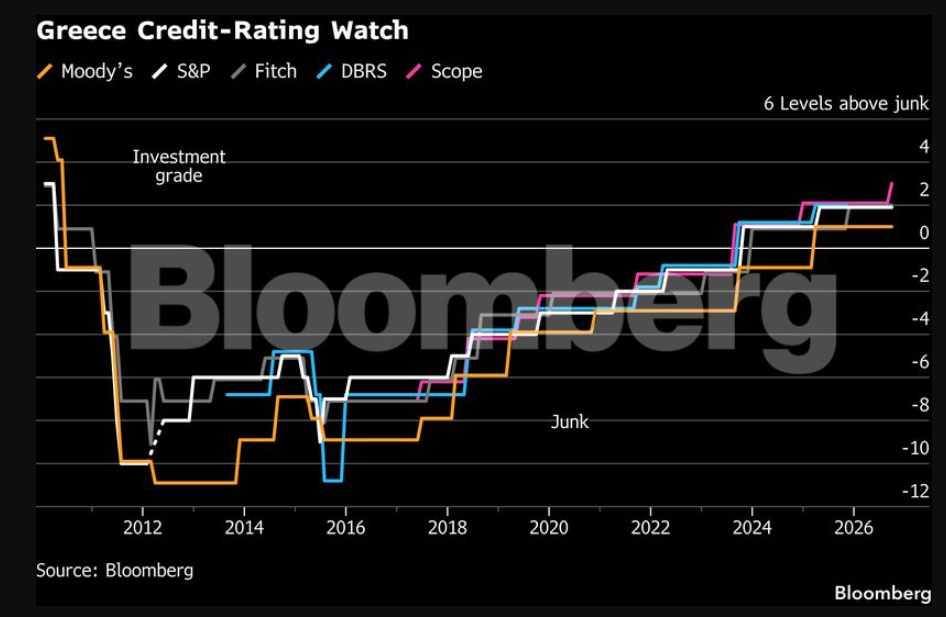
Greece has secured a double upgrade of its credit profile, reaching the same rating level as Italy according to Scope Ratings. Scope upgraded Greece to BBB+, matching the rating it assigns to Italy.
This marks the highest credit rating Greece currently holds among the major rating agencies. Meanwhile, Moody’s Ratings revised the outlook for the Greek economy to positive while maintaining the rating at Baa3—the lowest rung of investment grade.
Debt and primary surpluses behind the upgrade
According to Scope, the upgrade reflects the rapid decline in the public debt-to-GDP ratio and the strengthening of fiscal sustainability.
Also noteworthy is the favorable structure of Greek debt, a significant portion of which is held by states—the public sector—and is not subject to the whims of investor sentiment.
According to the agency, high and sustainable primary surpluses, structural improvements in tax administration and compliance, and a track record of prudent fiscal management play a decisive role.
For its part, Moody’s notes increasing signs that the Greek authorities’ continued commitment to structural economic and institutional reforms is beginning to bear fruit, bolstering the resilience of the economy and public finances beyond previous projections.
These two announcements mark yet another milestone in restoring Greece’s standing as a borrower in international markets, further distancing the country from the debt crisis era. Greek debt set to fall below Italy’s
Greece’s fiscal adjustment has progressed to such an extent that the country is expected to reduce its debt-to-GDP ratio below that of Italy by 2026.
In that event, Italy would hold the highest public debt ratio among major European economies.
Greek yields lower than those of France, Italy, and the US
The shift in Greece’s standing is now also reflected in bond markets. Yields on Greek securities are lower than those of France, Italy, and the United States.
Greece stands out within the European periphery for the strong performance of its fiscal metrics, at a time when investors are growing increasingly concerned about the fiscal situation of other major economies.
On Friday (Sept. 18), a key indicator of risk for French bonds reached a milestone level for the first time in 14 years.
At the same time, the Greek economy is growing faster than many other European economies, while the government’s primary surpluses—which exclude interest payments—consistently exceed targets. Early debt repayments of €13 billion
Stronger fiscal performance is enabling Athens to continue making early repayments to its creditors. The Ministry of National Economy and Finance plans to repay approximately €13 billion in bailout-related debt during 2026, continuing similar moves in the years that follow.
The strategy of early repayments is part of the effort to accelerate the reduction of public debt and further strengthen the country’s credit profile.
Greece is not a… quiet island amidst the Eurozone storm; the economy remains fragile and characterized by low productivity—a minor shock could easily undo whatever recent growth achievements have been made.