


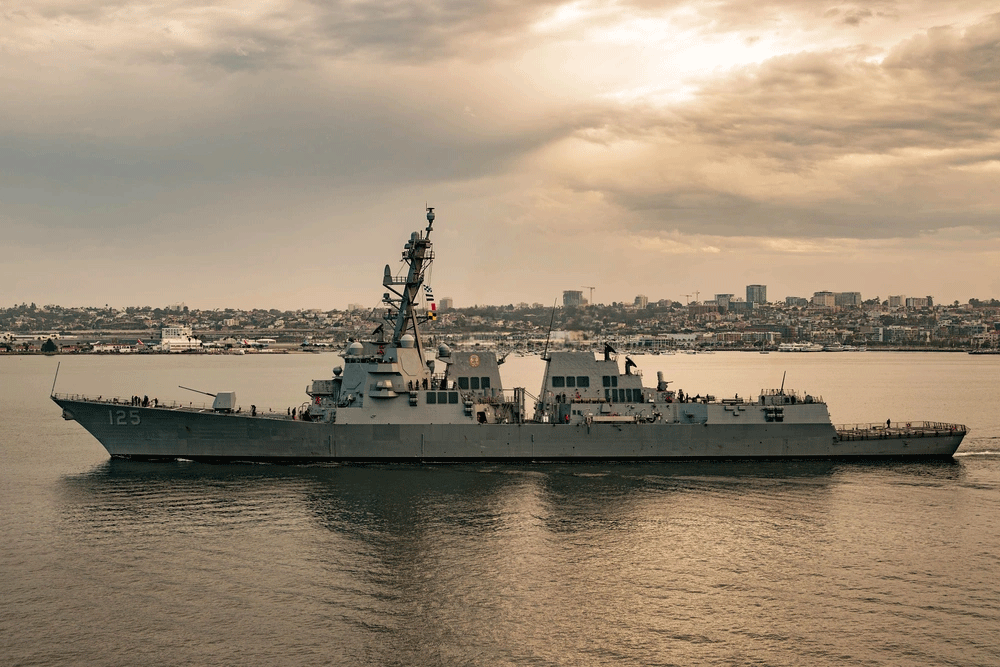
The US Navy is implementing a major technological shift with the Arleigh Burke-class guided-missile destroyers (DDG) by introducing the Flight III variant to the surface fleet.
The Flight III variant represents a revolutionary change rather than a simple, incremental upgrade; it is, in essence, a new type of warship. With two Flight III destroyers already delivered and another 23 under contract or construction at major US shipyards, this new capability is transforming the way the US Navy operates and projects power.
Guided-missile destroyers form the backbone of the US Navy’s surface fleet. These are highly capable, multi-mission vessels that execute a wide range of operations—from maintaining a presence during peacetime to ensuring national security and responding to crises.
As threats in contested environments become increasingly complex, the Flight III variant adapts to these demands by integrating technologies such as the AN/SPY-6(V)1 Air and Missile Defense Radar (AMDR) and the Aegis Baseline 10 system, ultimately making it the most advanced and lethal warship in the US Navy today.
Advanced Radar and Combat System
Aegis Baseline 10 is an advanced combat system designed to manage the massive volume of data generated by the AMDR—the most powerful radar ever installed on a U.S. Navy surface ship.
The radar’s enhanced sensitivity enables the crew to detect, track, and target more complex threats at greater ranges and in less time compared to earlier destroyers.
This technological leap also allows the Flight III destroyer to simultaneously conduct air defense and ballistic missile defense (BMD) operations without any loss in performance, effectively performing the mission of two Flight IIA-class ships.
Upgraded power and cooling infrastructure
For decades, Flight IIA destroyers relied on a traditional 450-volt electrical system. Although highly reliable, this legacy electrical grid is now operating at the limits of its capacity, leaving little margin to power modern, high-energy radar systems or future directed-energy weapons.
The increased sensitivity of the AMDR entails higher power demands for the ship. The 4,160-volt electrical grid on these vessels is designed to meet these needs and provide headroom for future capabilities. Flight III cooling systems have also been upgraded, featuring more powerful air conditioning units and increased capacity.
Flight III vessels also feature upgraded gas turbine generator sets—each rated at 4 megawatts—as well as a modified steel hull to support the weight of the new equipment and systems, resulting in a displacement of over 9,500 tons, compared to the approximately 9,300-ton displacement of the Flight IIA variant.

