



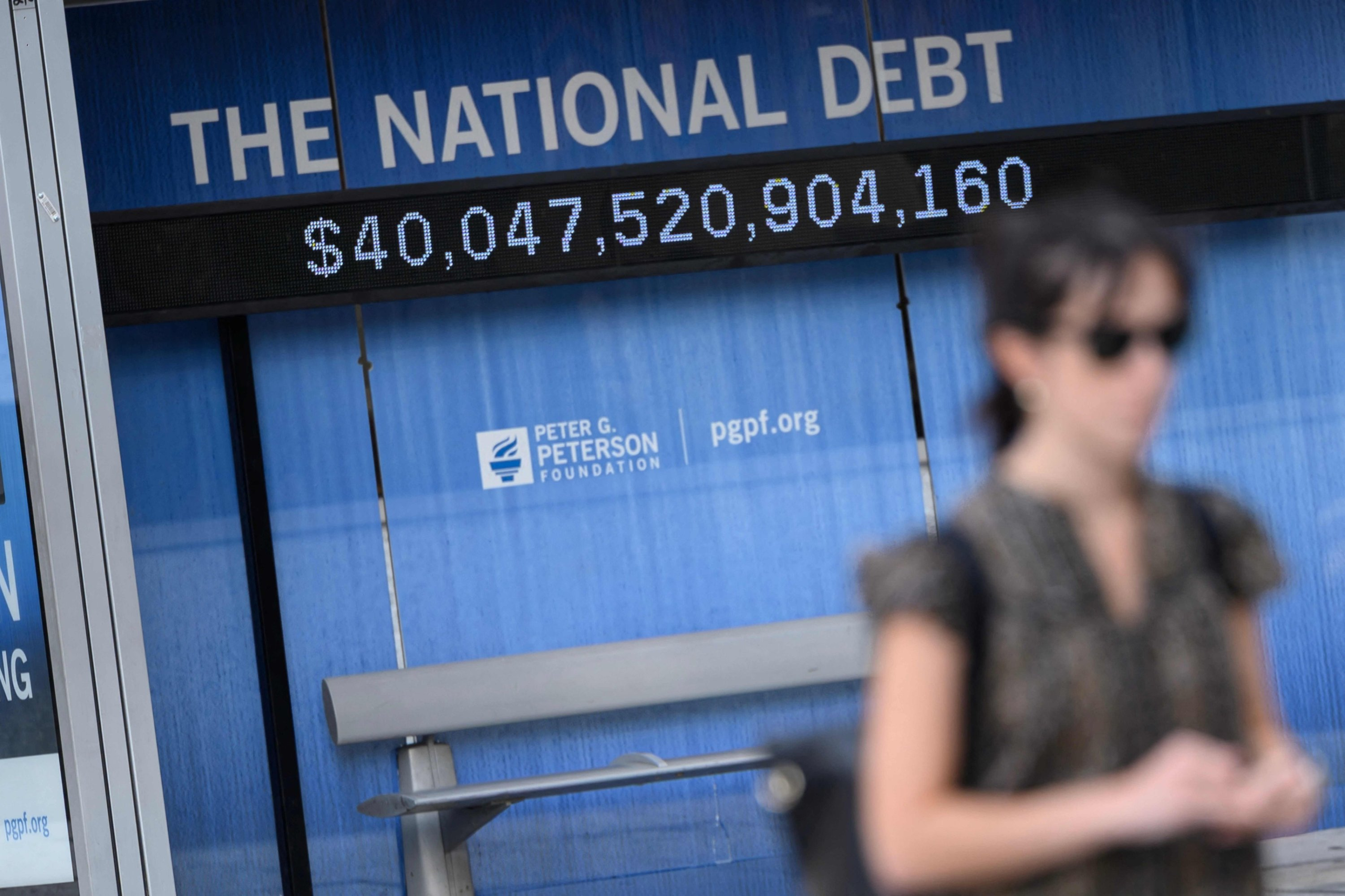
The United States’ national debt has exceeded $40 trillion, according to data released by the Treasury Department on Wednesday, August 19. The Americans who, with such outrageous audacity, demand to regulate the lives of everyone on the planet… owe it to everyone.
On the subject of the US foreign debt, we have written many times in The Liberal Globe and have warned that it is not an accounting problem but an aggressive economic cancer that will kill the patient. The facts seem to confirm us.
The data show that the debt held by the public and intra-governmental holdings amounted to $32.266 trillion and $7.781 trillion respectively. The total outstanding national debt reached $40.047 trillion.
The milestone, which came several months earlier than expected, reflects the fact that the U.S. federal government is spending more than it takes in in revenue, creating annual deficits that add to the national debt.
The federal government has invested trillions of dollars to respond to the COVID-19 pandemic, and has subsequently implemented tax cuts and increased military spending. As a result, the U.S. federal debt has risen rapidly in recent years, causing concerns in the bond market and rising Treasury yields. Increased interest payments have further increased the total amount of U.S. debt.
A monthly report from the U.S. Treasury Department shows that the U.S. federal government ran a budget deficit of $1.367 trillion in the first nine months of fiscal year 2026 (which began on October 1, 2025), with net interest payments totaling $827 billion during that period, exceeding defense spending of $713 billion and trailing only Social Security spending, which came in at $1.244 trillion.
Public debt data
The U.S. federal government debt topped $30 trillion in January 2022, surpassed $39 trillion in March 2026, and reached $39.7 trillion in July 2026.
- Overall picture: The debt has more than doubled in less than a decade, from ~$19.95 trillion in 2017 . This increase comes almost equally from both presidencies, with Trump adding a slightly larger amount .
- The role of the pandemic: The large increase in debt during the COVID-19 pandemic was a common feature of both administrations, with spending exceeding $1 trillion to stimulate the economy .
- Policies and spending: The increase in debt is attributed to a combination of factors, including:
Under Trump: Tax cuts, increased military spending, and “The Big and Beautiful Bill” legislation that is estimated to increase the debt by $4 trillion by 2034.
Under Biden: Massive pandemic recovery packages, infrastructure investments, and clean energy subsidies.
These data show that, regardless of administration, the US public debt has entered a trajectory of rapid and continuous expansion.
Can the US economy recover from the burden of massive public debt?
Thanos Chonthrogiannis, Chief Economist at Trust Economics, an Economic Research and Consulting firm, expresses strong concerns that the US economy is no longer able to recover from the burden of its huge public debt. His arguments revolve around three main axes:
1. Erosion of Resilience: The crisis is not only economic but also political. The political system has become incapable of managing the debt, due to the political deadlock that prevents either tax increases or spending cuts. This has eroded the resilience of the economy, which is no longer what it was decades ago. Symptoms such as rising debt service costs and rising interest rates are considered typical harbingers of an impending crisis.
2. Failure of “Growth Optimism”: The idea that economic growth alone can “solve” the debt problem is considered unfeasible. The United States has no chance of overcoming its debt problem through growth alone. The growth rate that would be required (over 4%) is more than double current projections, while structural spending on programs like Social Security and Medicare remains enormous. Even a potential boost from AI will not be enough in the immediate future.
3. Wrong Policy Interventions: Government attempts to intervene directly in the markets, such as increasing Treasury bond buybacks, are considered dangerous. Such moves constitute “economic engineering” that simply puts downward pressure on the dollar and could lead to a depreciation spiral, similar to the one Japan is experiencing, turning a debt crisis into a currency crisis. A simultaneous and careful implementation of spending cuts, tax increases, and interest rate cuts will be required to avoid huge economic consequences.
In short, the common view is that the American economy has lost the self-correcting capacity it once had. The combination of a huge amount of debt, rising interest rates, and a political inability to make tough decisions creates an explosive mix that makes it extremely vulnerable to a future crisis.
The US obsession with endless wars created this debt
The US obsession with endless wars is not just a foreign policy issue. It has become a deep structural pathology that is systematically undermining the country’s economic base. The costs of this strategy are enormous and multifaceted, far exceeding direct military spending and seriously affecting the long-term sustainability of the American economic model.
Since September 11, 2001, the so-called “war on terror” has cost an estimated $8 trillion. This includes direct military spending, increased spending on homeland security, veterans’ care, and, most importantly, the interest on the loans taken out to finance these wars. But the real cost is even greater: future veterans’ care obligations are expected to add another $2.2 trillion over the next three decades.
The result of this policy is that the enormous debt has reached $40 trillion. For the first time in history, annual interest payments on this debt (about $1.13 trillion) exceed total defense spending ($1.12 trillion). This historic milestone is a red line. It marks the beginning of the end for U.S. economic supremacy, as funds that could be invested in productive sectors, infrastructure, and innovation end up simply maintaining old debts.
Furthermore, the “permanent war economy” has eroded the private economy itself. Billions of dollars are being funneled into an oligopolistic defense industrial sector at a disproportionate cost. Warren Buffett has commented that F-35 fighters would cost $40 million instead of $400 million if Amazon built them.
This distortion not only wastes public funds, but also fosters corruption through the political influence of defense giants such as Lockheed Martin and Raytheon. At the same time, the government, faced with the dilemma of funding wars, is cutting spending on education, health, climate change and social welfare, shifting the burden to the most vulnerable citizens.
How do empires collapse?
Empires become weak from internal erosion and corruption. But they always collapse due to external factors. The historical event that marked the definitive fall of the Western Roman Empire from an external factor was the fall of Rome by the Vandals in 455 AD, as well as the final overthrow of the western throne in 476 AD by the German army of Odoacer. Another emblematic event was the First Fall of Rome by the Visigoths in 410 AD.
If you think the United States has not been completely conquered, conquered, or subdued, you are kidding yourself. By whom, I will let you answer that for yourself.
In conclusion, the American obsession with endless wars is not only a military or moral mistake, but an economic suicide.

