



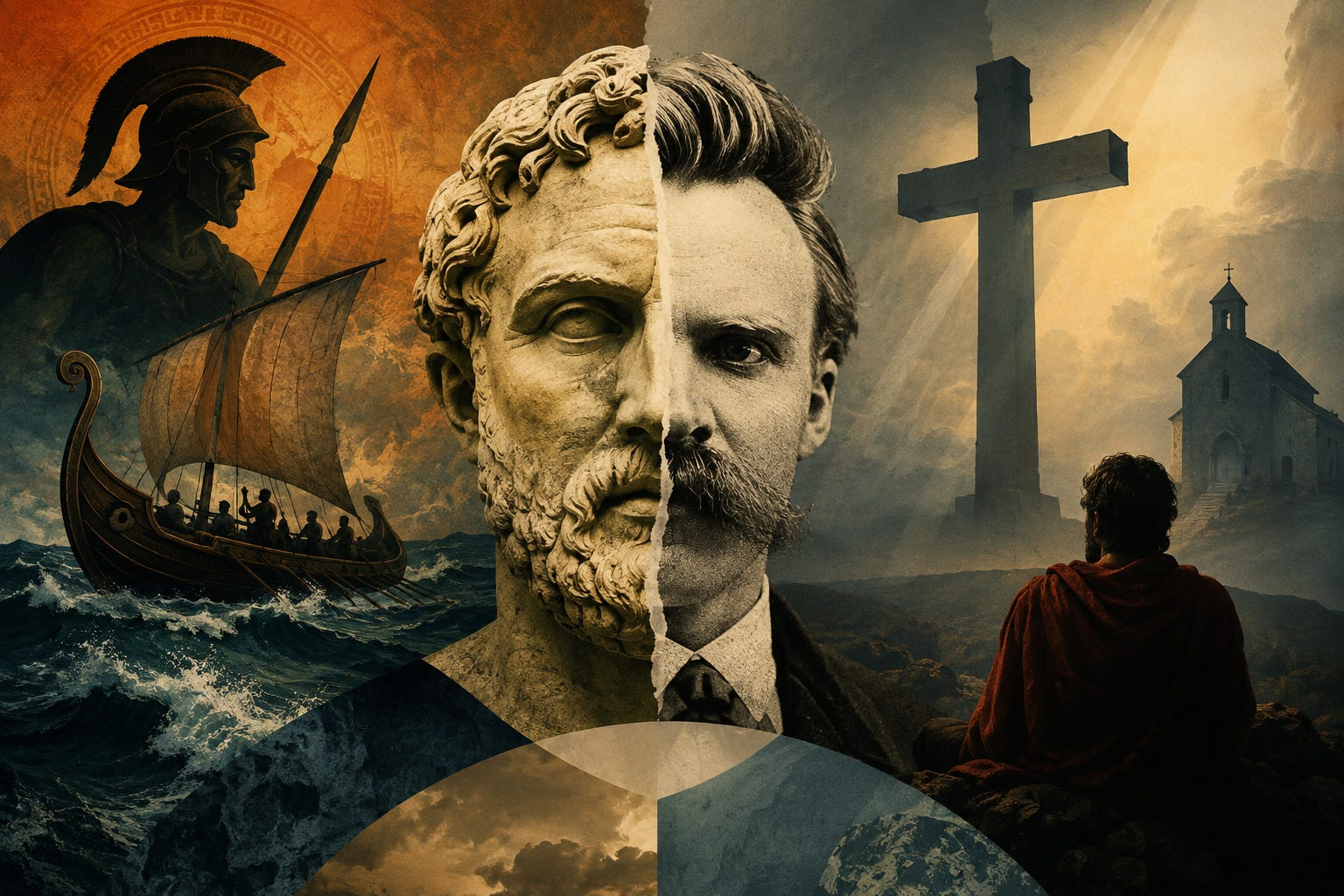
Friedrich Nietzsche saw Homer as the ultimate symbol of the Apollonian dream, a cultural savior who rescued ancient Greece from despair by transforming the terrifying, violent reality of existence into a beautiful, affirming myth. Rather than seeing Homer as a simple beginning of Greek culture, Nietzsche argued that Homer represented the masterful triumph over a deep, dark history of human pain and anxiety.
In his early masterpiece, The Birth of Tragedy, Nietzsche calls Homer the “dreaming Greek.” Our ancient ancestors felt acutely the horrors of nature and the cruelty of life. To survive, they created the bright, shining world of the Olympian gods. Homer was the artist who solidified this vision, placing a beautiful healing illusion between humans and their despair. The Homeric gods do not judge human sin. On the contrary, they justify life by living it themselves.
In his short, posthumously published (1901) essay “The Homer Competition” or “Homers Wettkampf”, Friedrich Nietzsche explains how the ancient Greeks viewed “competition” (amilla). [This work is the fifth of the “Five Prefaces to Five Unwritten Books” – “Fünf Vorreden zu fünf ungeschriebenen Büchern”, written in 1872. The Wettkampf was written by Nietzsche, who collected it, along with four other similar “prologues to unwritten books”, and gave their compiled edition to his close friend Cosima Wagner – wife of Richard Wagner – as a Christmas present].
Nietzsche says that the Greeks used jealousy and competition in a masterful way: They did not simply seek to destroy their opponent, but to become better themselves through the contest. This noble competition helped ancient Greece produce great athletes, poets, and philosophers.
Nietzsche explores the dark, violent history behind the Iliad. He notes that the early Greeks possessed a “tiger’s thirst for blood” and unbridled cruelty. Homeric society successfully channeled this raw, destructive hatred into healthy competition. This healthy conflict is known as the Hellenic Agon (“Contest”). Rather than seeking to annihilate an enemy, citizens competed to outshine one another in sports, art, and politics. Nietzsche believed that this very competitive drive was the driving force that made Greek civilization flourish and progress.
In his later writings, such as The Genealogy of Ethics, Nietzsche contrasts Homeric values with modern ones. Homeric heroes such as Achilles and Odysseus represent the “Ethic of the Masters.” This pre-Christian moral framework values strength, honor, conquest, and pride. It stands in stark contrast to the later “Ethic of the Slaves,” which celebrates humility and pity. Nietzsche deeply admired the Homeric world because it affirmed the natural instincts of life rather than feeling guilty about them.
Friedrich Nietzsche carefully examined Achilles and Odysseus to understand the true psychology of the ancient Greeks. He did not see them as mere heroes of some “fairy tale,” but as raw symbols of human instinct, strength, and an absolute passion for life. While modern readers sometimes see Odysseus as a cunning liar, Nietzsche deeply admired him for that very reason.
Nietzsche argued that Odysseus represents the highest Greek ideal, even more so than Achilles. His greatest weapon was not his physical muscles, but his sharp, agile mind. He possessed a single-minded passion to triumph over his enemies by any means necessary. His clever lies, verbal manipulations, and elaborate disguises were signs of a healthy, vital spirit practicing the art of survival.
Achilles represents the raw, elemental power of Greek martial virtue. Nietzsche used Achilles to highlight with a vivid example the Greek impulse “to excel always and surpass others” (“aien aristevein kai ipeirochon emmenai altres”). This unbridled rage and the competitive pride of the unsurpassed warrior were not considered “sins” or “bad” by the early Greeks.
On the contrary, the story of Achilles shows a culture that affirmed its darkest instincts rather than hiding them out of shame. Nietzsche noted that Achilles represents a pure, aristocratic pride that completely rejects modern ideas of humility.
The poignant “Scene of the Underworld” is the Ultimate Praise for Life: Nietzsche often highlighted a famous scene from the Odyssey, where Odysseus visits the Underworld and speaks to the ghost of Achilles. In the story, Achilles famously declares that he would rather be a poor slave on earth than rule over all the dead.
Modern readers often interpret this as evidence that Achilles supposedly regrets his choice of a short, glorious life. Nietzsche completely disagreed with this interpretation. He argued that this verse was a wonderful song in praise of earthly life. It proved that the Greeks loved existence so much that even the absolute worst life on earth was better than a golden afterlife palace in the other world.
In “The Genealogy of Morals,” Nietzsche also made a famous psychological point about the creators of these heroes: “Homer would not have created an Achilles if Homer had been an Achilles.” He believed that true art requires distance. A true warrior like Achilles is too busy fighting and bleeding to create beautiful poetry. Homer was able to sculpt these perfect heroes only because he stood back and dreamed them up from a distance.
Friedrich Nietzsche places Homer and his epics at the center of Western civilization, not simply as the intellectual products of an ancient poet, but as works that have shaped the imagination of Europe for more than two thousand years. He argues that the greatness of the Iliad and the Odyssey cannot be understood simply by asking who wrote them, because that question belongs to a much broader inquiry into how cultures preserve, transform, and remember their greatest creations. The epics are valued by European-Western humanity as apparently perfect works of art, admired by countless generations, and treated as models that later writers could imitate but never surpass.
Yet the more scholars examine them, the more uncertain Homer’s figure becomes. The poet seems almost to “disintegrate” under the weight of legend, tradition, and conflicting interpretations. Nietzsche does not see this as a reason to abandon Homer, but as an invitation to think more deeply about the relationship between genius, history, and cultural memory.
The real question is not simply whether Homer existed as a man, but why these poems became inextricably linked to his name, and what this tells us about the way cultures create their heroes.
The enduring power of the Iliad and the Odyssey, with their vivid depictions of courage, suffering, homecoming, and human endurance, proves that great literature has a life beyond the historical circumstances of its creation.
Nietzsche turns to the Homeric question, presenting it as the clearest example of this conflict. The problem is not simply whether Homer existed as a historical figure, but how modern academic research should approach the origins of the Iliad and the Odyssey.
Older generations accepted Homer without question, while later critics began to separate the poems into multiple levels and … authors. Nietzsche does not reject these investigations, but insists that they should be understood as part of a broader search for truth and not as acts of destruction against the ancient tradition.
It traces the history of Homeric scholarship from the ancient Greeks to Friedrich August Wolff, whose most important work was the Prolegomena ad Homerum (1795), in which he challenged the traditional belief that Homer was the sole author of the Iliad and the Odyssey.
Ancient scholars believed that the poems had been transmitted orally before they were written down, and they recognized that later editors and singers had modified parts of them. Wolff revived these questions in modern times and showed that even the most venerable traditions must be examined critically. For Nietzsche, this represented a significant advance, because it demonstrated that history could challenge inherited beliefs without abandoning respect for the cultural achievements of the past.
Nietzsche argues that the very name “Homer” changed meaning over time. In the early period, it did not necessarily refer to an identifiable poet, but served as a symbol for the entire tradition of heroic epic poetry.
Only later, as Greek artistic judgment became more sophisticated, did Homer become specifically identified with the Iliad and the Odyssey and eventually come to represent the supreme model of poetic perfection. Thus, the familiar image of Homer is not simply a historical fact, but a multidimensional result of centuries of cultural interpretation.
According to Nietzsche, the task of classical literature is therefore to understand how they were created and why they continue to exercise such extraordinary power over the Western imagination.
According to Nietzsche, the perfection of the Homeric poems is not to be sought in the flawless design, but in the extraordinary power of their individual scenes. The Iliad does not resemble a perfectly unified structure, but rather a magnificent decorative chain, a garland woven from countless brilliant images.
Later editors may have imposed greater organization, but this does not diminish the colossal artistic achievement. The poems’ timeless greatness lies in their living power, not in their abstract structural symmetry.
Nietzsche, therefore, reaches a striking conclusion. He believes in the existence of a great poet behind the Iliad and the Odyssey, but he does not believe that this poet corresponds to the legendary figure traditionally called Homer.
The historical name belongs to myth and cultural memory, while the artistic achievement belongs to an exceptional but ultimately unknown creator. The legend and the work should not be confused, even though both have now become inseparable in the history of Western civilization.


