The survival of a warship in the modern naval arena no longer depends solely on the power of its weapons. The rapid development of anti-ship missiles, unmanned aerial vehicles (UAVs), loitering munitions and underwater threats has transformed self-protection into one of the most important pillars of naval power.
Recent conflicts in the Red Sea, the Black Sea and the lessons from the war in Ukraine have shown that even the most advanced warships can be confronted with massive saturation attacks, where dozens of different threats appear almost simultaneously. In this environment, the discussion is no longer about whether a ship should have Soft Kill or Hard Kill systems, but how to effectively combine both categories to create a comprehensive multi-layered defense system. Even traditional proponents of Soft Kill systems such as the French Navy are currently developing Hard Kill systems that are being deployed or will be deployed in the future, such as the MPLS system, on their ships.
Soft Kill Systems
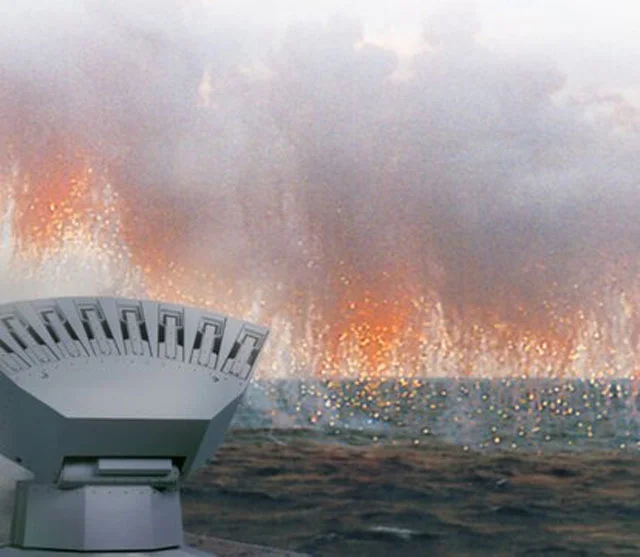
Soft Kill is defined as any means that do not attempt to physically destroy the threat, but rather to disorient, deceive, or deprive it of the ability to properly locate its target. The Soft Kill philosophy is particularly attractive, as neutralizing a threat can be achieved at a much lower cost than launching an interceptor or point defense missile.
The most well-known Soft Kill systems include:
- BAE Systems Mk 36 SRBOC, which launches chaff and infrared flares.
- Rheinmetall MASS (Multi Ammunition Softkill System), which is used by many European navies and can launch different types of countermeasures depending on the threat.
- Leonardo ODLS-20, a modern electronic countermeasures launch system.
- Terma C-Guard, which combines sensors and automatic deployment of countermeasures.
- Nulka Active Missile Decoy, perhaps the most successful active decoy in the world, which was developed by Australia and the USA. Instead of simply creating clouds of chaff, it hovers over the sea emitting an electromagnetic trail larger than that of the ship itself, drawing in many anti-ship missiles.
At the same time, modern electronic warfare systems are an integral part of Soft Kill. Typical examples are:
- AN/SLQ-32(V) SEWIP Block III of the US Navy.
- Thales Vigile.
- Saab SME-150.
- Indra Rigel EW Suite.
- Elbit Deseaver Mk II, for countering torpedoes.
These systems can detect, identify and jam enemy radars, sensors and guidance systems even before the missile is launched and are assisted by Soft Kill systems during the terminal defense phase.
Soft Kill has changed dramatically over the past twenty years. Early anti-ship missiles primarily used single-pulse radars, which were relatively easily fooled by a cloud of chaff. Today, however, missiles feature:
- active AESA radar,
- infrared sensors (IIR),
- passive RF sensors,
- GPS/INS,
- image recognition algorithms,
- Electronic Counter-Counter Measures (ECCM) capabilities.
This means that Soft Kill is no longer just about blinding the missile. It must create a convincing alternative image of the target, alter the electromagnetic environment, and exploit the weaknesses of the enemy’s sensors. And DRFM (Digital Radio Frequency Memory) technology is now the basis of many advanced jammers, as it allows the incoming radar signal to be digitally copied and modified, creating false targets in an extremely realistic manner.
Hard Kill systems
Hard Kill aims for the complete physical destruction of the threat. This includes all weapon systems that intercept the missile before it reaches the ship.
From long-range missiles, area air defense such as: SM-2, Aster 30 or Barak-8 and others. But basically when we talk about hard kill systems we usually refer to medium-short range missiles such as ESSM Block II, CAMM Sea Ceptor, Aster 15 or VL MICA NG but mainly to CIWS terminal defense systems of guns or missiles such as Phalanx Block 1B Baseline 2, Goalkeeper, the 35 mm Millennium Gun, the RIM-116 RAM or the DART system for OTO Melara 76 mm guns.
Modern reality creates a serious operational dilemma. A long-range missile can cost several million euros or dollars, while a commercially available UAV or a home-made drone can cost a few thousand. Intercepting every cheap threat with expensive missiles is not economically viable, especially in protracted operations or against saturation attacks. For this reason, most navies turn to the concept of cost–effective engagement, that is, choosing the most economical but adequate means of dealing with each target.
The next generation of self-defense systems will be based on sensors that work together through artificial intelligence. The ship will automatically recognize: the type of threat, the guidance sensor, the speed, the probability of a successful Soft Kill, the probability of a successful Hard Kill, and the Combat Management System will decide within seconds which combination of countermeasures should be used.
At the same time, new directed energy weapons are being developed. The navies of the US, the UK and other countries are already testing 50–300 kW lasers, which can destroy UAVs and small boats with a cost per shot that is essentially limited to the required electricity of a few euros or dollars. Where the cost compared to 20 mm tungsten bullets or DART missiles is zero. Accordingly, High Power Microwave (HPM) systems promise to neutralize entire swarms of drones through electromagnetic pulses that destroy their electronic circuits. Or electronic warfare systems such as CENTAURUS that have proven the ability to neutralize UAV systems.
The philosophy of multi-layered defence
Today, no advanced warship relies exclusively on a single form of protection. The international trend is to develop an integrated defense grid:
- Distances over 100 km: long-range missiles (SM-2, Barak Aster 30).
- 20–50 km: ESSM Block 2, CAMM or similar point defense systems.
- 5–20 km: electronic warfare, active decoys and chaff.
- 1–5 km: RAM or SeaRAM. or CIWS guns such as Phalanx or Millennium Gun.
Soft Kill operates throughout the engagement, while Hard Kill is activated when physical interception is required. Their simultaneous use significantly increases the probability of survival. So in the future, where threats will become more numerous, smarter and more sophisticated, this combination will be even more necessary than ever.
Conclusion
The question “Soft Kill or Hard Kill?” no longer reflects the modern reality. The success of a warship against the complex threats of the 21st century does not depend on the choice of a single type of defense, but on the harmonious cooperation of sensors, electronic warfare, active and passive countermeasures, interceptor missiles and close protection systems.
As anti-ship missiles become faster, smarter and more resistant to countermeasures while threats increase with loitering munitions, swarms of suicidal UAVs, USVs or UUVs, warships will evolve into fully network-centric self-defense platforms.
Artificial intelligence, advanced electronic warfare algorithms, active decoys, lasers and lower-cost interceptor weapons are expected to shape the new paradigm.
The future, therefore, belongs neither exclusively to Soft Kill nor exclusively to Hard Kill; it belongs to smart, integrated and multi-layered defense, where each system works complementary to the others, maximizing the ship’s survivability even in the most demanding operational conditions.