



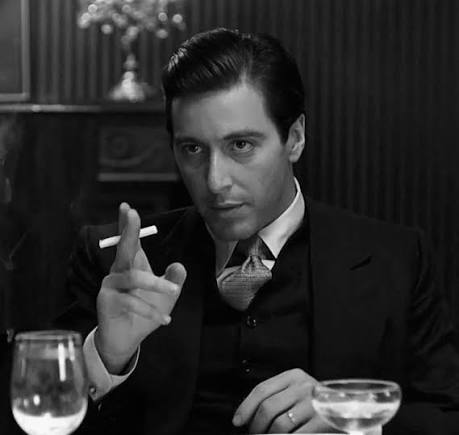
In 2025, during an informal discussion with reporters on Air Force One, the US president interrupted a reporter who was asking him about the Epstein files, telling her abruptly: “Quiet, quiet, you pig!” Is this behavior the end product of a culture celebrated by the films “Citizen Kane,” “Michael Corleone,” “Howard Beale,” and “Dr. Mabuse”?
This seems to be the view of the well-known and experienced film critic David Thompson, who in a provocative book, A Sudden Flicker of Light, describes cinema as “a fantasy machine”, “a parasite of reality” that “has begun to diminish our humanity” and “has turned us into spectators who are half-aware that they cannot acquire what they see.”
The unconventional Thompson even goes so far as to reject classic films, feeling “more than remorse” for the decades he devoted to cinema, “as if he were honoring society and history.” In fact, he even seems to attribute the rise of Donald Trump to the influence of films.
Indeed, President Trump could not have built his MAGA brand without learning a few tricks from the image industry, according to American author Michael O’Donnell, who summarizes that Thompson concludes, among other things, that the camera loves violence.
One of Thompson’s main arguments is that cinema “flatters murderers or those who do forbidden things.”
In World War I, Thompson writes, the machine gun “operated much like a movie camera, one bullet or frame at a time.” With the advent of sound, beginning with The Jazz Singer in 1927, the clapperboard “was as imposing as a gunshot.”
Violence infuriates viewers, Thompson believes, and he admits that he once found himself trying to be as tough as Robert Mitchum. He dismisses the work of Francis Ford Coppola and Martin Scorsese, believing that they were “deeply influenced by something in the medium itself that is attracted to arbitrary power and the brotherhood of the gang or family.” Gone with the Wind, he writes, perpetuated the myth of the American South and contributed to a form of violence against history itself. In other words, analyzing many of the films Thompson tackles in his book, along with Riefenstahl’s work and the sensual depiction of violence in The Godfather and The Good Boys, creates the sense that cinema—“movie,” as Thompson calls it in his book—was “constantly building something rotten and that punishment awaits us all.”
“The pessimistic sentiment that the book exudes is the antithesis of the enthusiasm with which Martin Scorsese talks about the magic of cinema. The distance between a creator like Scorsese and a critic like Thompson is like the difference between an open horizon and a dark room,” says O’Donnell.
Another film critic, Jordan Hoffman, discerning Thompson’s pessimism, tells Foreign Policy that “this is a mind that has been in dialogue with cinema and filmmaking for decades, and this summary reads like something he felt he had to get out of himself.”
No, it’s not the movies’ fault
However, some may disagree with Thompson. Sure, you can see Donald Trump reflected in Citizen Kane’s endless hall of mirrors. But that’s no reason to stop watching movies.
On the other hand, Gone with the Wind and The Godfather were based on a novel, i.e. literature, which Thompson considers superior to the big screen.
It’s true that cinema is in crisis. Movie theaters are closing, superhero blockbusters are struggling, screens are getting smaller, videos are getting shorter, and artificial intelligence is threatening to replace them all.
Thompson’s conversion may be surprising, but it is not surprising that a critic of his caliber should question the enduring value of cinema. The question of the influence of cinema is worthy of serious discussion.
Perhaps Trump’s rise is due more to the most primitive human instincts than to any cultural product. It is certain that films do us no harm, since, among other things, you as a viewer have the education to distinguish good from evil and reality from fantasy.


