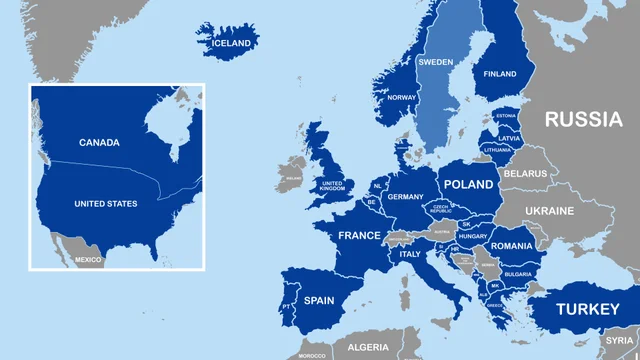
The NATO Summit in Ankara reflected the strategic transition that has been taking place in the Alliance in recent years. The main message of the Summit is recorded in an excerpt from the text of the Declaration of its results.
Specifically, it is noted: “NATO’s deterrence and defense are based on an appropriate mix of nuclear, conventional and missile defense capabilities, complemented by capabilities in space and cyberspace. We are committed to maintaining our combat advantage.
“We are investing in our ability to develop, sustain and sustain our armed forces, as well as to achieve the operational capability goals set for all areas of operations, including deep precision strikes, integrated air and missile defense, unmanned systems, cutting-edge technologies and information capabilities. We are developing an interoperable transatlantic warfighting cloud and adopting powerful artificial intelligence models.
In essence, the report says: “Investing in our ability to develop, sustain and sustain our armed forces, as well as to achieve the operational capability goals set for all areas of operations, states that NATO is moving from an Alliance of Deterrence by Power, to one that seeks Deterrence by Readiness.”
This is understandable and normal, given that in today’s hybrid operational environment the Alliance faces not only the possibility of a conventional military conflict, but a complex environment where conventional military threats, hybrid operations, cyberattacks, attacks on critical infrastructure, information influence operations and technological competition are combined. Also, NATO is not abandoning combat platforms (Platform-Centric Warfare), but is integrating them into a network-centric operational ecosystem (Network-Centric Warfare).
| Until the Summit Alliance of Deterrence | After the Summit Readiness Alliance |
| Collective Defense | Continuous Readiness |
| Deterrence Through Power | Deterrence Through Integrated Power and Continuous Readiness |
| Military Capabilities | Military Capabilities and Defence Industry |
| Crisis Response | Continuous Preparation for Strategic Competition and High-Intensity Warfare |
| Military Capability | Military Capability and National Resilience |
| Defence Planning | Holistic Defence with the Participation of the Whole of Society |
| Military Logistics Support | Strategic Logistics |
| Weapon Systems – Combat Platforms | Weapon Systems – Combat Platforms – Data – Use of Artificial Intelligence – Networks |
Therefore, the big change is not that NATO is abandoning deterrence through force. It is that it is redefining deterrence through readiness, resilience and the ability to compete for long periods of time and to shape an integrated ecosystem of national and allied power.
Specifically, in NATO’s new strategic concept, deterrence is no longer exclusively a product of military power. It is the result of the combined operation of military, industrial, economic, technological, informational power and national resilience.
In conclusion, Deterrence for the Alliance is no longer a static state of power, but a state of continuous production, renewal and maintenance of power. In this context, NATO today (after the conflicts in Ukraine and the Middle East) is no longer limited to preparing for a conflict. It is also preparing for the event that deterrence fails and the ability to conduct and sustain sustained high-intensity operations is required.
In particular, operational effectiveness will no longer be assessed solely on the basis of the available number of weapons systems and their quality, but also by the member country’s ability to maintain high force availability, rapidly replenish critical equipment stocks, protect its critical infrastructure, secure its supply chains and utilize advanced technologies, such as artificial intelligence, unmanned systems and integrated digital command and control networks.
From a geopolitical perspective, NATO’s strategic transition to a “Readiness Alliance” is of particular importance for all Alliance member states, as it changes the way in which the strategic value of each state will be assessed. In particular, criteria such as geographical location and military contribution to NATO operations remain necessary, but are no longer sufficient.
In the new strategic framework, the following now acquire significant importance:
- the defence industrial base,
- technological innovation,
- the resilience of critical infrastructure,
- energy security,
- the capabilities to support allied operations, and
- the ability of a member country to function as a reliable hub for the transfer of forces, materials, and information.
Consequently, the real challenge for each member country of the Alliance after the NATO Summit in Ankara is not simply to monitor the structural changes taking place in the Alliance, but to understand their strategic significance in a timely manner and to adapt its national defense planning accordingly to the logic of the “Ready Alliance”.
Because, the power of a state in NATO’s new strategic environment will not be determined only by the number and quality of the weapons it possesses, but by how ready it is to withstand, adapt, continue to operate, as well as to produce, maintain and renew its power in an environment of constant strategic competition.