Brussels seeks to act as a geopolitical force with increased common spending, but without any agreement on who will ultimately bear the cost.
At the heart of the discussion was Spain’s proposal, presented at the Eurogroup meeting in Brussels, to create a European mechanism that could issue up to 850 billion euros in common debt per year.
The initiative of Spanish Economy Minister Carlos Cuerpo envisages the creation of a “European Sovereign Debt Mechanism”, through which the European Commission would undertake the issuance of part of the member states’ borrowing.
The Commission would then issue European bonds and channel the funds to the states in the form of loans.
According to Spanish calculations, if all member states participate, the mechanism could create a common European debt market of around €5 trillion within five years, a size that Madrid considers necessary to create a truly safe European asset in euros.
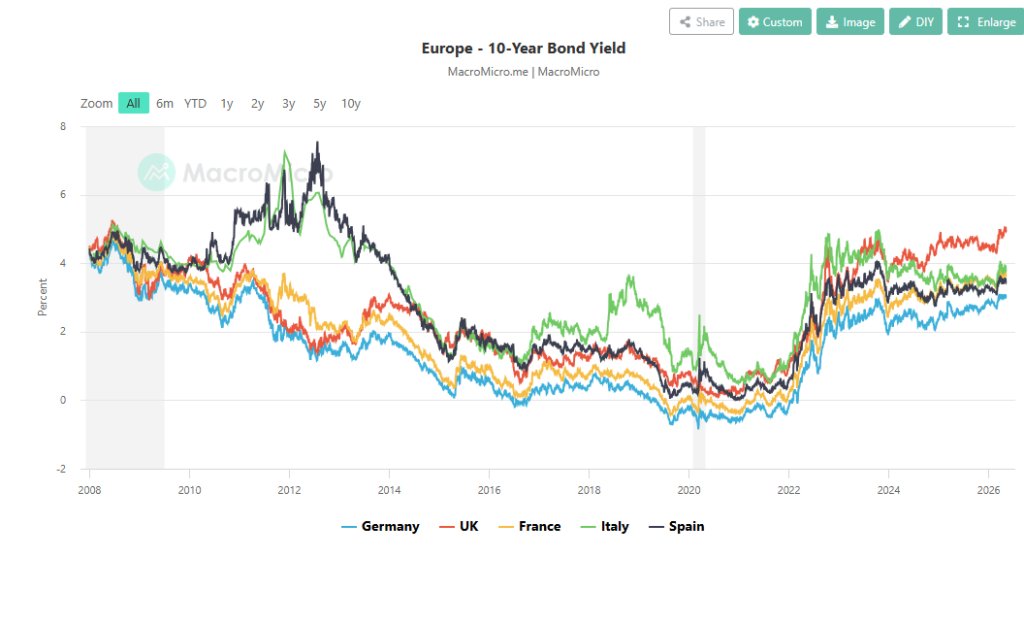
At the same time, it is estimated that European governments could save up to €25 billion a year in interest.
To put things in perspective, it should be noted that this was the amount that Mario Draghi activated to protect Europe from the consequences of the financial crisis with his famous statement that he had “done whatever was necessary”…
The Spanish government argues that the proposal does not increase the total public debt of the European Union, but simply reorganizes the way it is issued.
The new architecture… through devaluation
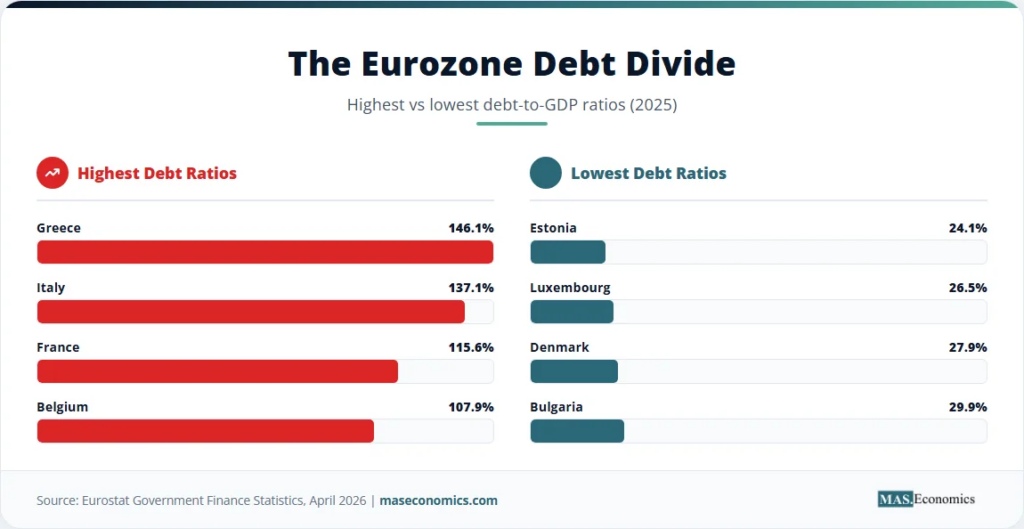
However, the political dimension is clear: it is one thing for each state to be accountable to the markets alone for its public debt, and another to create a permanent architecture of common European borrowing, which will ultimately be based on the European budget and, by extension, on European taxpayers.
The proposal caused immediate reservations from some of the largest economies of the European Union – which, however, have to face the thorny issues of the budget, but also the way to finance the defense spending from which they will benefit with “golden contracts”, such as the industries of Germany and France.
So they will necessarily and de facto be dragged towards that by sliding because no government – neither the French nor the German – can politically defend common borrowing, which does not have a large number of supporters in the major economies.
The Euro, the Dollar and Assets in the European Currency
During the meeting of Eurozone finance ministers, Germany and, to a lesser extent, France were among the countries that questioned the plan to centrally manage part of national borrowing, according to Liberal Globe sources familiar with the discussions.
The proposal was considered in the context of the effort to strengthen the international role of the euro as a reserve currency. It estimates that the creation of a large and deep market for common European bonds could significantly increase the attractiveness of the euro on international markets.
However, several countries remain opposed, arguing that joint debt may weaken incentives for fiscal discipline and create the so-called “moral hazard”, i.e. the tendency of some governments to increase their borrowing knowing that the burden will be shared at the European level.
During the closed talks, Germany, the Netherlands and Finland argued that the priority should be to strengthen the fundamentals of the European economy and not to create new joint borrowing mechanisms.
France and Austria also focused their reservations on the risk of a relaxation of fiscal discipline.
While of the countries that took a position, only Portugal expressed clear support for the Spanish plan.
The timing and the European budget
The timing is not considered accidental. Berlin has already rejected the prospect of increasing the Multiannual Financial Framework (MFF) for the period 2028-2034 and is calling for cuts of around €400 billion in a European Commission proposal that is close to €2 trillion.
Germany, as the largest net contributor to the EU budget, considers the size of the next EU budget excessive and has said that it will be difficult to reach an agreement if current spending levels are maintained.
If the EU budget meets Berlin’s objections, many believe that Brussels will seek alternative sources of financing through the issuance of joint debt.
Such a solution is presented as a tool to strengthen Europe’s strategic autonomy and the international role of the euro, without appearing as a direct increase in community spending.
Where could the funds be directed
Although the Spanish proposal does not formally link the new mechanism to specific spending, the broader geopolitical environment refers to the financing of European defense, support for Ukraine, the military industry, critical infrastructure, cybersecurity and industrial adaptation related to the rearmament of Europe.
NATO is also intensifying pressure on member states to significantly increase defense spending, aiming to reach 5% of GDP by 2035, while continuing economic and military support to Ukraine.
Europe needs a safe European asset
European Central Bank President Christine Lagarde said it was “quite obvious” that the European Union needed a European safe asset capable of competing with US government bonds.
Eurogroup President Kyriakos Pierrakakis said the proposal would be examined further and that the relevant consultations would continue at a technical level.
For his part, European Commissioner Valdis Dombrovskis recalled that the discussion on common European debt was not new, but was gaining new momentum in the context of negotiations on the next seven-year budget of the European Union.
French Finance Minister Roland Lescure described the Spanish proposal as interesting, but warned that it could create incentives for greater borrowing by some states, since the debt would be shared across the European Union.
Despite reservations, he stressed that the euro must become stronger, deeper and more liquid in international financial markets.
If a mechanism for issuing up to €850 billion of common debt per year is finally implemented, it will not be just a technical change in the way Europe borrows.
It will signal a fundamental change in the European Union’s fiscal architecture, transferring a significant part of fiscal sovereignty from member states to the European level.
Increasing defense spending is now a one-way street for Europe, but the real question is not just how much it will cost, but whether it can boost growth without derailing public debt.
ESM report – The defence industry will boost the production model
In its latest report (“Euro Area Stability Watch 2026“, June 2026), the European Stability Mechanism (ESM) argues that the economic impact of the new arms cycle is not predetermined.
If investments are properly designed, they can return a significant part of the fiscal cost to the economy, through higher productivity, higher growth and increased tax revenues.
In a special chapter, the ESM examines the cost of European defence support at a time when eurozone countries are being asked to increase their military spending towards NATO’s new target of 3.5% of GDP.
For the eurozone, this translates into additional spending of around €45 billion per year by 2035, while many economies still face high public debt and limited fiscal space.
The composition of spending
The ESM’s key finding is that Europe is not only lagging behind in terms of the amount of defence spending, but also in the way it allocates it.
Today, over 40% of the European Union’s total defence budget goes to staff salaries, around a third to goods and services, and just 20% to investment.
Even more tellingly, research and development (R&D) accounts for just 3% of total defence spending, compared with 12% in the United States.
According to the ESM, this chronic underinvestment in innovation maintains Europe’s dependence on non-European suppliers of critical technologies and limits the benefits that could be spread to the rest of the economy.
Productivity
The report presents new data on more than 1,300 defence companies and around 1.2 million non-defence companies in the four largest eurozone economies (Germany, France, Italy and Spain).
The analysis shows that defence companies have:
- around 40% higher total factor productivity (TFP),
- 35% higher investment intensity,
- higher capital intensity, higher wages than their counterparts in the civil economy.
Although the sector accounts for just 1.9% of the economy’s total turnover (and around 4.5% of manufacturing), it is one of the most technologically advanced sectors of European industry.
The ESM points out that the greatest economic benefit does not come from the final production of weapons systems, but from the network of companies that support them.
According to the report, 85% of the intermediate inputs used by the European defence industry come from companies within the eurozone itself. This means that each large defence order activates an extensive network of suppliers, who invest in new equipment, technologies and production processes.
The study estimates that a 10% increase in defence investment intensity leads to an increase in supplier productivity (TFP) of around 0.08%, with the greatest benefits occurring in companies that are already close to the technological cutting edge.
These spillovers come from both investment in capital equipment and expenditure on research and development.
How does the fiscal cost come down?
The main finding of the report is that defence spending can partly finance itself.
The ESM baseline scenario considers a permanent increase in defence spending of 1.5 percentage points of GDP, phased in over ten years.
Of this, one third is for personnel and two thirds for investment and equipment procurement, initially financed through borrowing and then debt is restored to its original levels through spending reallocation rather than through tax increases. The results show that:
- without productive spillovers, the state recovers around 25 cents for every additional euro of defence spending through higher economic activity and tax revenues,
- with strong productivity spillovers, the recovery increases to 53 cents per euro, reducing the net fiscal cost from 1 euro to 47 cents.
The most important mechanism for this recovery is employment and wage growth. According to the report, around 40 percentage points of the overall self-financing rate (53%) comes from increased labour incomes, which broaden the tax base.
Debt remains the big risk
Despite the growth benefits, the ESM warns that the burden of public debt remains real.
If increased defence spending is accompanied by permanently higher public debt, real interest rates rise, private investment is constrained and a larger share of public resources is directed towards debt servicing.
In contrast, when governments accompany defence spending with a credible medium-term fiscal adjustment plan, borrowing costs remain lower and more of the growth benefits are preserved.
Equally important is the method of financing. The report considers it preferable to redistribute existing spending over increasing taxes, as placing a burden primarily on labor reduces employment, limits growth and can evaporate a large part of the fiscal benefit.