


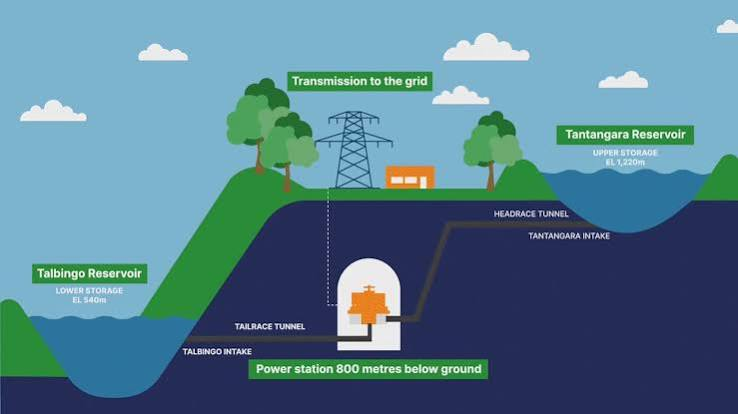
Australia is moving ahead with one of the most ambitious energy projects in its history. It is Snowy 2.0, a massive underground hydroelectric power station being built 800 metres underground in the Snowy Mountains of New South Wales and is set to be a key part of the country’s energy transition.
The project, led by Snowy Hydro, is one of Australia’s biggest bets, traditionally heavily dependent on coal, to boost the stability of its electricity grid and accelerate the integration of renewable energy sources.
The 2,200-megawatt “water battery”
The infrastructure, designed as a giant “water battery”, will use four large metro tunnels to excavate a complex network of galleries connecting the Tadangara and Talbingo reservoirs.
When operational, the facility will have a capacity of 2,200 megawatts and will be able to store up to 350 gigawatt hours of energy, enough to power three million homes for a week.
Snowy 2.0 is based on the reversible pumping system, a technology that allows the storage of excess energy from sources such as solar or wind. Its operation is based on the fact that when the demand for electricity is low and there is a surplus of renewable production, water is pumped to the upper reservoir, and when demand increases, this water is lowered and drives turbines to generate electricity.
This model transforms the station into a massive storage system, which is essential for offsetting the volatility of clean energy. Unlike chemical batteries, the hydraulic system allows water to be reused over and over again for decades. In fact, Snowy 2.0 is designed with an estimated lifespan of 150 years, making it a multi-generational infrastructure and a strategic asset for Australia’s long-term energy security.
The “impossible” tunnel
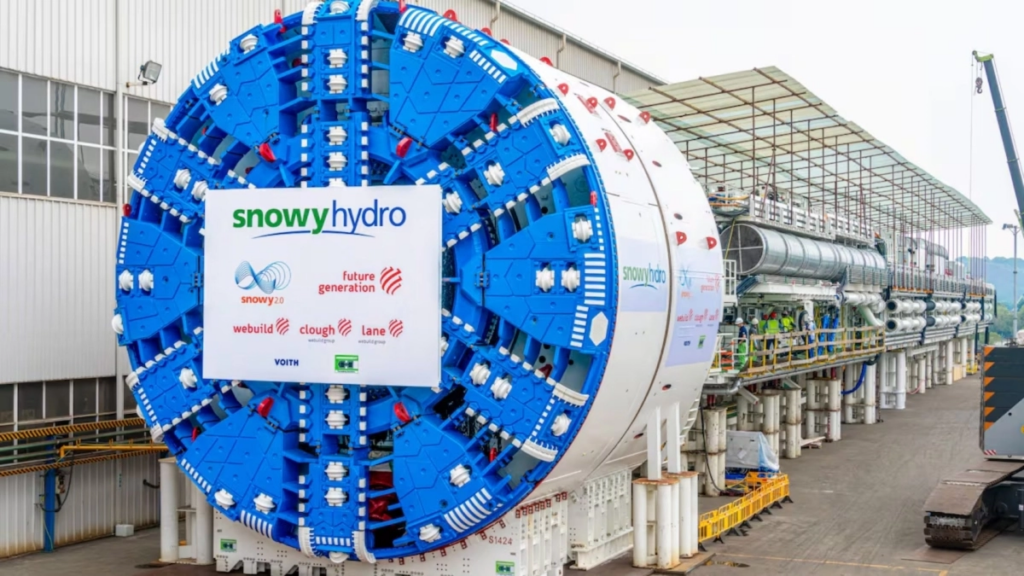
One of the project’s major players is Monica, the fourth metropod to be integrated into the project. This giant machine is working to drill a 9.9-metre diameter intake tunnel that will connect the Tadangara reservoir to the underground station.
The technical challenge is enormous, as the metropontine must cross the complex Long Plain Fault Zone, a geological formation particularly difficult due to its instability and hardness.
But it wasn’t just the excavation that was a challenge, as transporting the necessary components to assemble Monica was an administrative undertaking of immense complexity. The most impressive was that of the cutting head, the rock-drilling component consisting of a 137-tonne, seven-metre-diameter central block, which had to travel from the port of Port Kembla to the project site.