



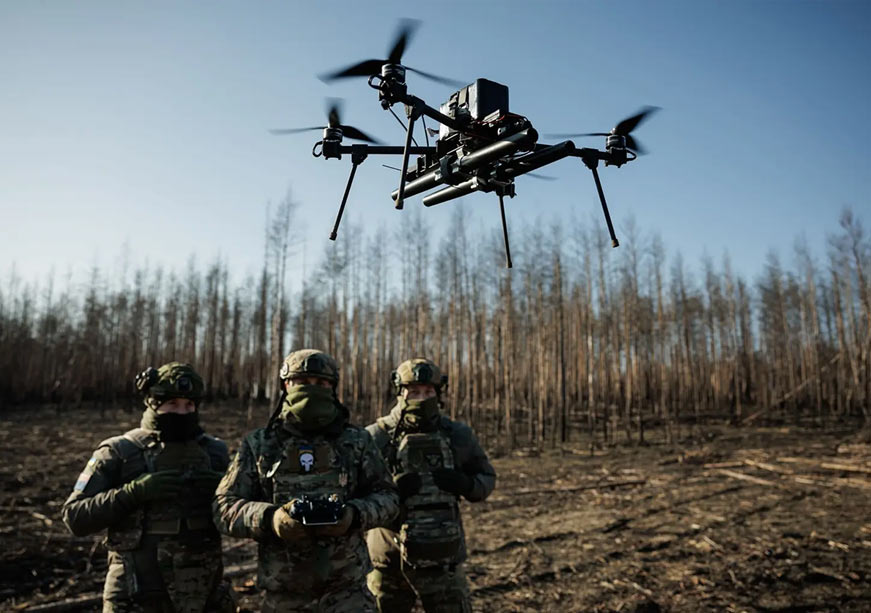
The continuation of carpet bombing (type of bombing) from the air with highly optimized means is achieved today with the use of drones. The carpet bombing tactic was developed during World War II, recalling the historic bombings of Dresden and Cologne and later the US bombings in Vietnam, such as Operation Linebacker. The advantage of drones in war:
- There are no losses in either aircraft or crews.
- In addition, the probability of hitting specific, predetermined targets is much higher.
- Also, with the reduction of costs and the reduction of risk, the harmful effect increases.
Obviously, the rapid development of drone technology has changed warfare. A front, such as still exists today between Russian and Ukrainian forces on the ground, as still exists in Lebanon between Israelis and Hezbollah, will no longer exist in future wars. We have already observed this war without a front in its entirety in the Israeli-American war against Iran, and we see it also in the war in Ukraine, although there is still a front on the ground.
Therefore, every military think tank and every military staff is inevitably concerned with the question of finding a highly effective but cheap solution to counter drones. The difficulties that must be overcome are enormous. The problem that must be addressed is the “overload” of air defense, since there is no upper limit to the production of large quantities of cheap, disposable unmanned aircraft.
Similarly, the number of drones attacking simultaneously in swarms is completely open-ended. Furthermore, it is not possible to predict where the drone launch sites will be and what flight paths they will follow to attack which targets.
Once the drones are in the air, the warning times are too short to concentrate mobile air defense units at the expected attack points. Depending on the range of the defense systems, sufficient “everywhere” capacities must therefore be maintained to withstand a drone storm. This does not seem feasible with both the available and the systems under development, for reasons of prohibitive cost.
Therefore, the design and deployment of defense against drones is a problem that cannot be solved with known principles for constructing defensive structures, especially since not only are the number of drones used, the time of attack, and flight paths difficult to predict, but also the question of which of the objects to be protected will be the target of a current attack remains open almost until impact.
We will analyze the above thinking by applying a logical thought experiment
Let us assume that there are a thousand infrastructures that are worth, that should be, protected, while the attacker can produce a thousand drones every day. Let us further assume that the country under attack has an external border of about 2000 km and the common border with the enemy is 1000 km.
Since it is not possible to predict at what point the enemy will send its drone swarms across the border and in what temporal and spatial mass, the defense must be configured in such a way that it is so strong along the entire border that it can repel a selective invasion of 1000 drones at any location. Either a large number of relatively inexpensive systems with short ranges at short distances, or, because of the longer flight time of drones, relatively expensive systems with longer ranges, could theoretically offer almost 100% protection.
However, the realistic scenario is that although the enemy can produce 1,000 drones a day, he does not need to use 1,000 drones every day. Especially at the beginning of a drone war, 10,000 drones could be used in a first wave and the entire protective wall of air defense collapses under the overload.
This problem also arises when it is not the border line that needs to be secured, but every important infrastructure that needs to receive its own protection from drones. That is, once the drone swarms are in the air, there is no comprehensive defense for them. Those who want to prevent the defense system from being overloaded overload their military budget by procuring maximum surplus capacity of defense systems.
There is, of course, the view of many military experts that the best way to defend against drones is to prevent them from taking to the air in the first place, or better yet, to prevent their production in the first place. But even in this case the enemy has the advantage, because it is easy to decentralize and hide drone production facilities and warehouses.
Even with the use of the most advanced satellite technology and AI-supported assessment, it is not sufficiently possible to locate the facilities without a large number of spies on the ground. Without permanent comprehensive reconnaissance, there are no targets that could be combated. Even high-precision hypersonic ballistic missiles are not really helpful.
No defense against drones is currently strong enough
It is becoming obvious that no anti-drone defense is currently strong enough to provide real protection against drone swarms. We see this from the daily news:
- Russia cannot adequately protect its infrastructure.
- Ukraine cannot protect its infrastructure as well.
- Israel cannot protect itself.
- The US cannot protect its bases in the Arabian Gulf.
It should also be noted that the use of cheap drones, even in large quantities, causes much lower costs than anti-drone defense. Providing defense systems at a national level alone requires more effort than setting up drone production factories, and a single shot of a defense system with a range of >10 km costs more than the drone that was shot down.
There is no doubt that drones will continue to become much smarter and more effective very quickly with the integration of AI technology. There is no doubt that defense systems will continue to show huge improvements in quality and achieve higher kill rates.
The key issues: cheap drones versus expensive defense systems and the size of the flying swarm versus the density of fixed defenses will remain unresolved for the foreseeable future. Thus, as long as drone swarms are sufficient to overload air defenses, cruise missiles and ballistic missiles will more easily reach their targets.
It is almost certain that the next phase of development will be very small “hunting drones” that will launch fully automatically after detecting swarms of drones in threatened areas, autonomously detect their targets, attack enemy drones at very high speed and detonate their small explosive charge when they approach them.
However, even this will only bring an advantage for a short period of time. The adversary can also test this system and develop countermeasures.
A war dominated by masses of drones no longer knows a front
- Attacks take place deep behind enemy lines and retaliation hits the attacker inland.
- Ground troops are powerless against this.
- Fighter aircraft can still be used effectively, but they are rapidly losing their relevance.
- Warships, as large, unwieldy targets, are subject to a high risk of loss.
- The strategic problem is that none of the conventional weapons that can be mobilized are sufficient to make the enemy surrender.
- Battles are fought until the materiel runs out.
Drone warfare will lead to the use of nuclear weapons
In conclusion, drones, no matter how dangerous they are, are not suitable for deterrence, they only tempt the eternal exchange of reprisals. The production of drones and attacks with them can be stopped to some extent, but never completely.
Therefore, we can assume that in the future drone warfare will lead to the use of nuclear weapons. It seems to be the only means of radically reducing the enemy’s resources and at the same time creating a huge deterrent effect that will force the opponent to surrender. Unless he also possesses nuclear weapons.
- From this logic arises the Israeli belief that under no circumstances should Iran possess nuclear weapons.
- From this logic arises the priority of the very poor state of North Korea for its own nuclear weapons program.
- Based on this logic, it can also be predicted that Pakistan and India will never provoke each other to the point where either side would feel compelled to use nuclear weapons.
- From this logic, it is understandable why the European NATO states without nuclear weapons of their own allow themselves to be paraded by Trump with the threat of terminating the NATO Treaty.
The fact that nuclear weapons have not been used for 80 years has caused some carelessness. Everyone knows about the danger, but they do not believe that anyone would press the red button again. This has led the Ukrainian leadership to a brazen provocation against Russia.
By now, however, Moscow should have realized that the intention to simply place Crimea and Donbas under Russian control and then declare the invasion of Ukraine over will no longer lead to the desired result.
Ukraine will not be willing to agree to a peace treaty with territorial concessions as long as the EU, especially France, Britain and Germany, keep this war alive with weapons, logistical support and a lot of money.
After significant Ukrainian strikes on the Russian mainland, including the major cities of St. Petersburg and Moscow, Russia is forced to seriously defend itself before the last refinery and oil terminal catch fire.


